Why 'If' Drives Logicians Crazy: A Mind‑Bending Puzzle
A Shocking Puzzle: When Is an “If” True or False?
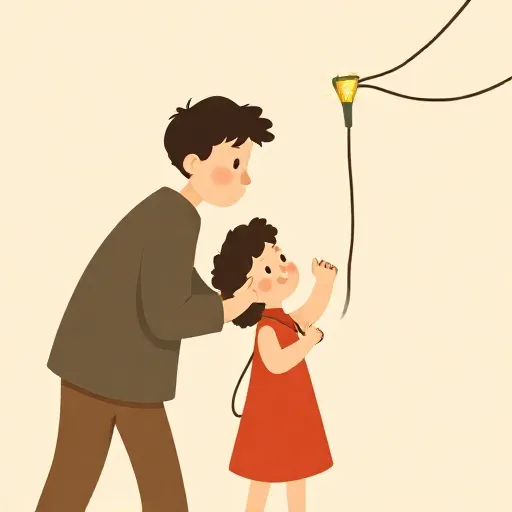
You see a sign: “If you touch this wire, you’ll get a shock.” You keep your hands away. The wire hums, but nothing happens to you. Now ask yourself: was the sign true? You didn’t touch it, so you didn’t get a shock. Did the sign describe a real fact about the world, or did something else happen when you read it?
Philosophers have argued about little words like “if” for over a century. The puzzle is both simple and deep: when is a sentence of the form “If A, then B” true or false? And how can we test it? This matters every time you make a promise (“If you’re home by six, we’ll get ice cream”), follow a rule, or plan for what might happen.
The Surprise Truth Table: A Simple Rule with Strange Results
In 1879, the logician Gottlob Frege (1848–1925) gave a clear‑cut answer. He said an “If A, then B” sentence is truth‑functional: its truth depends only on the truth of A and B. The rule is simple: the whole sentence is false only when A is true and B is false. In every other case — if A is false, or B is true — the sentence counts as true. Philosophers call this the material conditional (sometimes written “A ⊃ B”).
Frege’s rule has one big fan: modus ponens. From “If A, then B” and “A is true,” you can safely infer B. If you could have A true and B false while the whole “if” sentence was true, that inference would fail. So the truth table looks neat. But it also leads to two deeply odd results, often called the paradoxes of material implication.
First paradox: if A is false, the whole conditional is automatically true. So “If the moon is made of cheese, then I am a kangaroo” comes out true, because the moon isn’t cheese. Second paradox: if B is true, the conditional is also automatically true. So “If I tap my nose, the sun will rise tomorrow” comes out true just because the sun will rise.
These feel wrong. When you say “If you touch the wire, you’ll get a shock,” you don’t think it becomes true just because you stayed away. You want the sentence to match a real connection — not just a lucky absence of falsity.
A Clever Defense: It’s Not What You Say, It’s How You Say It

The philosopher H. P. Grice (1913–1988) had a creative reply. He agreed that “If A, then B” is truth‑functional at heart. The weirdness, he said, comes from the rules of conversation. When we talk, we expect each other to be informative. Saying “He’s either in the pub or the library” when you know he’s in the pub is literally true, but misleading — it’s weaker than what you could have said. Similarly, saying “If you touch the wire, you’ll get a shock” would be a strange thing to assert if you already knew the person would never touch it. The sentence might still be true, but it’s a bad conversational move.
But many philosophers think Grice’s defense doesn’t fix the real problem. The trouble shows up not just in speech, but inside your own head. You can believe the Republicans will lose the election, yet still reject “If the Republicans win, they’ll double income tax.” If the truth‑functional story were right, believing the antecedent is false would force you to think the conditional is likely true. That clashes with how we actually reason when we’re less than 100% sure.
Suppose It, Don’t State It: Ramsey’s Bold Move

In 1929, the mathematician Frank Ramsey (1903–1930) offered a completely different picture. To judge “If A, then B,” he said, you don’t hunt for a special proposition hiding in the sentence. Instead, you suppose that A is true, keep the rest of your beliefs as steady as you can, and then ask how likely B is under that supposition. This is the Ramsey Test.
On this view, a conditional is a recipe for thought, not a description of a fact. When you think “If I strike the match, it will light,” you imagine a situation where you strike it, and you estimate how probable the lighting is. The degree to which you accept the conditional is measured by conditional probability — the probability of B given A. The philosopher Ernest Adams (1926–2007) built a whole logic around this idea. He showed that if you treat conditionals this way, many argument patterns that felt fishy on the truth‑table view (like inferring “If not‑A, then B” from “A or B”) become invalid in the right way.
Then David Lewis (1941–2001) proved a startling result. He showed that there is no ordinary proposition whose probability always equals the conditional probability of B given A. In other words, your degree of belief in a conditional can’t be the same as thinking some fact is probably true. If Lewis is right, conditionals don’t have truth conditions in the usual sense. They work differently from sentences like “The cat is on the mat.”
Other Worlds: A Middle Path?
The philosopher Robert Stalnaker (born 1940) tried to keep truth conditions alive by using the idea of possible worlds. According to him, “If A, then B” is true if and only if B is true in the nearest possible world where A happens. So to check “If you strike the match, it will light,” you look at the world most similar to the actual one — except you’re striking the match — and see whether it lights. If it’s a dry match and the air is calm, the nearest such world has light; if the match is soaked, it doesn’t.
Stalnaker’s picture got many things right, but it hit a wall with uncertain guesses. Imagine a bag of a hundred straws: ninety are 10 cm long, one is 11 cm, and nine are 20 cm. You’re about to pick one. Intuitively, the claim “If the straw is over 10 cm, it’s less than 15 cm” is only 10% likely. But Stalnaker’s rule (using the nearest world) makes it seem much higher. The bite‑sized probabilities don’t match.
Why This Still Keeps Philosophers Up at Night

The argument isn’t over. Some think “if” is a restrictor that limits what a sentence is about: “If a Republican wins…” shrinks the claim to Republican‑winning cases. Others think the whole puzzle shows that logics built for certainty need to be replaced with logics of high probability. Still others defend variations of the truth table, arguing that it’s the simplest tool and works well enough for mathematics.
This matters far beyond logic textbooks. When a doctor says “If the pain gets worse, go to the hospital,” she is issuing a conditional command — not just stating a fact. When you promise “If I finish my homework, I’ll call you,” the whole point is to create a connection between two possibilities. The Ramsey‑style view explains such speech acts more naturally: you commit to doing something, but only if a certain condition is met. The truth‑table view would turn your promise into an odd claim that is automatically kept if you never finish your homework.
The mystery of “if” touches every choice you make, every plan you sketch for the future, and every argument you piece together. And after more than a hundred years, philosophers are still arguing about what that tiny word really means.
Think about it
- Your friend says, “If I win the video game tournament, I’ll share the prize with you.” They lose the first round. Did they break their promise? Why or why not?
- A sign reads, “If the light is red, do not cross.” You arrive at midnight and the light is broken — it’s off, not red. Can you still follow the rule, or does the rule no longer apply?
- Imagine you’re 99% sure your team will lose. Are you forced to think “If my team wins, I’ll eat my hat” is probably true? Or can you think it’s probably false? What does your answer say about how you understand “if”?