Whose Side Is the Law Really On? The Riddle of Ideology
A Rule That Helps Some and Hurts Others

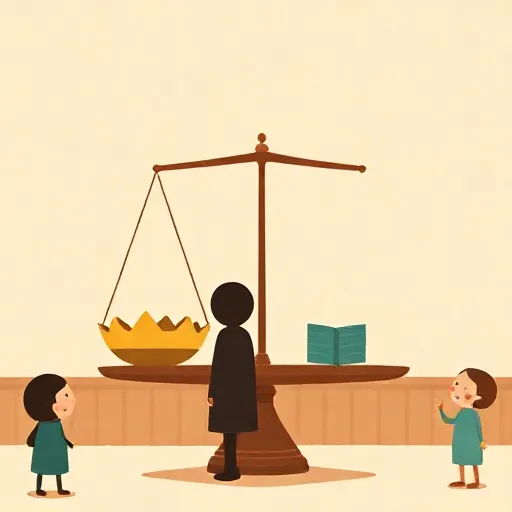
Imagine your school announces a new homework rule. The homework counts only if you type it, but you can type it only at home. Kids whose families own a computer and have quiet study space get a boost. The rule sounds neutral — it applies to everyone — but the effects are lopsided. Is the rule just what it seems, or is something deeper at work?
Philosophers who study law and society ask exactly this kind of question. They use a special word for sets of ideas that seem fair, but might actually protect the power of certain people: ideology. The word itself was coined around 1800 by the French thinker Destutt de Tracy (1754–1836). He hoped ideology would be a science of how ideas are shaped by the material world, a tool for human progress. Today, however, the word points to something much more charged: ideas that are not just about understanding the world, but about keeping a particular political order in place. And nowhere is that debate sharper than around the law.
What Is Ideology? A Liberal Answer
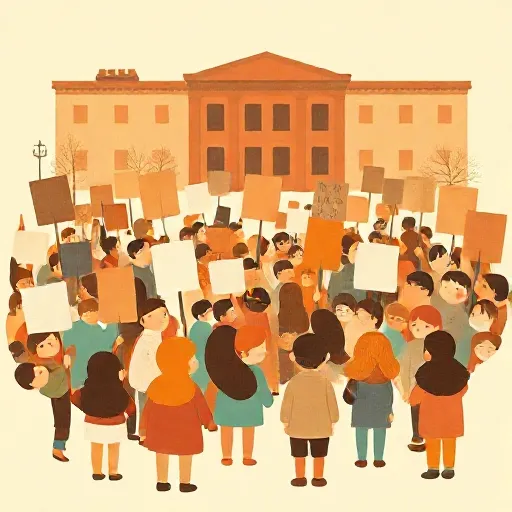
Not everyone thinks ideology is sneaky. The American sociologist Daniel Bell (1919–2011) called ideology an action‑oriented system of beliefs. By that he meant a set of ideas whose main job is to get people to do something — march, vote, protest, obey. An ideology doesn’t have to hide the truth; it just gives people a reason to act. On Bell’s view, an ideology can support the way things already are, or it can demand big changes. Workers’ rights movements, environmental groups, and free‑market clubs all have ideologies, and they’re all open about them.
When law is seen this way, there’s nothing automatically suspicious about it being ideological. A law that raises the minimum wage reflects the ideology of citizens who think poverty is unfair. A law that cuts taxes reflects a different ideology. Law becomes the place where competing action‑oriented beliefs battle it out, and the winners shape the rules. Bell even thought that in a stable, wealthy liberal democracy, big ideological fights might cool down — what he called the “end of ideology.” The law would just become the calm expression of widely shared values.
But other thinkers thought this picture was far too comfortable. They said ideology isn’t something people choose openly. It’s something forced on them, often without their knowing.
Marx’s Suspicion: Ideology as a Camera Obscura
Karl Marx (1818–1883) and Friedrich Engels (1820–1895) had a darker idea. Like de Tracy, they believed ideas are shaped by the material world. But as historical materialists, they zeroed in on how economic life — who owns the factories, who labours in them — shapes everyone’s thinking. In a capitalist society, they argued, most people are workers who don’t own what they produce. The system generates suffering and conflict, so it is always at risk of protest. That’s where ideology kicks in.
For Marx and Engels, ideology is a set of ideas that disguises the ugly features of an unequal economic order so that people accept it. It makes market forces look like natural laws, as fixed as gravity. It convinces you that your poverty is just bad luck, not a built‑in feature of a system that benefits a few. Crucially, ideology isn’t a simple lie told by villains. Even the powerful are caught in it, persuaded that their wealth is a sign of merit, not of an unfair setup. As Marx and Engels put it in a famous line, “the ideas of the ruling class are in every epoch the ruling ideas.”
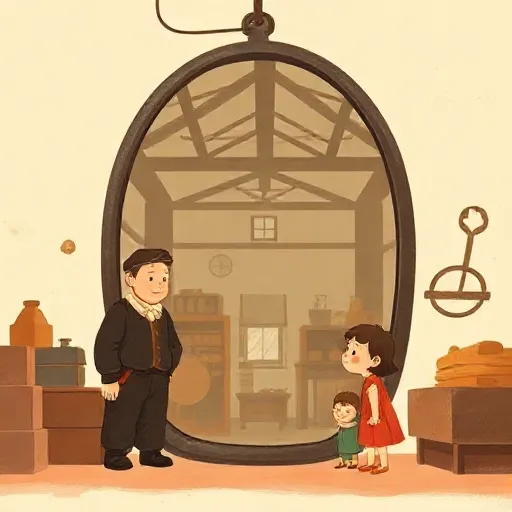
They compared ideology to a camera obscura — an early device that projects an image upside down. The image is still recognizable; you can tell it’s the same room. But it’s inverted in a way that hides the true relationships. A worker looks at the economy and sees not that human beings create value, but that money seems to create itself. The world is familiar, but flipped.
Later Marxists like Louis Althusser (1918–1990) added that ideology is pumped into people’s minds through institutions — schools, churches, the media, the legal system. James Mannheim (1893–1947) noticed that ideologies give people a version of truth they actually want to hear, both the rich and the poor. So ideology isn’t pure fiction; it has to reflect real social conditions well enough to win consent. But its main job, according to the radical view, is to protect a flawed status quo.
Law as Ideology: The Rule of Law on Trial
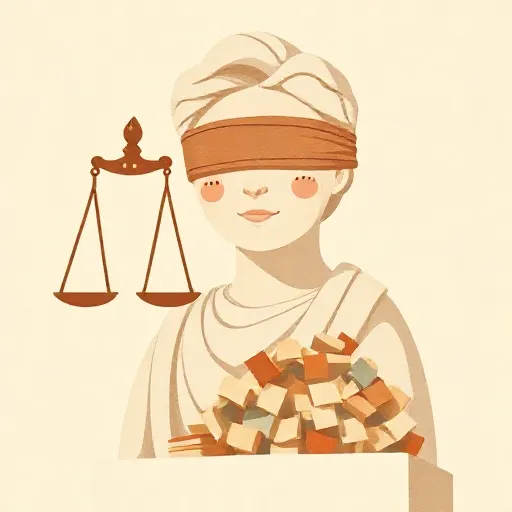
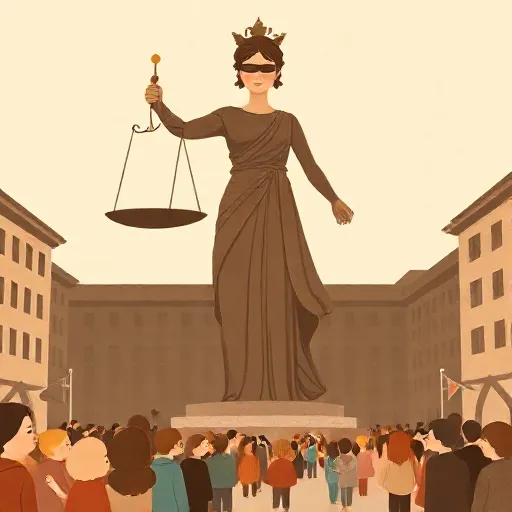
If ideology follows power, then the law is one of its favourite hiding places. Many Critical Legal Studies thinkers in the late twentieth century, mixing Marx with other radical traditions, argued that, beneath all the solemn procedures, law is fundamentally indeterminate. Judges don’t just apply clear rules; their decisions are shaped by politics, class, and ideology. The idea that the law is a pure, logical system? That, they said, is the biggest ideology of all.
The rule of law is the centrepiece of this debate. The rule of law means that laws must be general, public, clear, and applied equally to all — no secret decrees, no punishing someone without warning. It’s often praised as the backbone of a free society. Yet thinkers on both the political right and left have noticed how neatly the rule of law fits with capitalism. The economist Friedrich Hayek (1899–1992) celebrated the rule of law precisely because, he said, it creates a predictable space for free markets to flourish.
Radical critics take that link as a warning. They argue that by saying only state power needs to be restrained, the rule of law distracts us from other, deeper forms of power — like the power of a boss over a worker, or of a rich family over a poor one. It whispers that if laws are applied the same way to everyone, justice is done, even when some people start with vastly more than others. Equality before the law begins to look like equality itself, and that makes demands for genuine economic fairness seem unreasonable.
Is the rule of law inherently a trick? Not everyone agrees. The legal philosopher Joseph Raz (1939–2022) compared the rule of law to a sharp knife: the knife’s sharpness makes it good at cutting, whether you’re cutting bread or cutting a rope. Likewise, the rule of law simply makes the legal system efficient — whatever justice it does or doesn’t serve. The rule of law doesn’t say “exploit workers.” But critics reply with a subtler point: a society that puts enormous emphasis on procedural fairness may make people less hungry for the messier, deeper kinds of justice that shake up power structures. Even if the rule of law isn’t born ideological, it can have ideological effects.
Why Seeing Ideology Matters — and Its Limits

So does that mean law is nothing but a mask for power? If you answer yes too quickly, you risk a problem. The radical view can encourage cynicism: if all legal protections are phoney, then maybe there’s no point fighting for your rights. That cynicism is the opposite of what Marx intended — he wanted to free people, not make them give up.
The historian E.P. Thompson (1924–1993) pointed out a twist. In order for law to work as ideology — to make people accept an unequal order — it has to offer something genuinely valuable. A king can’t just say “I’m fair” while stealing your lunch; he has to actually be fair in some real way, at least sometimes, or nobody believes him. Law that trumpets justice, equality, and freedom must actually deliver bits of those ideals. Otherwise, the ideology cracks. So even if legal rules paper over deep injustices, the paper itself is woven from real threads of justice. You might say that the rule of law, for all its limits, also creates a language that ordinary people can use to criticise power.
This is why the riddle of ideology still matters to you, not just to professors. When you hear a rule at school, at home, or in your country, you can ask: Who benefits? Who made this rule, and what was their interest? Is there an upside‑down image lurking beneath the surface? Ideology isn’t a simple monster. It’s like a pair of glasses you didn’t know you were wearing. Learning to notice them is a kind of superpower — one that lets you spot hidden unfairness without giving up on the idea that fairness is worth chasing.
Think about it
- Think of a rule at your school or in your family. Who does it benefit most? Is it possible that someone’s interests are hidden behind the way the rule is presented?
- If a law seems fair on the surface but actually protects an unfair advantage, is having that law still better than having no law at all?
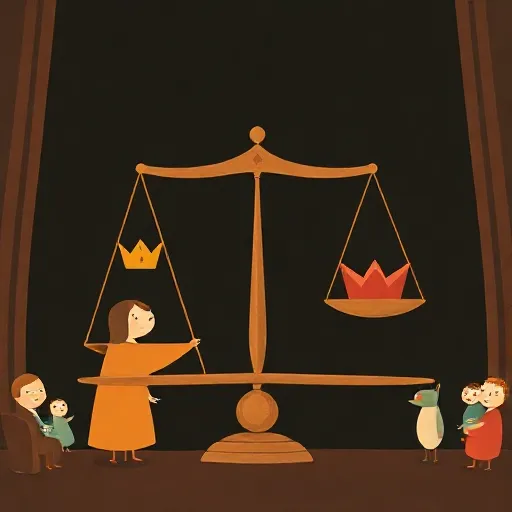
- Imagine you are designing a new set of rules for a community. What would you do to make sure ideology doesn’t quietly creep in and tilt the scales?