Did Humans Invent Language, or Did It Always Exist?
The Gods’ Secret Language
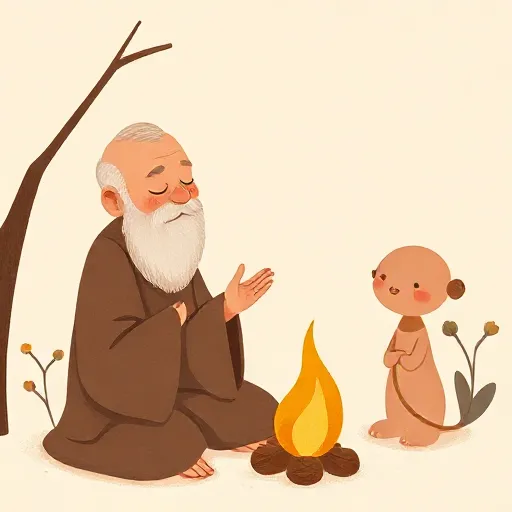
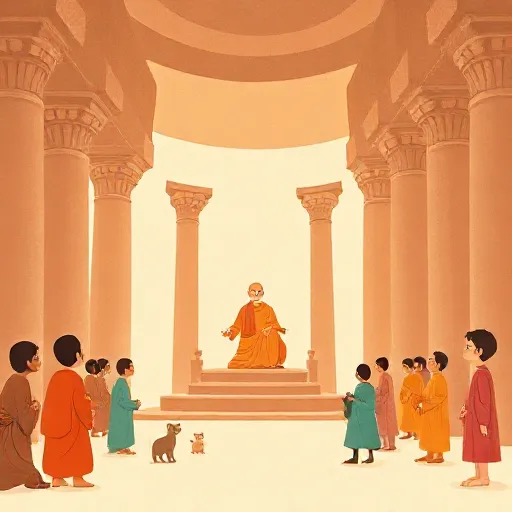
Over three thousand years ago, beside fire altars in ancient India, priest‑poets called sages chanted hymns to the gods. They did not think they were making up the words. They said the language itself was a gift — a divine speech (devī vāk) that the gods had created and then hidden inside the world. Only a small part of it, they claimed, could ever be heard by ordinary humans. The rest — a full three‑quarters — stayed out of reach, a secret only the gods knew. The sages believed that this hidden speech could slip into a person’s heart during deep meditation, so they listened inward, not outward, to discover it.
Over centuries, the idea grew bigger. The hymns were collected into four ancient books called the Vedas. The sages began to say that the Vedas were never written by any human hand at all. The word they used was apauruṣeya: “not made by a person.” The texts were thought to be eternal, without beginning, untouched by the cycle of creation and destruction that kept restarting the universe. Speech itself became a goddess — Vāk — who demanded to be worshipped before anyone could ask the other gods for help. Language, in this view, was not a tool that humans built. It was more like a force of nature, older than anything else, and full of creative power.
The Fight Over Who Wrote the Vedas
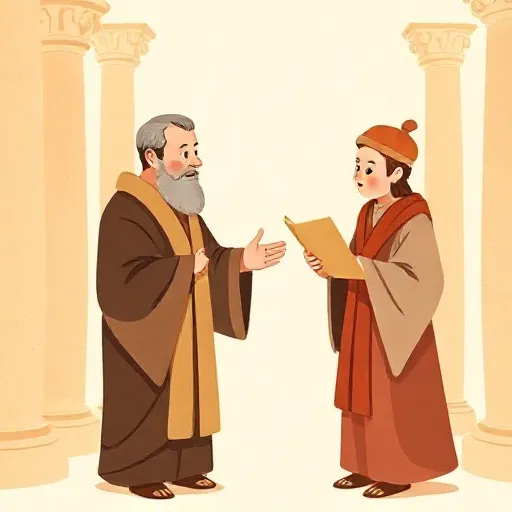
But not everyone agreed. Buddhist and Jain thinkers around the fifth century BCE pointed out that each Vedic hymn was connected to a specific poet‑priest — names like Vasiṣṭha and Viśvāmitra. These poets, the critics said, were just people. They could be ignorant, they could make mistakes, they could be driven by passion. How could their words be trusted as absolute truth? The Buddhists and Jains offered a different account: their own teachers, the Buddha and Mahāvīra, were omniscient (sarvajña) and compassionate, so their words carried authority, not ancient hymns composed by fallible humans.
The defenders of the Vedas — the Mīmāṃsā school — took a surprising route. They agreed with the critics that no human could be all‑knowing and free from faults. But they insisted the Vedas were not human words at all. They were uncreated (apauruṣeya again) and had existed forever. And because they had no author, there was no human mind to mess them up. The connection between a Sanskrit word and its meaning was not something people invented; it was innate, eternal, just part of the universe. The Mīmāṃsakas even said you do not need a God to write the Vedas — the universe was never created, karma brings its own rewards, and the Veda is simply there, like gravity.
A rival Hindu group, the Nyāya‑Vaiśeṣika logicians, hated that conclusion. They insisted that the universe must have a creator‑God, and that God, being omniscient and perfectly good, was the only trustworthy speaker. For them, the Vedas were words spoken by God at the beginning of the cosmos. The ancient sages merely received those words in deep trances; they never authored a syllable. This had a sharp side‑effect: it meant God spoke only Sanskrit. Vernacular languages, in their view, were fallen, garbled forms that could never carry spiritual truth. So the fight split into three camps: the Vedas are authorless, the Vedas are spoken by God, or the Vedas are human — and therefore unreliable.
The Grammarian Who Thought Words Were Everything

Into this clash stepped the grammarian‑philosopher Bhartṛhari (c. 400 CE). He grew up inside a tradition that had already decided Sanskrit sounds were eternal. Earlier grammarians, like Patañjali (c. 150 BCE), had wrestled with a puzzle: if you say the word “chair,” the physical sound vanishes the moment it’s spoken — so how can you ever grasp the whole word? Patañjali’s answer was that the mind stores up sound‑impressions and builds a mental image of the word. But Bhartṛhari went much further. He claimed that the real unit of language is not the word — it is the sentence. And the meaning of a sentence does not arrive piece by piece. It arrives all at once, in a single flash of understanding he called pratibhā: an instantaneous intuition, like a sudden insight.
Bhartṛhari gave a name to this whole‑sentence flash: sphoṭa. The sphoṭa is the meaning‑burst that breaks open the moment you truly understand an utterance. The drawn‑out sounds you actually hear — what he called dhvani — are just the stretched, physical echo of that flash. For Bhartṛhari, words, stems, and roots are useful fictions that grammarians slice out for teaching, but they do not exist in real communication. In fact, he declared that language itself is the ultimate stuff of reality: śabdabrahman, the word‑principle. Both the words we speak and the objects we speak about are transformations of that one underlying word‑reality. So he pulled language all the way up to being the foundation of the universe — no separate god required.
What Do Words Really Mean?

With so many schools arguing, Indian thinkers needed a sharp picture of how meaning works. They distinguished at least three layers. The primary meaning is what a word directly points to: “bull” means a bull. But if the primary meaning makes no sense in context, you leap to a secondary meaning. For instance, the phrase “a cowherd‑colony on the Ganges” literally says the village is sitting on top of the river — impossible. So your mind grabs a related secondary meaning: “on the bank of the Ganges.” This move is called lakṣaṇā, the secondary signification.
But the most delicate layer is vyañjanā: suggestion. Poets loved this. Imagine a young wife whose husband is away. A guest arrives at night. She says, “My dear guest, I sleep here and my night-blind mother-in-law sleeps over there. Please make sure you do not stumble at night.” The literal words are about safety. But the suggested meaning is something else entirely — a whispered invitation that never gets spoken out loud. Indian poetics built entire theories around these hidden meanings, showing that language can dance far beyond the dictionary.
Different schools tied their meaning‑theories to their biggest goals. The Mīmāṃsakas, guardians of the Veda, insisted that word‑meaning was eternal and fixed, not a matter of human intention, because the Veda had no author to have intentions. The Nyāya logicians, who wanted a trustworthy God, said God set up the connections between words and things on purpose. The grammarians, like Bhartṛhari, focused on the flash of understanding, not on whether the outside world matched it. And Buddhists often used language‑analysis to show that no fixed meaning could capture reality at all. Each school built a theory of meaning that fit its own deepest mission.
Why Does a 2,000‑Year‑Old Fight Still Matter?

You have probably felt a spark of this ancient debate without knowing it. When you say “I promise,” the words seem to build an invisible bridge of trust. When you hear a line of poetry that hints at something sad without saying it directly, your mind leaps to the hidden meaning. And when someone tells you that the meaning of a rule or a holy book is “just obvious,” you are hearing an echo of the Mīmāṃsā claim that meaning is fixed and eternal — no interpretation needed.
The Indian thinkers we met did not settle their fight. That is exactly what makes them so alive. Is language a tool we invented, or does it have a life of its own? Can a sentence deliver truth in a single flash, or is meaning stitched together from tiny word‑pieces? The next time you feel a word hit you — a nickname that stings, a line from a song that makes your chest ache, a promise you know you have to keep — you are standing in the middle of that old, unfinished argument. The sages would say you are touching something ancient, maybe even divine. And you get to decide what you really think.
Think about it
- If you grow up speaking a language, do its words feel like tools you chose or like something that was always already there?
- Suppose a friend uses a polite sentence that clearly suggests a rude meaning. Is the suggested meaning part of what the words themselves do, or is it only in your head?
- If a holy book were truly authorless and eternal, would that make it more trustworthy — or harder to understand?