How Do Words Mirror the World? A 10th-Century Genius Explains
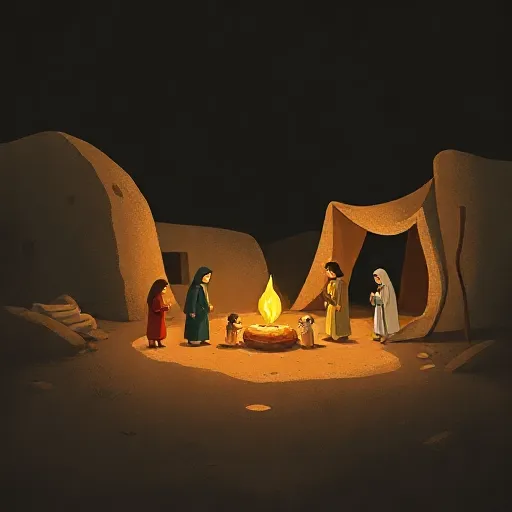
A Village Without Words
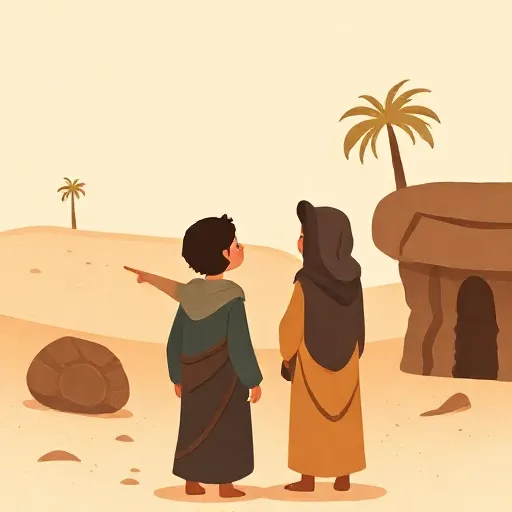
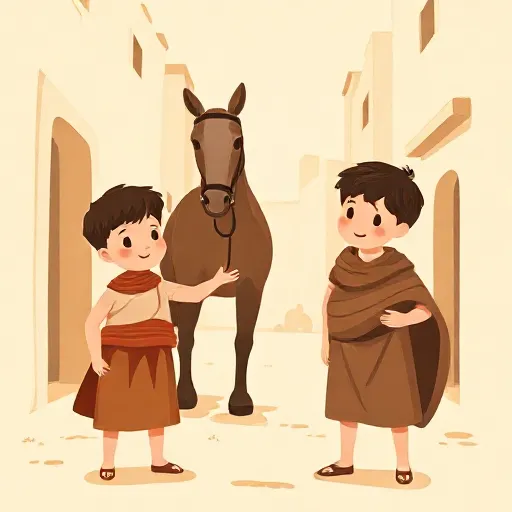
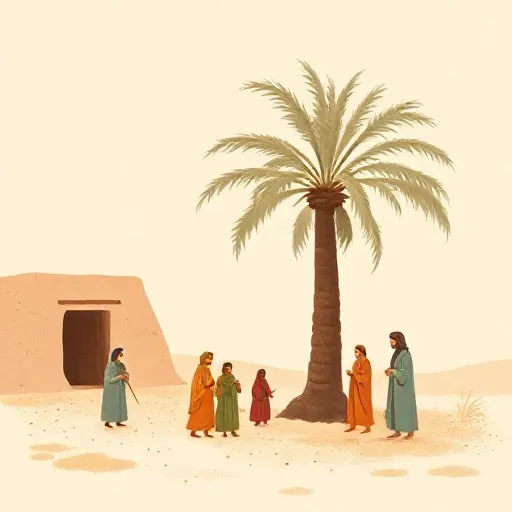
Imagine waking up in a village where nobody has ever spoken a single word. You can see a date-palm tree, a stone, a horse. You can point at them. You can even think about them quietly in your head. But you cannot name them. How would you ever tell someone else, “Look, a horse!” just by pointing? The 10th-century thinker Al‑Fārābī (who lived around 870–950) asked this very question. He wanted to understand how language gets born — and what its birth tells us about how our minds work.
Al‑Fārābī did not think languages just fell from the sky. Instead, he told a story. In his story, people first have primary concepts — the mental pictures of things in the world they get from seeing, hearing, and touching. They can spot a horse or a person. They can reason quietly and even plan actions. But they have no words, only pointing. That works for “look at that horse,” but not for “I was scared yesterday.”
The big leap, he said, happens when the community realizes they can agree to label things with sounds. One day, somebody makes a noise while pointing at a horse; others copy it. Slowly, a convention settles: this sound means horse, that sound means stone. A leader or law‑maker then organizes these agreements into a shared dictionary. A language is born.
The Hidden Order of Thoughts
Once a community has words, Al‑Fārābī thought something fascinating happens. People notice that the words they use can begin to imitate the regime — the natural order — of the concepts in their minds. If two concepts are similar, the words for them should sound similar. If one concept is built from another, the word for it should be a grammatical derivative. The language stretches and grows to copy the hidden architecture of thought.
But copying is messy. Sometimes the same word ends up pointing to two different concepts — a problem called homonymy. Sometimes a word that is grammatically derived (like “living”) gets used for an underived concept (like “animal”). Al‑Fārābī saw these mismatches as dangerous. He worried they could trip up students trying to follow a logical argument, because they would not be able to see the real relationships between concepts hidden behind the words. He never tried to force everyone to fix their everyday speech, but he gave careful advice to translators and philosophers who needed words that perfectly tracked the logical structure of ideas.
One part of the regime of concepts he never expected language to copy was the hierarchy of inclusion: the idea that “animal” is broader than “human,” and “substance” is broader still. He followed Aristotle in thinking there are ten top‑level categories — the most general kinds of thing you can talk about, like substance, quantity, quality, and so on. Languages do mark the very bottom of this ladder by using proper names (like “Zayd”) for single things. But nobody expects a language to bake the whole ladder into its grammar. That would be asking too much.
Why We Argue: Logic as a Social Art

With language in place, something even more remarkable becomes possible: people can argue with words. Al‑Fārābī saw the arts of logic not as dusty rules in a book, but as skills that grow out of real human needs. The first logical art to appear, he said, is rhetoric — the skill of persuading others. Political and religious leaders use it to move crowds. Alongside rhetoric grows poetry, which stirs the imagination and puts listeners into certain states of mind. (More on poetry later.)
But when people start sharing opinions, they inevitably disagree. So a second art emerges: dialectic, or formal debate. In a dialectical contest, one person asks questions, the other must answer. The questioner tries to trap the responder into a contradiction; the responder defends their view. Even if a debater wins, though, that does not prove the conclusion is true — only that one side argued better.
Dissatisfied with mere victory, some seekers push further. They want demonstration — an argument that guarantees truth with certainty. Al‑Fārābī believed that Plato was the first to grasp demonstrative methods, but it was Aristotle who wrote down the universal rules in a book called Posterior Analytics. A demonstrative proof must start from premises that capture the essence of things — the properties that make a thing what it is — and then move step by step using syllogisms that cannot fail. This is the gold standard of logical thinking. But Al‑Fārābī suspected that reaching genuine demonstration is incredibly hard, and that most of what even smart people do every day — doctors diagnosing a patient, farmers deciding when to plant — is actually a kind of refined rhetoric, because it deals with particular messy cases, not universal certainties.
A key tool in all these arts is the syllogism: a simple argument with two premises that forces a conclusion. Al‑Fārābī analyzed syllogisms in several styles. The most basic kind, categorical syllogisms, uses sentences like “Every horse is an animal.” He recognized valid patterns such as Barbara: “Every B is an A, every C is a B, therefore every C is an A.” He also explored hypothetical syllogisms — “If p then q; but p; therefore q” — and even modal logic about necessity and possibility. But for him the formal rules were never the whole story. The real engine of logic is the order in which you arrange ideas; he said a syllogism is a sequence that, once laid out in the mind, makes “the mind as a result finds itself unavoidably looking down at something else of which it was ignorant before”.
Poetry That Tricks Your Brain
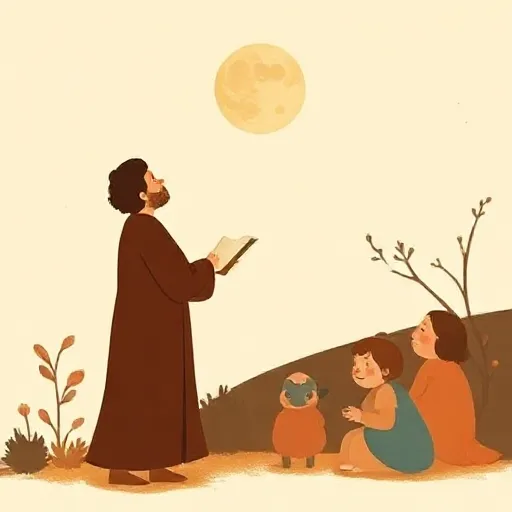
One of Al‑Fārābī’s oddest yet deepest ideas is that poetry is a branch of logic. How can a love poem or a battle song be logical? His answer: poetry often contains the seed of a syllogism, even if it looks false on the surface. Take these lines by the poet Abū Tammām, written after a victory: “Knowledge lies in the bright spears gleaming between two armies.” Read literally, that is obviously false — knowledge isn’t a spear. But Al‑Fārābī would say the poem is planting a hidden argument in your mind: “The spears give certainty. Knowledge gives certainty. Therefore the spears are knowledge.” It is an invalid syllogism in strict form, yet it works by imagination. The poem makes you feel that the battle resolved the chaos — and that feeling is a kind of assent, reached not by deduction but by the power of words.
So poetic statements are, in a sense, “false,” but their job is not to state facts. Their job is to arouse the imagination and move the soul. Al‑Fārābī even connected poetry to music, noting that music can do some of the same work: just as poetry is built from a finite alphabet of letters, a tune is built from a finite palette of sounds. In some cultures, he observed, the music that accompanies a poem is considered part of the poem itself — a striking thought that would make perfect sense to anyone who has ever been moved by a song’s melody as much as its lyrics.
What Al‑Fārābī Still Teaches Us
You have probably felt the mismatch between words and thoughts that worried Al‑Fārābī. Have you ever tried to explain a feeling, and the words came out wrong? Or argued with a friend, only to realize you were both using the same word to mean different things? Al‑Fārābī’s story about the village without words is not just a fairy tale. It points to a real, living puzzle: we build languages to share our inner worlds, but the fit is never perfect.
His ideas about logic as a social art also still matter. When you see a politician persuade a crowd with a slick speech, or a social media post that tricks people with a clever but faulty argument, you are watching rhetoric and poetry do exactly the work Al‑Fārābī described. He would say that the only defense is to learn the rules of reasoning — not just to win debates, but to notice when your own mind is being nudged toward a conclusion by imagery rather than evidence. And he would remind you that even the smartest people spend much of their time reasoning about messy real‑world cases where absolute certainty is impossible. That doesn’t mean giving up on truth. It means learning which tools to reach for: dialectic to test ideas, demonstration when you can find essences, and poetry when you need to inspire.
So the next time you struggle to put a thought into words, or you hear a sentence that grabs your heart before your head can object, you are standing right where Al‑Fārābī stood: in the gap between concepts and language, wondering how to bridge it.
Think about it
- If everybody in your town agreed to call dogs “blargs” from now on, would “blarg” really mean dog? Why or why not?
- A friend tells you a story that makes you believe something, but later you realize the facts don’t support it. Was your friend doing logic or poetry?
- Al‑Fārābī thought language should copy the order of thoughts. Can you invent a sentence where the grammar completely hides what you actually mean — on purpose?