
Why Does 7 + 5 = 12? Kant’s Shocking Answer About Math
Can Philosophy Be as Certain as Math?

It’s 1763, and a little-known professor named Immanuel Kant (1724–1804) is hunched over a desk in Königsberg, Prussia. He’s writing an essay for a prize competition. The question he’s supposed to answer: can metaphysics — the search for the deepest truths about reality — be proved with the same rock-solid certainty as math? Everyone expects a grand “yes,” with a clever method for making philosophy as airtight as geometry. Kant, however, will argue no — and in explaining why, he will quietly launch a new way of thinking about what math is and why it works.
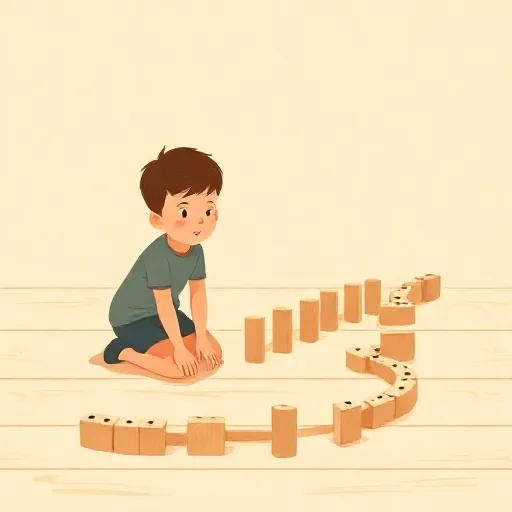
Kant’s essay loses. It gets second place behind a rival named Moses Mendelssohn. But its ideas stick. Kant argues that mathematicians and philosophers do completely different things. A mathematician, he says, combines clear concepts of magnitudes — like lengths, sizes, numbers — and then examines a visible sign, a drawn figure or symbol, to see what can be discovered. For example, you define a trapezium by arbitrarily putting together the concepts “four straight lines,” “plane surface,” and “opposite sides not parallel.” Then you draw it and look. The drawing reveals relationships that the bare definition didn’t spell out. Philosophy, on the other hand, can only analyze its concepts — pick them apart to see what’s already hiding inside — without building anything new from scratch. That difference, Kant says, “completely changes the method of thought.” Mathematicians synthesize; philosophers analyze. So philosophical proof can never be quite the same as mathematical proof.
This early insight is only the beginning. Over the next twenty years, Kant will deepen the idea so much that he gives math a whole new foundation — one built not out of eternal truths floating in the sky, but out of the structure of your own mind.
The Big Distinction: Synthetic vs. Analytic
By the time Kant writes his great book the Critique of Pure Reason, he’s found a sharper way to put the difference. Analytic judgments are ones where the predicate (the thing you’re saying) is already contained in the subject concept. “All bachelors are unmarried” is analytic, because “unmarried” is simply part of what “bachelor” means. You don’t need to check the world; you just unpack the definition.
Synthetic judgments connect a subject and a predicate that go beyond the subject concept. “The cat is on the mat” is synthetic — nothing about the concept cat forces it to be on a mat.
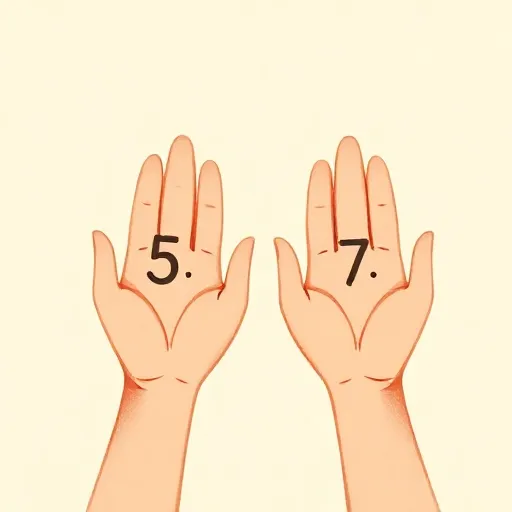
Now here’s the move that surprises people: Kant says all properly mathematical judgments are synthetic. Even simple arithmetic. Take 7 + 5 = 12. Could you get the number 12 just by analyzing the concepts of seven, five, and addition? Kant says no. No matter how long you stare at the pure idea of seven added to five, you’ll never find twelve sitting there waiting. You have to go outside the concepts themselves. You need intuition — a concrete, singular presentation that your mind can inspect. You might hold up five fingers, start with seven in your head, and count on: eight, nine, ten, eleven, twelve. What you’re doing is building new knowledge with the help of a sensible picture or action. The judgment “7 + 5 = 12” therefore goes beyond bare concepts; it’s synthetic.
At the same time, mathematical truths are necessary and don’t depend on any particular experience — you didn’t have to check every group of seven and five apples in the world to know. So they are a priori (prior to experience). That makes them synthetic a priori, a kind of judgment that combines being genuinely new and yet universally certain. Explaining how such judgments are possible becomes the central mission of Kant’s whole philosophy.
Building a Triangle in Your Mind

If math is synthetic, where does that extra knowledge come from? Kant’s answer: from the construction of concepts in pure intuition. That sounds like heavy machinery, but the core idea is simple. When a geometer wants to prove something about triangles, she doesn’t just shuffle definitions around on paper. She must exhibit a triangle — either by drawing one physically or by picturing one in her imagination. The moment you hold a single, concrete triangle before your mind’s eye, you’re not just thinking about a triangle; you’re building an example that makes the concept visible. That’s what Kant calls construction.
Now, you might ask: how can looking at this particular triangle prove something about all triangles? Kant’s reply is that the features that make your example special — the exact length of its sides, the specific size of its angles, the fact that the lines aren’t perfectly straight because your hand wobbled — are “entirely indifferent” to the general concept triangle. You ignore them. Only the relationships that belong to the concept matter, and those shine through in the intuition. The construction works because the mind isn’t copying experience; it’s actively producing what it sees. You can draw the triangle on paper or simply imagine it: in either case, the object you display borrows its pattern from nothing in experience, so the knowledge gained is a priori.
This idea lets Kant explain the power of geometric proof. You don’t test a theorem about intersecting chords inside a circle by drawing every possible pair of lines (you’d never finish). You draw exactly two chords, label nothing but the spatial relation you’re interested in, and see the universal rule announce itself. The act of drawing is a controlled act of the imagination. For Kant, that’s not a casual trick — it’s the engine of mathematical discovery.
Why Space and Time Are the Keys
But not everything can be constructed this way. Kant insists that only magnitudes — quantities and spatial shapes — are constructible in pure intuition. Qualities like colors or tastes need empirical intuition; they can’t be presented a priori. The reason is that space and time, according to Kant, are not properties of things out there in the world. They are the pure forms of human sensibility — the built-in mental lenses through which any object of experience must appear. Because your mind is structured to represent everything in spatial and temporal terms, mathematical construction isn’t an optional trick. It’s a natural consequence of how your perception works.
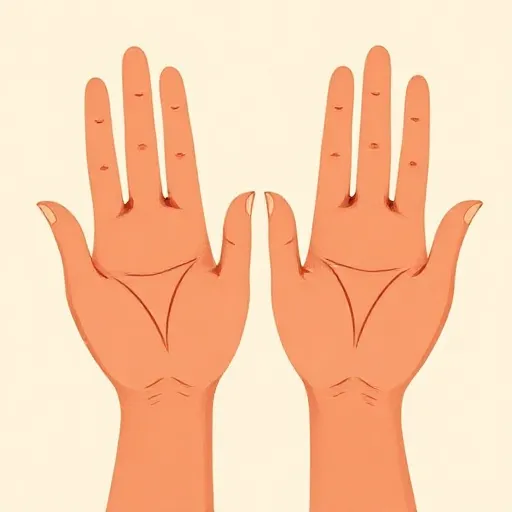
Kant offers a famous argument to show that space, in particular, is an intuition rather than a concept. Take your own left hand and right hand. You can describe them perfectly as mirror images, identical in every measurable part. Yet no amount of twisting or turning will allow your right hand to fit inside the same outline as your left hand — they are incongruent counterparts. If space were just a conceptual container that you understood through definitions, this internal difference would be impossible to account for. The very fact that you can immediately see the difference proves that spatial knowledge depends on an intuitive grasp, not on a list of properties. Early on, Kant used this example to argue for an absolute Newtonian space. Later, in his critical period, he turned it around to claim that space is transcendentally ideal — a form imposed by the mind, not a feature of things in themselves. That move ties the whole certainty of geometry to the way you, as a human knower, necessarily represent the world.
When the mathematician draws triangles or when you count on your fingers, you’re not peeking at some external, eternal realm of perfect shapes. You’re examining the most basic framework of your own experience. And because that framework is the same for every human being, the results are universal and necessary.
The Fight Over Kant’s Math

Kant’s ideas didn’t sit quietly. In the late nineteenth and early twentieth centuries, new developments seemed to threaten them. Gottlob Frege (1848–1925) and Bertrand Russell (1872–1970) built powerful systems that tried to reduce mathematics to pure logic — making it, in their eyes, completely analytic. If numbers could be defined as sets of sets, and addition as a logical operation, then perhaps “7 + 5 = 12” really was contained in definitions after all. At around the same time, mathematicians discovered consistent non-Euclidean geometries — geometries where parallel lines meet or curve away. If there are coherent alternatives to Euclid’s space, could Kant still claim that Euclidean geometry is necessary and grounded in intuition?
For a while, a standard story said modern logic and new geometries made Kant’s theory of mathematics obsolete. But contemporary philosophers have pushed back hard against that verdict. Many point out that Kant was never trying to describe every possible logical construction of math. He was trying to explain how human mathematical knowledge actually works — how you, a creature stuck in space and time, learn and trust geometry and arithmetic. The fact that non-Euclidean geometries are logically consistent doesn’t change the fact that your perceptual experience is Euclidean through and through. And while logic can reconstruct arithmetic, you still learned to add by counting physical objects or picturing steps in time — using your intuitive “number line.” Some scholars, like Charles Parsons and Michael Friedman, argue that Kant’s insight about the role of intuition remains indispensable: you can’t fully account for the evidence of a geometric proof without acknowledging the diagram you draw and inspect.
The field today is alive with new work that doesn’t simply side with or against Kant, but explores his ideas about magnitudes, spatial imagination, and the schemas that connect pure concepts to your sensory life. The core puzzle Kant raised — how can a thought be both new and necessarily true? — hasn’t gone away.
Why This Still Matters to You

Next time you solve a math puzzle in class, or figure out how much change you should get back at a store, or just walk around a room without bumping into things, you’re using the very mental machinery Kant wrote about. He’s not telling you that math is a game we made up. He’s telling you that math’s fierce certainty doesn’t need a spooky world of perfect Forms. It comes from the active way your mind structures every moment of experience. You are caught inside a frame of space and time, but that same frame gives you the power to construct truths that hold for everyone who shares it.
That’s why Kant’s question — “How is pure mathematics possible?” — isn’t just a dusty historical puzzle. It’s a question about what it means to know anything firmly, and what it means to be the kind of mind that can look at a triangle and see a universal law. When you build a proof in your head, you aren’t just discovering a fact that was sitting in some invisible cloud waiting for you. You’re building it with the tools of your own perception. And once you see that, the things you know start to tell you something about who you are.
Think about it
- If you had been born without the ability to see or imagine spatial shapes, could you understand what a triangle is? What would be missing?
- A fictional alien perceives the world in four spatial dimensions. It “draws” shapes you can’t picture. Would its geometry be less certain than yours, or just different? Could you ever prove which geometry is “real”?
- If a computer program could prove all the theorems of geometry without ever drawing a diagram, would that mean Kant was wrong about human minds? Or would it just show that machines and people know things in different ways?