
Can Reason Answer Everything? Kant Said No.
Was That Dream Real? How Reason Checks Reality

You wake up, heart pounding. You dreamed you won the lottery. For a moment, that joyful feeling lingers — you were rich! But then you look at your ticket, check the winning numbers online, and see they don’t match. That dream wasn’t real. How do you know? You just used a basic power: reason — your mind’s ability to step back, ask whether one belief fits with everything else you know, and sort true from false.
Immanuel Kant (1724–1804) spent his whole career trying to understand what reason can and can’t do. He loved science and mathematics, but he also saw that people use reason to make huge claims about God, the soul, or the universe as a whole — claims that go far beyond anything we can see, hear, or touch. Are those claims trustworthy? And if reason can lead us into wild mistakes, why trust it at all?
Kant’s answer is both humble and bold. Reason has limits, but it’s also the only tool we have to build a world where people think for themselves and treat each other fairly.
When Reason Reaches Too Far: The Tower of Babel
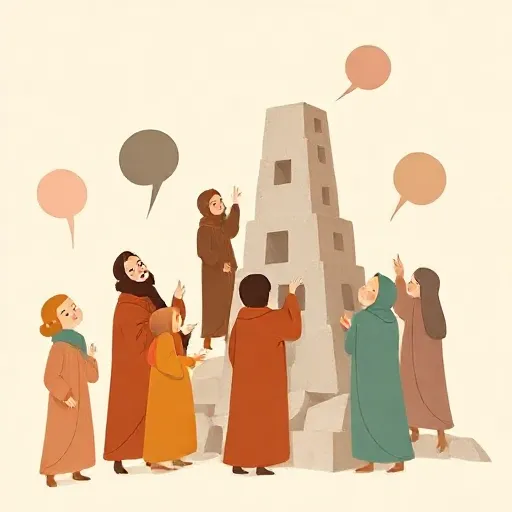
Kant noticed something strange. Reason seems to hunger for answers to the biggest questions: Does the universe have a beginning? Is the soul immortal? Does God exist? But when we try to reason about those things, we get stuck. Kant called these “transcendental ideas” — ideas that go beyond any possible experience. He showed that for some of these questions, you can build equally strong arguments for both sides. For example, you can prove the universe must have started at some moment, and you can also prove it must have existed forever. Kant called these head‑on clashes antinomies.
This isn’t just a historical curiosity. Kant thought these contradictions reveal something important: when reason tries to operate without any input from the senses, it creates illusions. He compared it to the biblical story of the Tower of Babel. People tried to build a tower to the heavens, but they lost a common language and couldn’t finish. In the same way, thinkers who speculate about God or the soul often talk past one another, because there’s no shared experience to test their claims. Moses Mendelssohn (1729–1786) called Kant the “all‑destroyer” for showing these limits.
But Kant wasn’t trying to destroy anything. He wanted to stop people from treating reason like a magic telescope that can see into a hidden world. Because when reason claims to know things it can’t possibly know, it makes itself look foolish — and that feeds skepticism about reason altogether.
A Copernican Revolution of the Mind

So how should we use reason? Kant proposed a famous analogy. Copernicus realized that we can better explain the movements of the planets if we assume the Earth spins around the Sun, rather than the other way around. Kant made a similar turn about knowledge. Instead of assuming our minds simply copy the world, he suggested that our minds actively shape experience — organizing everything we perceive into space, time, and cause‑and‑effect. These structures are like the glasses we can never take off.
This explains why we can be sure about some things (like “every event has a cause”) without having to check every single event. Such principles are constitutive: they make experience possible in the first place. But when it comes to big ideas about the universe as a whole — what Kant called “regulative” principles — reason should only use them as guides for science, not as proven facts. For instance, we assume nature behaves according to universal laws, and that assumption helps us do physics, but we can never prove it’s true beyond all experience.
Reason’s real job, Kant argued, is to examine itself — to figure out how it works and where its limits lie. That self‑knowledge is what he called a “critique” of pure reason.
Freedom and the Voice of Duty

Kant didn’t stop at what we can know. He thought reason has an even more important role: telling us what we ought to do.
Suppose you really want to push past someone in a queue. Your desire gives you a motive. But if someone asks, “Why did you do that?” saying “Because I wanted to” doesn’t justify your action — it only explains it. To justify yourself, you need a reason others could accept, too. For Kant, this is where morality comes from. He proposed one supreme principle, the Categorical Imperative: “Act only according to that maxim through which you can at the same time will that it become a universal law.” In other words, before you act, ask: Could everyone act this way? If not, you’re not justified.
This is demanding, but Kant saw it as the core of freedom. If you’re just pulled around by your desires, you’re not really free — you’re like a puppet, Kant said, controlled by heteronomy (rule from outside). Real freedom, autonomy, means giving a law to yourself that any rational being could follow. And Kant believed we all feel this, deep down. Even a person facing death for refusing to lie, he argued, knows they could do it because they know they ought to. He called this awareness the “fact of reason” — our immediate sense that moral demands are real, and that we are free enough to meet them.
Thinking for Everyone: Public Reason

Kant thought this idea doesn’t just apply to actions — it applies to thinking itself. In his essay “What is Enlightenment?” he issued a famous challenge: Sapere aude! — Dare to be wise! Dare to use your own reason without a boss telling you what to think.
He was careful, though. Using reason privately means following the rules of your job or your role — a police officer, a cleric, a student. That’s necessary for society to function. But public reason is different. When you step back from your role and speak as a “scholar before the entire public of the world of readers,” you must be free to criticize, to question, to argue. No authority is so holy that it can’t be examined. Reason, Kant said, “has no dictatorial authority, but whose claim is never anything more than the agreement of free citizens, each of whom must be able to express his reservations, indeed even his veto.”
He also gave three maxims for good thinking: (1) Think for yourself — don’t let prejudice or superstition guide you. (2) Think from the standpoint of everyone else — enlarge your mind by imagining others’ perspectives. (3) Always think consistently — make sure your beliefs hang together. These maxims aren’t just for philosophy class. They’re the heart of a free society, because they treat every person as someone whose voice counts.
Why Kant’s Idea of Reason Still Matters

Today, we’re flooded with information. Social media shows us opinions we already like. It’s easy to stay in bubbles where nobody challenges us. Kant’s picture of reason pushes back hard. He asks you to ask: Could I defend this belief to someone who completely disagrees? Could everyone think and act this way without the whole system falling apart?
That doesn’t mean you have to agree with everyone. It means you have to take others seriously as fellow reasoners. When you stop and genuinely listen to objections — when you ask whether your reasons work for everyone and not just for you — you’re doing what Kant thought reason is really for. You’re not just being smart. You’re building the kind of shared world where people can live together without bullying, without blind tradition, and without pretending to know things nobody can know.
So next time you’re absolutely sure you’re right, try a Kantian move. Step back. Ask: “Would my reasons still make sense if I was standing in someone else’s shoes?” That one question is the beginning of both real thinking and real fairness.
Think about it
- Imagine your school banned all books except textbooks, to avoid “wrong ideas.” Would that rule violate Kant’s idea of public reason? Can you think of a case where some limit on free speech is still reasonable?
- Kant says you should act only on a rule that everyone could follow. Suppose a friend tells you a small lie to avoid hurting someone’s feelings. Can you turn that into a universal law without contradiction?
- If you can’t prove that the world follows universal laws, why should you trust science at all? How would you answer someone who says science is just another belief?