Who Makes Stuff Happen? The Philosopher Who Blamed God for Everything
A Letter That Started a Storm
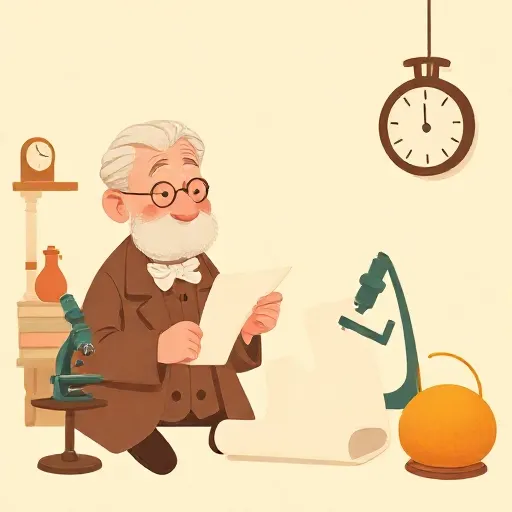
In 1698, an aging professor named Johann Christoph Sturm (1635–1703) received a letter that stung like a challenge. The famous philosopher Gottfried Wilhelm Leibniz (1646–1716) had just published an essay accusing Sturm of turning the universe into a puppet show. Nature, Leibniz fumed, could not be a collection of powerless dolls waiting for God to move them. Sturm thought otherwise. To him, the very idea that burning fire or falling rain had real inner power was a mistake — only God truly makes things happen.
Sturm was not some lone crank. He held the chair of mathematics and physics at the University of Altdorf and had spent decades building a complete system of natural philosophy. He had learned from both radicals and traditionalists, and he had taught curious students to experiment with telescopes and air pumps. His big book, the Physica Electiva (published in part in 1697), laid out a careful method for finding the truth about nature — and a startling conclusion: no natural being, from a stone to a tree, has active causal power of its own.
The Eclectic Detective

Sturm did not think any single philosopher had all the answers. He called his approach eclecticism — a method that picks the best ideas from everywhere and pieces them together into a coherent picture. It was the opposite of “sectarian” philosophy, where you follow one master like a slave (he singled out rival camps: Aristotelians, Cartesians, Gassendists, alchemists). An eclectic philosopher, Sturm wrote, “did not want to hang on to every word of someone, nor swear by the words of one master.” Instead, you collect, compare, and test. Truth is a shared project, not a private trophy.
His method had three steps. First, gather phenomena — observed facts, experimental results, careful reports. Second, collect the hypotheses (educated guesses) that thinkers have offered to explain those facts — whether from ancient Greeks, medieval Arabs, or modern microscope-wielders. Third, critically sift through them. A good hypothesis must be simple, fit the phenomena, not clash with other established findings, and feel right to both the senses and the imagination. Sturm called this never‑ending work: like a ship at sea, philosophy constantly needs old planks replaced without sinking.
The Trilemma: Why “Substantial Forms” Are a Mistake

Medieval and Renaissance philosophers often talked about substantial forms — inner principles that make a thing what it is and account for its powers. Fire’s form makes it burn; a horse’s form makes it a horse. Sturm believed this whole idea was a confusion.
He set up a trilemma. A substantial form, he reasoned, must be either (1) a purely material thing, (2) a purely spiritual thing distinct from matter, or (3) some kind of being halfway between the two. If it’s purely material, then it can’t be a separate substance — it must just be a mode (a way matter is arranged), like a lump of clay being shaped into a cup. If it’s purely spiritual, like the human rational soul, then it’s not a “form of the body” at all, just a separate thing glued to matter — and you can’t use that model to explain the form of a tree or a flame. The third option collapses too: if a form’s whole nature is to be a relation between things (shaping matter, giving tendencies), then it’s not a “substance” but a relation. A relation can’t exist by itself. Sturm concluded that the only honest option is to admit that what we call “forms” are really just passive, structured arrangements of matter — passive mechanical forms. And since matter has no active power, those forms are causally idle. The fire doesn’t do anything; it just is a certain pattern of particles.
God Does the Heavy Lifting
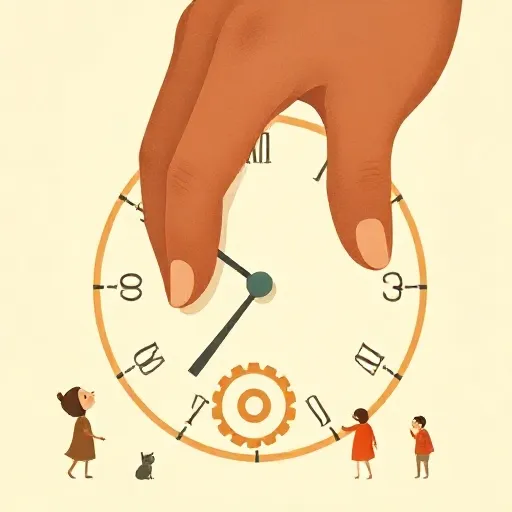
If matter and its modes are powerless, what makes the world run? Sturm’s answer was unflinching: God alone is the efficient cause of all natural events. God’s will is “that truly acting power which moves while not being moved.” This is a view later philosophers would call occasionalism. In Sturm’s version, God freely decided to act not according to absolute whim, but according to a “hypothetical power”: when certain passive conditions are in place (say, a spark near gunpowder), God has promised that a certain result will follow (an explosion). The passive forms are sine qua non causes — necessary conditions, but not the real doers.
Think of a clockwork universe. The gears click, the hands spin, the bird pops out on the hour. In Sturm’s picture, God is not just the clockmaker who built the machine; God’s activity is the constant, invisible current that turns every gear. The shapes of the gears (the passive forms) explain why the clock tells time rather than playing music, but the gears themselves exert no force. This move allowed Sturm to keep explanations detailed and mechanical — you still study the structures — while removing the need for hidden inner powers.
Leibniz Fights Back
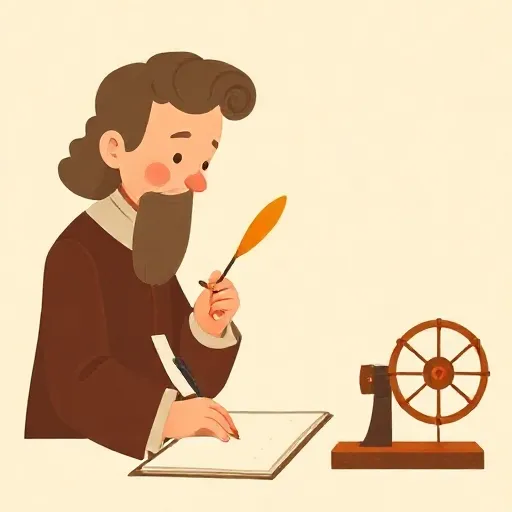
Leibniz found Sturm’s world absurd. In his reply, De Ipsa Natura (1698), he insisted that a substance — a real, self-standing thing — cannot be entirely passive. If a watch has no native force, it is just a heap of metal. Similarly, if a drop of oil spreading on water has no inner activity, then it is nothing more than a collection of shapes that God happens to push. For Leibniz, the very idea of a thing existing includes a kind of inner striving or activity. Without it, you can’t even tell one thing from another.
Sturm saw the problem differently. He thought Leibniz was smuggling in an unnecessary ingredient. You don’t need to imagine active powers inside each leaf to explain why it falls. The falling is fully covered by the leaf’s passive form (its weight, its shape) and God’s general will. Sturm’s young contemporary, the Cartesian occasionalist Nicolas Malebranche (1638–1715), had used similar ideas — but Sturm’s own version gave passive forms more explanatory work, and he barely relied on general “laws of nature” the way Malebranche did. Leibniz’s simplification of Sturm as “just another Malebranche” missed the point. The two men had, as philosophers often do, a deep clash of fundamental intuitions.
Why the Fight Still Tickles Our Brains
Sturm died in 1703, and his Physica specialissima — the promised third book on life and humans — was never found. But the question he wrestled with never disappeared. When scientists say a magnet “attracts” iron or that an electron “repels” another, are they naming a real inner power, or are they just describing regularities? Sturm thought you could explain everything with God-powered patterns, no hidden forces needed. Modern philosophers debate similar terrain: is there true causation in nature, or only lawful succession?
The Leibniz–Sturm battle lines are still drawn. Every time you toss a ball and ask, “Did the ball throw itself?” you are stepping into a 300‑year‑old argument. Sturm’s answer might feel extreme, but it forces us to be honest about what we really mean when we say something “makes” something else happen.
Think about it
- If you wind up a toy car and it rolls across the floor, did the toy car cause the motion, or did your winding? What if you never existed — could it move?
- Suppose a scientist says, “Gravity makes the apple fall.” Is “gravity” the name of an invisible power, or just a convenient label for the fact that apples always fall?
- Could a perfectly complete scientific explanation of the brain ever leave out the feeling that you are making a choice? Why or why not?