The Priest Who Said God Does Everything — Even Your Thoughts
A Bookstall That Changed Everything

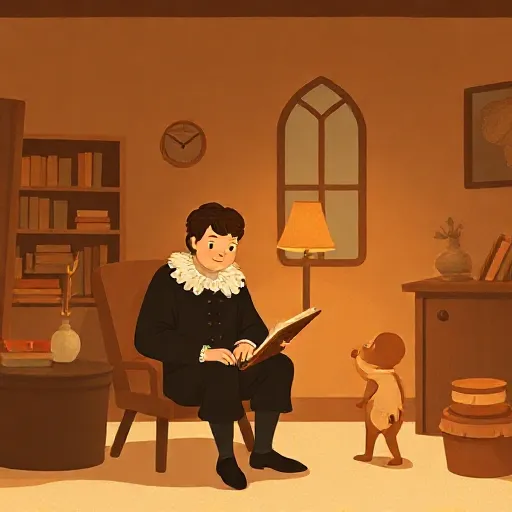
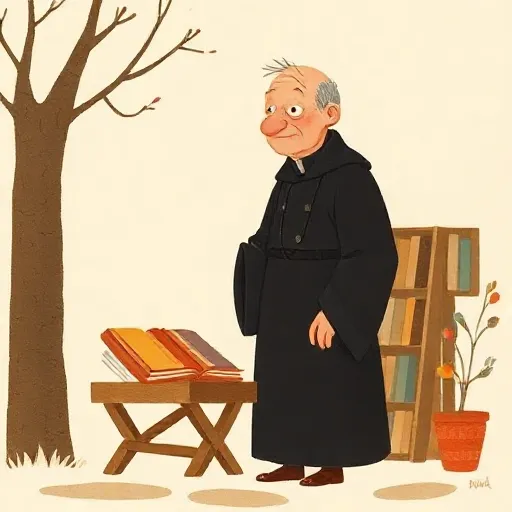
One day in 1664, a thin young priest named Nicolas Malebranche (1638–1715) stopped at a bookstall in Paris. He had a painful, twisted spine and weak lungs, so he usually stayed indoors. But that day he spotted a book that made his heart pound so hard he had to put it down just to breathe. It was René Descartes’s Treatise on Man, which described the human body as a machine. Malebranche was ecstatic. He felt he had finally found a way to study the natural world without the dusty, old ideas of Aristotle that he had disliked at university.
That moment sparked a decade of fierce study. Malebranche poured his thoughts into a book called The Search After Truth (1674–75). He wanted to show where human thinking goes wrong—because of our senses, our imagination, our passions—and how we can steer ourselves toward clear, certain knowledge. But the solutions he offered were startling. He argued that we do not see objects in the world directly, that God is the only real cause of anything, and that we understand morality by glimpsing an eternal order in God’s mind. Those ideas upset many people. They still raise deep questions today.
Do You See the World, or Does God Show It to You?

Imagine you look at a red apple. Common sense says the apple is out there, and your eyes just see it. Malebranche disagreed, fiercely. He insisted that we do not perceive objects “by themselves.” After all, it would be silly to think your soul leaves your body and flies to the apple to inspect it. So we need something else: ideas. An idea is a mental representation that stands between you and the apple. But where do these ideas live?
Malebranche argued that ideas cannot be made by our own minds, nor could they come from little copies (“species”) floating off objects. He listed four possible ways we might see bodies, and showed each one led to contradictions. The only option left, he thought, was that we see everything in God. God contains an infinite intelligible extension—a kind of perfect, invisible blueprint of all possible shapes and bodies. When you see the apple, you are actually looking at God’s idea of it. This is the vision in God.
He also had another reason. Certain truths, like “2 + 2 = 4,” are eternal and unchanging. They could not be just inside your head, because your head changes. Malebranche said such necessary truths must exist in an unchanging Reason—God’s mind. So mathematics and geometry are literally glimpses into the divine intellect.
A rival thinker, Antoine Arnauld (1612–1694), pushed back hard. Arnauld said ideas are not things separate from our perceptions; an idea is simply my act of seeing the apple, a modification of my own soul. But Malebranche replied that this would make all knowledge subjective, trapping us in our private minds with no guarantee that our thoughts match reality. The debate between them became one of the great intellectual battles of the 1600s.
Oddly, Malebranche also claimed we have no clear idea of our own soul. You know you exist and that you think, but you cannot map your thoughts like you can map distances and shapes. You feel sadness or see blue, but you cannot arrange those experiences on a precise scale. So, strangely, we know the nature of body better than the nature of our own mind—exactly the opposite of what Descartes had said.
Who Pulls the Strings? God as the Only Cause

Malebranche took an even more dramatic step. He argued that nothing in the created world truly causes anything. The only true cause is one where you cannot conceive the cause without the effect—a necessary connection. You can imagine throwing a ball and the ball just floating, and there is no contradiction. You can imagine deciding to lift your arm and nothing happening. So neither balls nor brains have real causal power. Only an all-powerful being’s will has that kind of necessary link. So God is the only cause. This is occasionalism: creatures provide the occasion, but God does the doing.
His second argument came from the idea that God conserves things by continuously creating them. If God must create a ball in a new place each moment to keep it in motion, then God is the direct source of every movement. When you decide to stand up, your will is merely the occasion for God to move your legs.
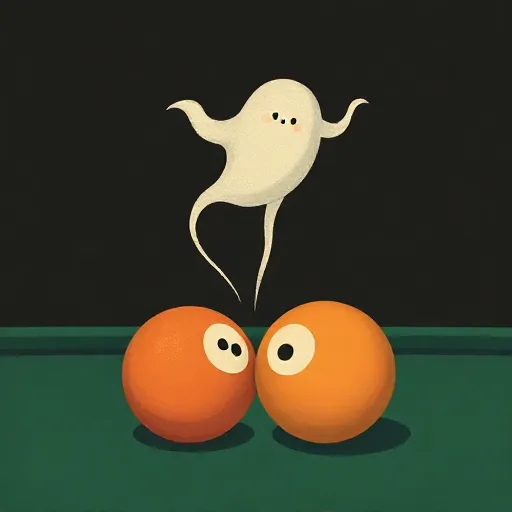
But wait—if God is the sole cause, why does it look like one billiard ball makes another move? Malebranche answered that God usually acts by general volitions, or fixed laws, rather than by particular volitions (special miracles). So the laws of nature are simply the steady habits of God’s will. Science can still study those patterns.
Not everyone was satisfied. The German philosopher Gottfried Wilhelm Leibniz (1646–1716) objected that if God directly produces every single effect, then nature is just a nonstop miracle. Malebranche insisted that acting by general laws is not miraculous because it follows a regular rule. But Leibniz thought a miracle was anything that only God can do, so occasionalism made everyday events constant miracles. The French thinker Pierre Bayle defended Malebranche, sparking a three-way dispute that echoed for decades.
If God Does Everything, Why Is There Suffering?

Now comes a hard puzzle. Malebranche himself was born with a severe spinal malformation that caused him pain. If God alone causes everything, why did not God just give him a straight spine? Why would a good, all-powerful creator permit suffering?
Malebranche’s answer was that God could have prevented that malformed spine by using a special, one-off intervention. But God’s wisdom chooses to act through the simplest, most general laws. Those simple laws sometimes produce particular evils—like twisted spines, earthquakes, or disease—but they also allow an orderly universe with the fewest rules and the most effects. God does not will the evil itself; God wills the overall beautiful system. This is Malebranche’s theodicy, his defense of God’s goodness in the face of evil.
For moral evil—wicked choices humans make—Malebranche pointed to human freedom. He said we have an inner sensation of being free. God pushes us with an inclination to love the good, but we can freely consent to stop our search at a lesser good, like money or pleasure, and treat it as our ultimate goal. That sinful resting is our own act, not God’s. Critics like Arnauld complained that Malebranche’s God did not care enough about individuals. Malebranche replied that God’s general love extends to each person through the very laws that make the world orderly.
What Deserves Your Love? Malebranche’s Moral Compass

Malebranche wove his ideas into a moral theory. He thought the universe has an objective order of perfection. God is infinitely perfect and deserves infinite love. Human minds are less perfect but still more valuable than lifeless matter. Right action means loving things in proportion to their perfection. Pleasure is not bad—it is a good that motivates us—but loving physical pleasures above truth and God puts your soul out of order.
This love of order, he said, is glimpsed in God’s wisdom, just like mathematical truths. So the vision in God provides not only knowledge of bodies but moral guidance. He rejected the quietist claim that you must have a pure love of God with no thought of your own happiness. Instead, you should seek happiness by loving the greatest good. In doing that, you do not erase yourself; you find yourself in a rightly ordered love.
Why Malebranche’s Questions Still Haunt Us

Malebranche’s thoughts are not museum pieces. When you wonder whether the colors you see really exist outside your mind, you are trespassing on his territory. When you ask if a scientist could ever predict your every choice, you are poking at his claim that only God is a true cause. His challenge still stings: can you prove there is a material world out there? Malebranche thought reason alone could not prove it; only faith could assure us that our senses are not an elaborate dream.
His ideas forced people in his century to rethink what a cause is, what freedom means, and how a good God can allow evil. And his central insight—that much of what we take for granted about seeing and doing may point beyond the physical world—continues to nudge even non-religious thinkers. Next time you hold an apple, ask yourself: where exactly is its redness? Malebranche would smile and tell you to look higher.
Think about it
- If every time you moved your arm God had to make it happen, would you still feel like you are the one moving it? Would that feeling matter to whether you are free?
- Can you ever be 100% sure that the world is not a dream? What, if anything, would convince you?
- If simple laws of nature sometimes lead to painful diseases, is that a better world than one where a powerful being breaks the laws every day to stop every small hurt? Why?