God Moves Every Ball — But You Still Choose
The Doctor Who Finished Descartes’s Book
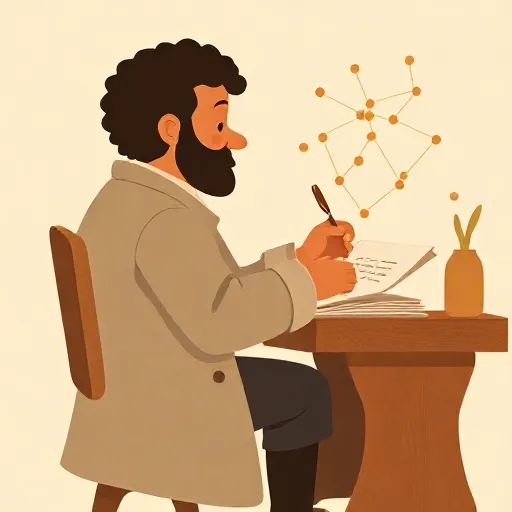
In April 1664 a book about the human body finally appeared in Paris. The famous philosopher René Descartes (1596–1650) had written it years earlier but never finished the drawings. Now a young doctor named Louis de La Forge (1632–1666) was brought in to supply the missing pictures. His careful sketches of nerves, animal spirits, and brain pathways helped readers see what Descartes was describing. But La Forge wasn’t just an illustrator. As he studied Descartes’s notes, he realized a huge piece of the project was missing.
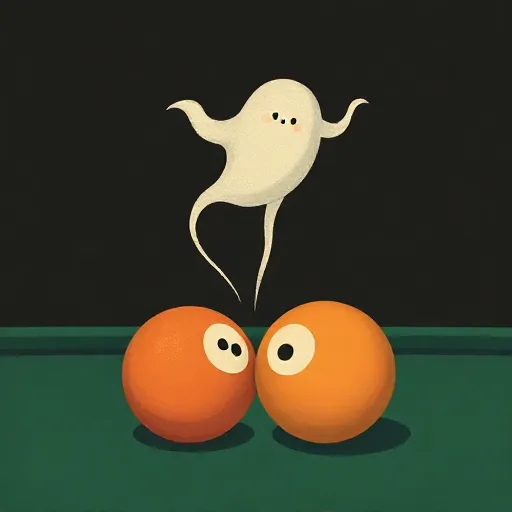
Descartes had planned to describe the body, then the mind, and finally explain how the two are joined. He died before he got past the body. La Forge decided to write that second book himself. In 1666 he published Traité de l’Esprit de l’Homme — Treatise on the Human Mind. It argued for a startling idea: when one ball hits another, no force actually jumps between them. All motion comes directly from God. Yet human minds still make real choices. How could both be true?
Can a Thought Move Your Arm?

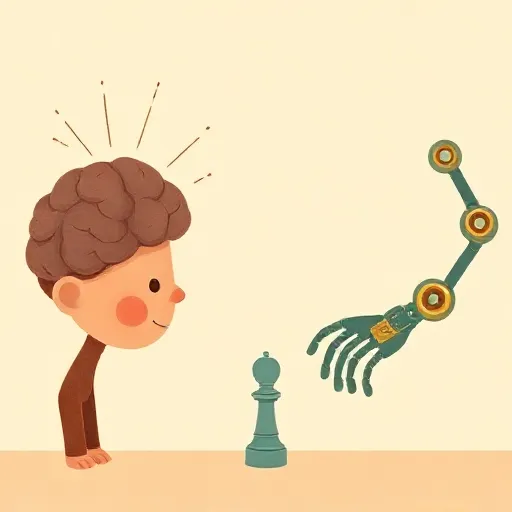
Descartes had split reality into two completely different kinds of stuff. A substance is a thing that can exist on its own. The body is an extended substance — it takes up space and can be divided into parts. The mind is a thinking substance — it has no size, no shape, and can’t be chopped in two. This view is called substance dualism. It sounds clean, but a sharp critic immediately spotted a problem.
Princess Elisabeth of Bohemia (1618–1680) wrote to Descartes: If the mind isn’t extended and can’t make physical contact, how on earth can it move the body? A shove needs touching, shape, or size — none of which a mind has. La Forge took this challenge seriously. He wanted to show that mind–body interaction is no more mysterious than two bodies bumping into each other. In fact, he thought body-to-body pushing was the bigger puzzle.
Why a Ball Can’t Really Push Another

La Forge began with a simple observation. Motion, Descartes had said, is just a mode of a body — a way that body is, like its shape or its position. A mode can’t peel off and wander over to another object; you can’t take the roundness from a billiard ball and hand it to a cube. So if motion is a mode, it stays tied to the body that has it. When a moving ball strikes a stationary one, the motion can’t literally jump across.
But something clearly makes the second ball start rolling. La Forge argued there must be a force of motion that is really distinct from the moving body. That force, unlike motion itself, can be applied to different bodies without belonging to any of them as a property. And here’s the crucial step: if this force isn’t a mode of any body, it can’t be made of extended stuff at all. It must be something non-physical — a spiritual power.
La Forge put it bluntly: “motion is only a mode which is not distinct from the body to which it belongs and which can no more pass from one subject to another than the other modes of matter.” Therefore, he concluded, “every body which is in motion must be pushed by something which is not itself a body and which is completely distinct from it.” No ball, no brick, no fingertip ever moves anything by its own power.
God Moves Your Arm, but You Still Choose
If bodies can’t move bodies, who does? La Forge answered: God. “God is the universal cause of all the motions which occur in the world,” he wrote. This view is called occasionalism — the idea that physical events are occasions for God to act directly, not for one body to transfer force to another. Every crash, every heartbeat, every falling leaf is a divine movement.
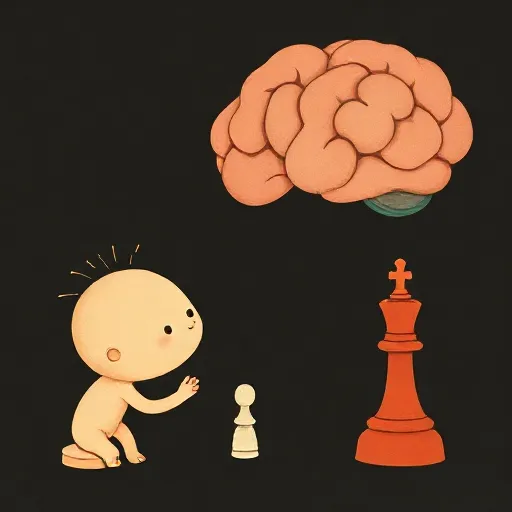
But La Forge wasn’t ready to say that our minds are helpless passengers. He defended a partial occasionalism. God moves all bodies, but finite minds are genuinely active causes of their own thoughts and decisions. When you decide to raise your hand, your act of will is real; it’s not God thinking for you. Your choice then becomes, through a law God established at creation, the occasion for God to move your arm in just that way.
He explained this with a kind of two-part causality. God is the principal cause — the power that actually shifts the arm. Your will is the particular cause — the signpost that tells God’s power where to go and when. So you’re not a puppet. La Forge wrote that God “included the consent of our will in his decree, and it was only after having foreseen how our will would determine itself … that he consequently willed absolutely that such effects would result.” Your freedom matters; it is part of the blueprint from the start.
This also meant that mind–body interaction wasn’t a special mystery. In both ball–ball and mind–body cases, an immaterial force — God — does the moving. The only difference is whether a human will gets to point the way. La Forge could tell Princess Elisabeth that her worry was backwards: body-to-body causation was just as spiritual as mind-to-body causation, once you looked closely.
Why a 400-Year-Old Idea Still Echoes Today

You raise your hand to answer a question. Was that you doing it? Most people would say yes. But La Forge’s picture adds a layer: the actual pushing of your muscles is done by God, working through natural laws that respond to your decision. You are still in charge, because God set up the universe so that your choices steer the motions.
Is that a satisfying answer? Philosophers have argued ever since. Some think occasionalism makes God do all the work, leaving us as mere spectators. Others, like La Forge, insist that a choice is a real cause even if it doesn’t shove atoms around by brute force. The debate touches everything from video-game physics (when your avatar moves, did you push it?) to legal responsibility. If a scientist could predict every move you’ll ever make, does that mean you never really choose? La Forge would say: God foresaw your choice from eternity, and that doesn’t make it any less yours.
The next time you feel the satisfying click of one object hitting another, remember: a quiet 17th-century doctor thought that the force never truly crosses the gap. Something much grander is moving the world — and your will is part of the score.
Think about it
- If a machine could predict every arm movement you make before you decide, would you still be the one causing your own motion?
- In a video game, you press a button and your character kicks a ball. You didn’t physically touch the ball. Is it fair to say you kicked it?
- If God ultimately moves every muscle, does it still make sense to praise someone for a brave action or blame them for a cruel one?