Did Spinoza Believe Absolutely Everything That Happens Must Happen?
Wait, Could I Have Chosen Vanilla Instead?

You are standing at an ice cream counter. You choose chocolate. Later you think, “I could have picked vanilla instead.” Most people assume you could. But the 17th‑century philosopher Baruch Spinoza (1632–1677) would have shocked you: maybe you could not have. He believed that every single thing that happens — including which ice cream you scoop — had to happen exactly as it did, and could not have been any other way. This view is called necessitarianism: the idea that the actual world is the only possible world. To Spinoza, nothing is truly contingent — nothing “could have been otherwise.” Not even the smallest leaf could have landed a centimetre to the left.
Spinoza knew this idea clashes with common sense. He must have thought he had very strong reasons for it. The debate over whether he really meant full‑blown necessitarianism, and what it means for us, is still alive today.
God, Substance, and the Search for Reasons
To see why Spinoza might have been a necessitarian, we need his favourite tool: the Principle of Sufficient Reason (PSR). The PSR says that for every fact there must be a cause or reason that fully explains why it is so and not otherwise. No “brute” unexplained facts are allowed. If a triangle exists, something explains why; if it does not exist, something explains that too. Spinoza took this principle with utmost seriousness.
He then sorted everything that exists into two basic types. A substance is something that exists independently and is conceived through itself. A mode is something that exists in something else — like a shape, a thought, or a particular object. Your body, a falling leaf, and even the idea of pizza are all modes. Spinoza argued that there is only one substance: God (or Nature). Everything else is a mode of that single substance.
Spinoza also had a striking view of causation. He thought a cause is not just an event that pushes something else; it provides a reason that makes the effect follow necessarily — the way the fact that a triangle’s angles sum to two right angles follows from what a triangle is. Causal relations are conceptual connections. So if something exists, its cause must explain its existence the way a definition explains a mathematical truth.
Now apply the PSR to substances. A substance cannot be caused by anything else, because substances are causally isolated. So a substance’s existence must be explained by its own nature. That means it is self‑caused: its essence involves existence. Therefore it exists necessarily — it cannot fail to exist. Spinoza further argued that only one such substance can exist, because if there were more than one, we would need a reason why this one exists rather than that one, and no such reason could exist. So only God necessarily exists, and no other substance could ever exist.
So far, so necessary. But what about all the modes — the everyday things? Are they necessary too?
The Chain of Modes and the Big Gap
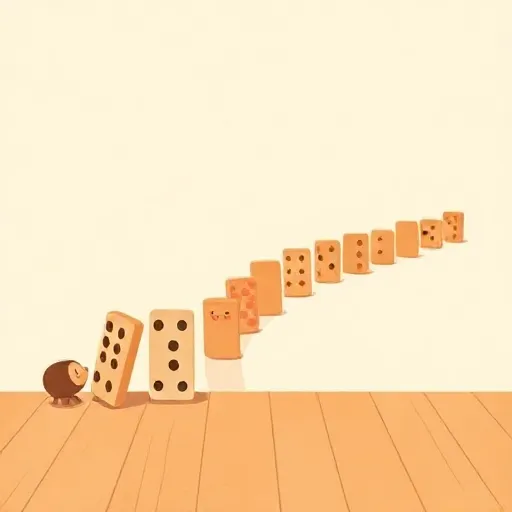
Modes, for Spinoza, are everything besides substance. He claimed that infinitely many modes exist, all following from God’s necessary nature. This seems to make them necessary as well: if God exists necessarily, and modes follow from God, then by a modal transfer principle (if x is necessary and y follows from x, then y is necessary), modes should be necessary too. But Spinoza noticed a wrinkle.
He distinguished between infinite modes and finite modes. Infinite modes are general features of the world that follow directly or indirectly from God’s absolute nature — things like the laws of physics, or what Spinoza cryptically called “the face of the whole universe.” These infinite modes exist necessarily.
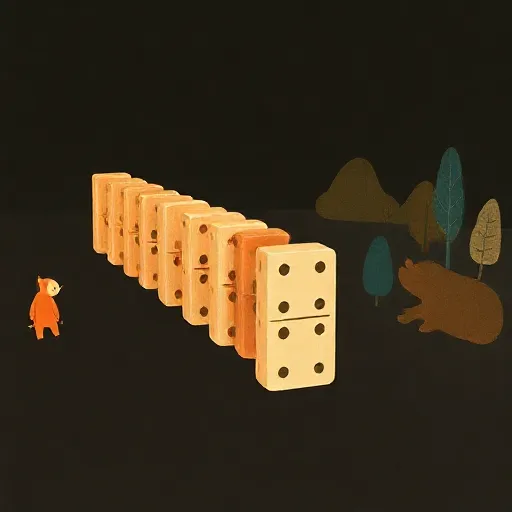
Finite modes — particular things like you, a leaf, a passing thought — don’t follow that way. In a key passage, Spinoza says that a finite thing “could not have been produced by the absolute nature of an attribute of God; for whatever follows from the absolute nature of an attribute… is eternal and infinite” (Ip28d). Instead, each finite mode is caused only by other finite modes, in an infinite chain stretching back forever with no first cause. So between God (and the infinite modes) and any particular desk or daydream, there seems to be a gap. If the modal transfer principle can’t reach across that gap, finite modes might be contingent — they might not be absolutely necessary.
Interpreters disagree fiercely about what Spinoza really intended. Some, like Edwin Curley, say Spinoza was not a full necessitarian about finite things. On this reading, a finite mode is partly determined by God’s infinite modes (the laws of nature) and partly by earlier finite modes, but the whole series of finite events could have been different. That matches our everyday feeling that the leaf could have landed further left.
Others, like Don Garrett, argue that Spinoza did embrace full necessitarianism. They point out that while no single finite mode follows from God’s absolute nature, the entire collection of finite modes as a whole does follow from God. If the whole series is necessary, then each member, considered as part of that whole, is necessary too. The gap, on this view, is only apparent — a matter of how we look at things.
Necessity Depends on How You Look

Spinoza may have found a subtle way to have it both ways. He thought that necessity is not just “out there” in the world; it also depends on how we conceive things. In his system, a thing’s modal status — necessary or contingent — is grounded in the conceptual relations through which we understand it.
If you conceive a finite mode — say, your decision to eat chocolate ice cream — in isolation, just by itself and its immediate causes, you will not see why it had to happen. It will appear contingent. But if you could conceive that same event in relation to the entire infinite network of causes stretching back to God, you would see that it necessarily follows from the whole. In that full conceptual picture, it is necessary.
This explains why we humans so often experience things as contingent. Our minds naturally grasp things in limited, close‑up ways. Spinoza wrote, “Insofar as the Mind understands all things as necessary, it has a greater power over the affects, or is less acted on by them” (Vp6). He believed that if you could see the whole causal web, you would understand that nothing could have been otherwise — and that understanding might calm your emotions.
So Spinoza may hold a kind of double‑truth. From our everyday, zoomed‑in perspective, things are genuinely contingent. From the universe’s absolute, zoomed‑out perspective, they are necessary. Both statements can be true, just relative to different ways of conceiving. This lets him say both that a human being’s essence does not involve necessary existence (IIa1) and that God could not have produced things in any other way (Ip33).
Why It Matters: Freedom, Regret, and the Big Picture

Why should anyone care whether Spinoza was a necessitarian? Because the question cuts to the heart of how we think about choice and responsibility. If every decision you make, every mistake, every triumph, had to happen exactly as it did, what becomes of praise and blame? Does it still make sense to punish someone for a bad act if they could not have done otherwise?
Spinoza’s answer was surprising. He thought understanding necessity can actually increase a special kind of freedom — not the freedom to have chosen differently, but the freedom that comes from comprehending why things happen and being less tossed around by emotions. Think of the regret you might feel after losing your temper with a friend. You think, “I could have stayed calm.” Spinoza would say that if you truly grasped the full chain of causes — your exhaustion, your past experiences, the state of your brain — you would see that you could not have acted differently in that moment. This doesn’t mean you shouldn’t try to improve. It means self‑blame loses its sharp edge. You can focus on understanding and reshaping the causes, rather than beating yourself up.
Spinoza’s ideas still fuel debates about free will, determinism, and what it means to explain why anything happens. They invite you to ask: is our feeling of openness real, or is it just a trick of a limited view? Could your life be both fully determined and still meaningful?
Think about it
- If a future super‑computer could predict every choice you will ever make with perfect accuracy, would it still be fair to punish people for wrong choices? Why or why not?
- Spinoza believed that seeing your actions as necessary could make you feel less angry or guilty. Can you think of a time when understanding why someone (or you) acted a certain way made you less upset?
- If the whole universe is one giant, unbreakable chain of events, does that make your life feel more connected and meaningful, or smaller and less important? Explain.