Are You Really Free, or Just Part of Nature’s Machine?
The Decision You Didn’t Make
You reach for your water bottle. It feels like a free choice. You wanted a sip, so you took one. Nobody made you do it. The whole thing seemed to start inside you — your desire, your decision, your action.
Now imagine someone tells you that every piece of that sequence was already set before you even felt thirsty. The thirst, the wanting, the reaching — all of it had causes stretching back before you were born. You might say, “No, I felt myself choose.” And that feeling is powerful.
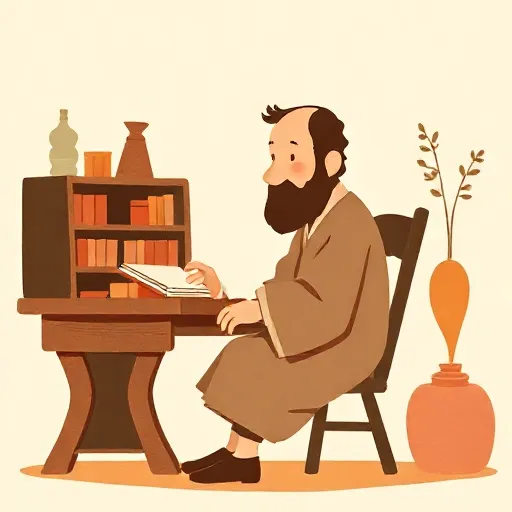
In the 1600s, a Dutch philosopher named Baruch Spinoza (1632–1677) argued exactly this: that feeling of choosing is real — but it’s not what you think it is. For him, human beings are not visitors standing outside the machinery of nature. We are parts of the machine. Every thought, every desire, every moment of joy and sadness follows the same laws that make rivers flow or planets spin. If Spinoza is right, the way you see yourself — as a free, special, self-made person — might need a serious rethink.
One Set of Laws for Everything
Spinoza didn’t wake up one morning and decide to shock people. He arrived at his ideas by following a simple but strict principle: the laws of nature are always and everywhere the same. A rock falls because a force acts on it. A flower grows toward the sun for reasons a biologist can study. So why, Spinoza asked, should the human mind get a special pass? Why should our feelings and decisions run on some separate, magical rulebook?
Most thinkers before him, and plenty after, treated the mind as an exception — a place where consciousness flickers on and off, where good and evil are real forces, where a person can be an uncaused cause of their own actions. Spinoza rejected all of that. He wrote that human beings are not “a dominion within a dominion.” In plainer words: you aren’t a king standing above your backyard; you’re another animal in the garden.
If that sounds bleak, keep reading. Spinoza wasn’t trying to make us feel small — he was trying to understand what we actually are. And to do that, he built his whole psychology on one core claim: every particular thing in nature has a striving (in Latin, conatus) to keep itself going. Not because it wants to in the way you want lunch, but because its very essence is a kind of power pushing to persist. A candle flame doesn’t “decide” to burn — it just keeps burning until something outside snuffs it out. Spinoza thought human beings were like that, too, only much more complicated.
Why You Feel Happy and Sad
If every living thing just strives to keep existing, where do your big, messy feelings come from? Spinoza’s answer rearranges how you think about happiness and sadness. He called these affects — the changes in your power to go on being.
Imagine your striving as a battery that powers everything you do. When your capacity to act increases, you experience joy (laetitia). When it decreases, you feel sadness (tristitia). These aren’t just moods — they are signals, like a battery indicator blinking green or red. A good meal, a kind word, a finished task — all raise your power a little. An insult, an injury, a fear — all drain it.
Desire, for Spinoza, is simply the conscious awareness of that striving. When you find yourself wanting something, you are really sensing your own conatus aiming in a particular direction. And here’s the twist that unsettles many readers: you don’t want a thing because it is good. You call it good because you want it. The wanting comes first, built into your nature and shaped by everything that has ever affected you. The label “good” is something you tack on afterwards.
This flips everyday thinking upside down. You might say, “I signed up for soccer because it’s a good sport.” Spinoza would gently rephrase: you were drawn to soccer by a mix of reasons — perhaps it excited you, perhaps friends played it — and because those reasons increased your feeling of power, you then judged soccer to be good. Your judgment rode on the back of your striving, not the other way around.
The Freedom We Actually Have

What about freedom? If every decision bubbles up from causes you never chose, doesn’t that mean you’re just a puppet? Spinoza didn’t dodge this question. He met it head-on — and his answer is one of the most surprising parts of his whole system.
He denied that we have free will in the usual sense. You don’t own a little inner switch that can flick left or right independently of everything else. Every idea, every impulse, comes from a chain of causes. But Spinoza thought that another kind of freedom is still possible: freedom from external control. You are free, he argued, to the extent that what you do flows from your own nature, rather than being forced on you by things outside you.
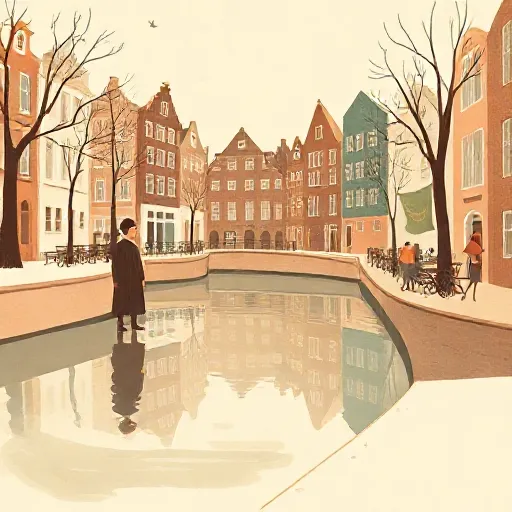
Think of the water in that canal. If a dam blocks it, the water is not free — its motion is constrained by an outside obstacle. But when the lock opens and the water moves according to its own weight and shape, it acts freely, even though its behavior is entirely caused. Similarly, when you act from clear understanding — when your own mind, and not panic or pressure or someone else’s command, is the real source of what you do — you are free in the only way a part of nature can be.
That means people who act out of blind passion or confusion are less free. Their actions are pushed by outside forces they don’t understand. The greedy person who can think of nothing but money, the person obsessed with another’s approval — Spinoza called these states a kind of “madness,” because the person is no longer running from their own deeper nature, but from a loop someone else started.
Good, Evil, and Why They’re Not Out There
If good and evil are just labels we slap on things we already want or fear, then are they real? Spinoza’s answer is careful and a bit startling. Good and evil are not “positive” things inside objects, like sugar being sweet or a rock being hard. They are what he called modes of thinking — ways that your mind organizes experience.
What’s good for a sad person might be bad for someone who is angry. The same song might soothe one listener and irritate another. Spinoza used the example of music: it is good for someone who is melancholy, harmful to someone who is mourning, and neither good nor harmful to someone who is deaf. The music doesn’t change — the person’s state does.
This doesn’t mean Spinoza threw morality in the trash. Instead, he tied goodness to a clear, measurable fact: an increase in your power to strive and thrive. When you experience joy — an honest, active joy that comes from understanding and healthy connection — you are becoming more perfect, more real. And that, for him, is the only solid ground on which to build an idea of the good life. The best kind of person isn’t someone who follows a list of rules from outside. It’s someone whose own nature is so clear and strong that they automatically act in ways that increase their power — and, Spinoza was convinced, also the power of those around them.
Why This Still Matters Right Now
You probably don’t spend your days worrying about seventeenth-century metaphysics. But Spinoza’s ideas have a way of creeping into ordinary life. The next time you impulsively check your phone for the tenth time in an hour, ask yourself: did you freely choose that? Or was a whole machinery of habit, design, and marketing nudging you long before you felt the urge?
Spinoza would say that understanding those causes — the way certain apps are built to trigger small cycles of joy and sadness, the way your own past experience wires certain desires — is the first step toward a more genuine freedom. You can’t step outside the chain of causes. But you can come to see it more clearly, and when you do, you can act more from your own nature and less from the pull of every passing notification.
This way of thinking also softens blame. If someone hurts you, Spinoza would resist the idea that they are a purely evil, uncaused monster. They are a part of nature, too — a confused, low-power part, maybe — and understanding that doesn’t erase the harm, but it can change the way you respond. It turns moral outrage into a kind of clear-eyed problem-solving.
His ideas also invite you to rethink what makes a good day. Not the number of likes. Not the expensive thing. But whether, at the end of it, you feel stronger, more able to think and act and care — whether your conatus is a little brighter than it was in the morning.
Think about it
- If every desire you have is caused by earlier events, should you still be praised when you do something kind? Or blamed when you do something hurtful?
- Spinoza thought we don’t want things because they are good — we call things good because we want them. Can you think of a case where you changed your mind about what was good only after your feelings changed first?
- Imagine you could trace every choice you made today all the way back to before you were born. Would that make you feel less proud of your achievements, or would it change nothing at all?