
If God Is Perfect, Why Does Evil Exist? Leibniz’s Bold Explanation
A Question That Kept Leibniz Up at Night

Gottfried Wilhelm Leibniz (1646–1716) sat in his study in Hanover, thinking about a problem that had troubled thinkers for centuries. If God is all-powerful, all-knowing, and perfectly good, why is there so much evil in the world? Earthquakes, cruel rulers, painful illnesses — how could a perfect being let these happen? Leibniz didn’t think this proved God doesn’t exist. Instead, he argued that the world we live in is the very best one God could have made, and that God isn’t to blame for evil. His answers were clever, but they also sparked huge debates that continue today.
Two Sides of the Same Puzzle
In Leibniz’s time, most people believed in God, so the big worry wasn’t “does God exist?” but “how can God be holy if he’s connected to evil?” We call that the holiness problem — it’s about whether God can stay clean when evil happens in a world he creates, keeps in existence, and constantly cooperates with. But a different version was also growing. If God is so great, why does our world seem so imperfect? This underachiever problem asks: if God exists, shouldn’t the world be a lot better? Some 17th-century thinkers, a group called the Socinians, used this puzzle to argue that God isn’t all-knowing — otherwise, he wouldn’t have made such a flawed place. Atheists today go further, saying evil shows there is no God at all. Leibniz tackled both versions, but he spent most of his energy on the underachiever problem.
Why This World Must Be the Best

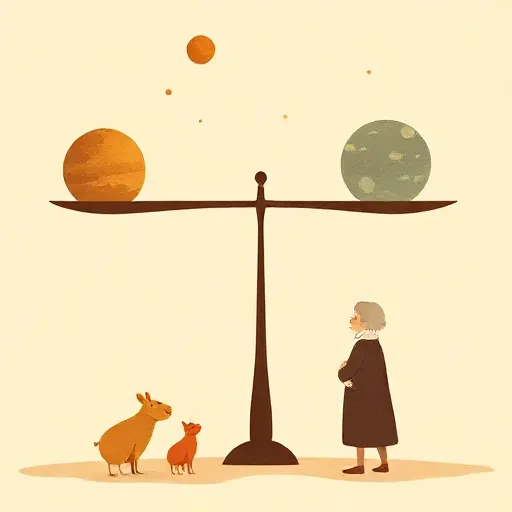
Leibniz’s core move was to say that God created the best of all possible worlds. If God is all-good, he must choose the best. If he’s all-powerful and all-knowing, nothing can stop him. So the actual world is the best. But Leibniz didn’t just assume this. He relied on his famous Principle of Sufficient Reason: for everything that happens, there must be a complete reason why it happens and not something else. Even God’s choice of which world to create needs a reason. If possible worlds got better and better forever, like an endless staircase, there would be no single best one. God would have no reason to pick any particular world, and that would violate the Principle. So Leibniz concluded the chain of possible worlds can’t go on infinitely — there is a top, and we live in it.
But you might immediately object: “Wait, is this really the best? I can easily imagine a world without a particular tragic event, like a school fire or a hurricane.” Leibniz answered in two stages. First, we can’t know how changing that one bad thing would affect everything else. Removing one disaster might unravel the whole fabric of the world and make it worse overall. Second, we might be using the wrong standard. Maybe God judges a world’s goodness not just by human happiness, but by how much variety of life it contains, how well it mirrors divine perfections, or how simple its laws are. Leibniz thought God aims to create the richest variety of beings and phenomena governed by the simplest laws. A world without any conflict or tragedy might have less variety, or its laws would have to be full of exceptions. So the world could be best in ways we can’t see from our small corner.
The Donut-Hole Defense: Is Evil Even a Real Thing?

Before Leibniz, medieval philosophers had another way to protect God from blame. They argued that evil isn’t a real thing at all. It’s just a privation, a missing of good. The hole in a donut isn’t made of donut — it’s the absence of cake. Similarly, evil isn’t something God creates; it’s just a lack of goodness, like blindness is a lack of sight. So God doesn’t need to cause evil. This view, the privation account, seemed to clear God of blame.
Young Leibniz rejected this idea. He said it was an illusion. If you paint two pictures, one larger and one smaller, you are still the author of the fact that the smaller one lacks size — the lack follows from the positive things you painted. In the same way, when God creates all the positive features of the world, the resulting lacks (evils) are an unavoidable by‑product. So God would still be responsible. Later in life, however, Leibniz came back to a version of the privation view, though scholars disagree about how exactly he combined it with his other ideas. This puzzle remains hotly debated among experts.
Permission and the Hidden Hand of God

Leibniz wanted a way to say that God is deeply involved in every event of the world, yet never does evil himself. He built a careful definition of permission. God does not will that evil happen; God does not will that it not happen either. Instead, God brings about a larger situation — creating the best possible world — that tragically includes evil as a consequence. God knows this will happen, but he permits it only because he has a duty to create the best world and that duty’s goodness outweighs the evil. So the evil is an unavoidable side‑effect, not something God does on purpose. Leibniz used this to argue that God doesn’t break the moral rule “do not do evil that good may come.”
But a thorny question remained. Traditional believers also held that God is a concurrent cause — he cooperates in every single action of every creature, even bad ones. If God helps a thief move his hand to steal, doesn’t that make God a partner in crime? Leibniz’s answer turned on what makes predictions about free choices true. Take a conditional future contingent, a statement like “If Eve were tempted by a serpent, she would freely eat the fruit.” Did God decide that this statement is true, or does he simply know it because something independent makes it true? Leibniz eventually took the second view: God discovers how you would freely act from the very concept of you, not because he forces your choice. Your own intellect presents reasons to your will, and your will freely follows what seems best. The will isn’t causally forced — it’s “morally necessitated,” like a wise magistrate who simply can’t bring himself to run naked through the streets. That’s not the same as being physically forced; you could do it, but you won’t. So God can cooperate in your action without making you sin, and his holiness stays intact — at least in Leibniz’s mind. Scholars still argue whether this succeeds.
Why Leibniz’s Puzzle Still Keeps Us Thinking

The problem of evil didn’t disappear after Leibniz. Voltaire mocked his “best of all possible worlds” in the novel Candide, and philosophers ever since have argued whether his defense works. But the debate isn’t just for professional thinkers. When you see something terrible on the news, or when you face your own unfair suffering, you might wonder: if there is a God, why wouldn’t he step in? Leibniz’s ideas offer a way to think that maybe the universe makes sense as a whole, even if the pieces look ugly. They also challenge us to ask what “good” really means — is it just avoiding pain, or is there something more valuable about a world with risk, growth, and freedom? Three centuries later, we’re still not sure. But the questions themselves sharpen how we understand justice, responsibility, and the kind of world we want to live in.
Think about it
- If a being could make you perfectly happy, but you would never face any challenges or growth, would that be a better life than a life with some struggles? Why or why not?
- If scientists could prove that every time something bad happens, it’s part of the only way to make the universe as rich and complex as possible, would that change how you feel about your own painful experiences?
- Can you imagine a situation where letting something bad happen is the right thing to do, even if you could stop it? Give an example.