Can Virtue Make You Happy? Leibniz’s Cosmic Answer
The Man Who Saw Harmony Everywhere

In the winter of 1695, in a candlelit study in Hanover, a man in a powdered wig bent over a heap of papers. Gottfried Wilhelm Leibniz (1646–1716) was not just any thinker; he was a genius who dreamed that the universe was a perfectly woven tapestry and that learning to read its threads could make you happy.
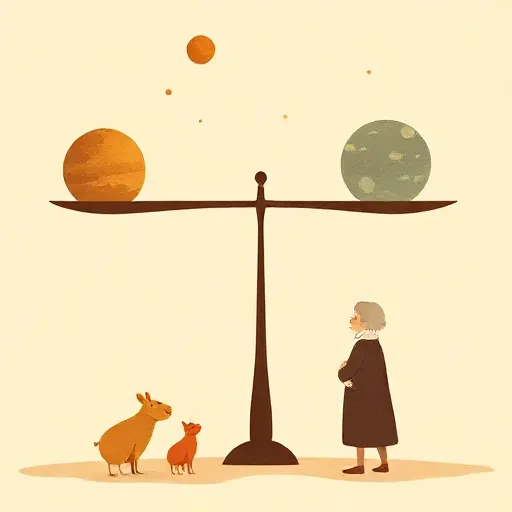
Leibniz believed that goodness is not one simple thing but three kinds woven together. He called them the metaphysical good, the moral good, and the physical good. The metaphysical good is reality itself—the very being of things. The moral good is virtue, or acting with wisdom and justice. The physical good is pleasure, the warm feeling of joy. Each kind of good has an opposite evil: the lack of reality (non‑being), sin or vice, and pain. Leibniz thought these three goods, though different, lock together like gears. His big idea was that if you understand how they connect, you discover the recipe for a happy life.
Perfection Is Not All‑or‑Nothing

For Leibniz, the metaphysical good is perfection, and perfection is the same as reality. A thing is good simply because it exists, and the more reality it has, the more perfect it is. Crucially, perfection is not an on‑off switch. It comes in degrees, like the volume of a song. God, who is limitless, has infinite perfection. Everything else—stars, trees, people, even the whole universe—has a finite, limited degree of perfection. As Leibniz put it, God cannot give a creature all perfection without turning it into another God, so every created thing has some limits.
That built‑in limit is what Leibniz called metaphysical evil: not a sinister force, but simply the absence of being where more being could have been. Where there is less reality, there is less perfection, like a shadow that appears only because light is partly blocked. Leibniz described perfection more vividly as “harmony”—unity in variety. Imagine a grand clockwork where many different parts move together according to a handful of laws. That harmony makes a thing “worthy of being observed,” like a painting that draws your eye again and again. The more harmonious something is, the easier it is to contemplate, and the more real it is.
Justice: Loving with Your Mind

So far we have talked about how much reality a thing has. But Leibniz held that moral goodness is something we do: it is the development and perfection of what makes us human. The central virtue, he argued, is justice, and he defined it in a surprising way: “the charity of the wise man.” Charity here means love—not just a warm feeling, but taking genuine pleasure in the happiness and perfection of others. Wisdom is knowing what truly makes things better. So justice is love guided by understanding.
This means that a person who loves wisely does not just throw help at others blindly. She takes the time to understand the order of the world—what leads to lasting happiness and what only seems good. According to Leibniz, the more you expand your love to care for more people and act with real knowledge, the more morally good you become. God, whose wisdom is infinite and whose love reaches all beings, is the ultimate model. Our job is to imitate that divine love as best we can, slowly growing in virtue and becoming more like a “little divinity” in the city of the world.
Pleasure: The Feeling of Perfect Order

Where does pleasure fit in? Leibniz gave a striking answer: pleasure is nothing other than the perception of perfection. When you feel a rush of delight, whether from music, a painting, or a sudden insight, you are sensing harmony—order and unity shining through variety. Pain, by contrast, is the perception of imperfection, a glimpse of discord.
He distinguished two kinds of pleasure. Sensual pleasures, like the sweetness of a fruit or a melody that moves you, are confused perceptions of perfection; you feel the order without being able to explain it. Intellectual pleasures, such as understanding a proof in geometry or grasping the structure of the cosmos, are distinct perceptions of perfection. Sensual pleasures can be deceptive and fleeting, while intellectual pleasures are pure and lasting. True happiness, Leibniz insisted, is simply a lasting state of pleasure—a mind that continually perceives and imitates the harmony of the universe.
The Invisible Lawbook
If virtue and happiness are connected, how do we know what virtue demands? Leibniz answered with a natural law theory. The moral rules are as fixed and discoverable as the truths of arithmetic; they do not depend on God’s free choice. Even God cannot make injustice just, any more than he can make a circle a square. This made Leibniz a fierce critic of thinkers who said morality is whatever God happens to command. If goodness were only an artifact of God’s will, he reasoned, we could not love God for being good, and the whole basis of religion and morality would crumble.
Leibniz arranged the natural law into three rising degrees of justice, borrowed from ancient Roman law but given new depth. The lowest degree, strict right, says: “hurt no one.” It is the bare minimum—don’t murder, don’t steal—and its job is to keep the peace. The second degree, equity, says: “give each their due.” This includes duties of gratitude and generosity that go beyond what law can force, actively promoting the happiness of others. The highest degree, piety, says: “live honorably.” Piety requires us to view our whole lives, not just our earthly span, through the lens of the soul’s immortality and God’s perfect governance. Only then can we trust that every good deed will ultimately be rewarded and that being virtuous is never a losing bet.
Why the World’s Harmony Still Matters to You

Leibniz’s whole vision rests on one big hope: that the world is not a random mess but a place where goodness and happiness ultimately add up. Against this, he saw a rival in René Descartes (1596–1650), whose philosophy, Leibniz complained, could only offer “patience without hope.” Descartes held that God’s will has no standards of good above it, so we can never be sure that God’s actions are aimed at our benefit. Descartes also denied that we can know God’s purposes, and his account of the soul, Leibniz argued, left no room for memory after death—making it impossible for God to reward virtue justly. Without hope in a wise and good divine order, Leibniz thought, morality would leave us merely enduring life rather than joyfully advancing.
Leibniz held that genuine optimism is not a lazy belief that everything is already perfect moment by moment, but a trust that the universe can grow in moral and physical perfection over time—especially for minds who freely learn and love. He often wrote that souls can progress endlessly toward greater happiness, yet he also saw a real puzzle: if everything is interconnected, can one mind’s gain in perfection happen without another mind’s loss? He admitted he could not prove which view was correct. That uncertainty is still alive today.
So when you face a small decision—whether to keep a promise, share the last slice of cake, or stand up for someone—Leibniz would want you to see it as part of a grand order. He would say that every act of wise love increases your own joy because it tunes your soul to the harmony of the world. But he would also leave you with a question he never fully settled: is the orchestra of life arranged to make goodness and happiness ring in tune over the long run? The answer matters as much in your kitchen as it did in his candlelit study.
Think about it
- If you could see a perfect hidden order in everything, would that make you more likely to be kind?
- Imagine a world where every good deed always gets a reward. Would people do good for the right reasons, or only for the prize?
- Do you think the universe is set up to make goodness and happiness eventually match up? What would convince you?