Why Nothing Can Start from Zero: A 12th-Century Quest
A Question That Would Not Let Go
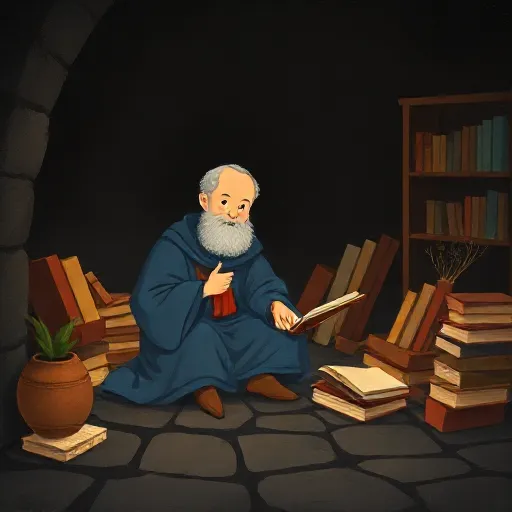
Joane Petrizi lived in Georgia in the 1100s. Almost no records of his life survive. What we know about him comes from the words he scratched onto parchment while working alone for years on a single enormous project. That project was a commentary — a chapter-by-chapter explanation — on a book called The Elements of Theology by the ancient Greek philosopher Proclus (412–485). Petrizi did not just summarize Proclus; he argued with him, dug deeper, and tried to solve the question that had been bugging him since he first opened the book: if every single thing in the universe comes from something else, can we trace it all back to one beginning?
The Greeks had a word for that beginning: the One. Petrizi believed that proving the One was the most important job any thinker could take on. If you could not prove the One, he wrote, nothing else in knowledge was truly certain. Everything would just float, ungrounded, like a bird without a branch to land on.
The Chain of Being: Why There Cannot Be an Endless Line of Causes
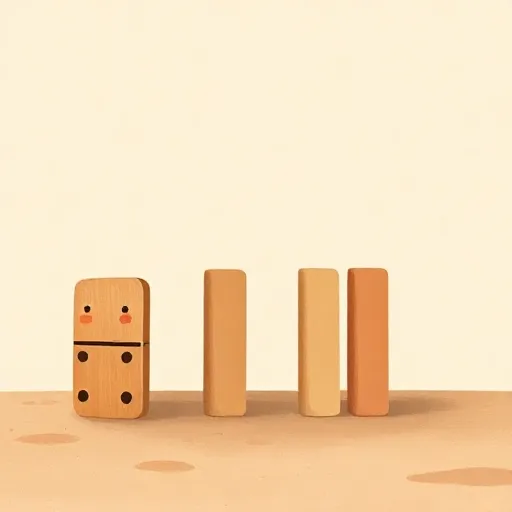
Start with something ordinary: a glass of water on a table. Why is it there? Because you put it there. And why did you do that? Because you were thirsty. And why? You can keep going backwards, step by step. Petrizi believed that this chain of reasons could not go on forever. If it did, you would never reach a starting point — and without a starting point, the whole sequence would collapse.
He began with a simple axiom that he borrowed from Proclus: every chain of beings needs an origin. Think of a row of falling dominoes. If the dominoes stretch back infinitely, you will never see the first one tilt. That means no motion can ever begin. Petrizi said the same logic applies to the universe itself. There must be something that is first, a cause that is not itself caused by anything else. He called it the One.
For Petrizi, the One was not just the first cause in a timeline. It was the most real thing of all. Everything else — mountains, frogs, thoughts, music — exists only by sharing in the One’s reality. Take away the One, and everything else would vanish like a morning mist. So the One is not just first; it is what holds the entire cosmos together.
A Cause Unlike Any Other: The Good That Gives but Never Takes

Petrizi gave the One another name as well: the Good. He meant something precise by that. If you watch how a campfire works, its heat and light spread into the forest, but the fire itself does not become cold or dark. It gives without taking. In the same way, Petrizi argued, the One pours out goodness to everything below it, yet stays perfectly full and simple. Nothing it creates can add anything to it.
This was a radical idea. It meant the One does not need the universe. It does not create out of loneliness or a desire for praise. It simply overflows, the way a saturated sponge drips water even when no one is squeezing it. Everything that exists, from a star to a housefly, is a reflection of that sheer goodness. Petrizi insisted that even beauty in the world is just a trace of the Good shining through.
He made a careful distinction. The Good in itself is pure, above all nature. The things we call “good” — a kind friend, a sunset — are good only because they participate in the One. Remove that participation, and the goodness fades. So if you ever wonder why anything is good at all, Petrizi’s answer was simple: it borrowed its goodness from the One. There is no other bank.
When Aristotle Wasn’t Enough: Petrizi’s Fifth Cause
For over a thousand years before Petrizi, philosophers in Europe and the Islamic world had relied on Aristotle’s (384–322 BCE) system of four causes to explain why anything happens. A wooden chair, for example, has a material cause (wood), a formal cause (the shape of the chair), an efficient cause (the carpenter who cut the wood), and a final cause (sitting). Petrizi studied those four causes carefully — and then he shook his head.
The problem, he wrote in his commentary, is that those four causes do not capture the most interesting kind of change: the act of bringing something genuinely new into existence. He added a fifth kind: the creative cause. A mother bird building a nest does not just move twigs around — she brings something into being that was not there before. Petrizi believed the ancient followers of Aristotle, especially the interpreter Alexander of Aphrodisias (around 200 CE), had overlooked this. He sided with Proclus, who had already criticized the old model.
By adding a creative cause, Petrizi made room for the idea that the One is not merely a remote first mover but an active source that pours out being itself. This cause is invisible in the way a sculptor’s intention is invisible inside a block of marble. You cannot see it, but you would never mistake the finished statue for a random pile of stone. Petrizi wanted philosophers to notice that creative act hiding behind all things.
Thought as a Force: Petrizi’s Surprising View of the Mind

One of the most striking parts of Petrizi’s philosophy, only recently reconstructed by scholars, is his theory of epistemology — the study of how we know things. He did not treat the human mind as a passive camera that simply records the world. Instead, he argued that reason has a productive power. When you deeply understand something, your mind does not just copy it; your reason actually helps constitute that thing as a knowable object.
This was a daring move. It suggested that the act of knowing is not separate from the act of being. Petrizi described reason as simple, bodiless knowledge, capable of grasping truths that go beyond what the senses can deliver. In doing so, he hinted that the human intellect shares something with the One. Just as the One emanates being into the cosmos, human reason emanates meaning into the raw data of experience.
This idea would echo through centuries of Georgian thought. Later thinkers like Anton Bagrationi (1720–1788) copied Petrizi’s words almost verbatim when defending the special power of reason. They insisted that reason’s activity is not like a series of separate thoughts but a continuous illumination — a single steady beam, not a flickering candle.
Why Petrizi Still Matters: The Starting Point You Cannot Dodge
You might wonder why a 12th-century Georgian commentator arguing about Proclus is worth caring about today. Scratch the surface of any contemporary debate about the origin of the universe, and you will find Petrizi’s question still burning: does the chain of causes stop somewhere, or does it loop forever? Physicists ask it. Philosophers ask it. And every kid who looks up at the night sky and blurts out “But what made that?” is asking it too.
Petrizi’s real legacy is not a final answer but a way of refusing to stop short. He insisted that you must take the question of origins all the way to the end. If the One is not provable, he said, no piece of knowledge can stand firmly. You might disagree with his conclusion — many have. But the structure of his thinking forces you to face an uncomfortable choice: either there is a first thing that needs no cause, or everything you think you know is dangling over an infinite pit with no floor.
The next time you trace a fact back to its causes — why a grade was what it was, why your town is built where it is — you are doing what Petrizi did. The question of whether that backward chain ever lands on solid ground has not gone away. A medieval thinker with a quill and a stubborn mind left that question shining, unanswered, for you.
Think about it
- If a friend said, “Nothing in the universe has to have a first cause — things could just go back forever,” what would be the strongest argument for or against that claim?
- Petrizi thought the One is pure goodness that gives without needing anything. Can you think of something in your own life that is good for its own sake, not because it leads to something else? If you can, where does that goodness come from?
- If you could design a universe, would you build it with a single starting point, or would you let every event be caused by something before it without end? What difference would it make for the people living inside it?