Can One Simple Thing Really Make a Whole Universe?
A Sunrise Prayer and a Life of Questions
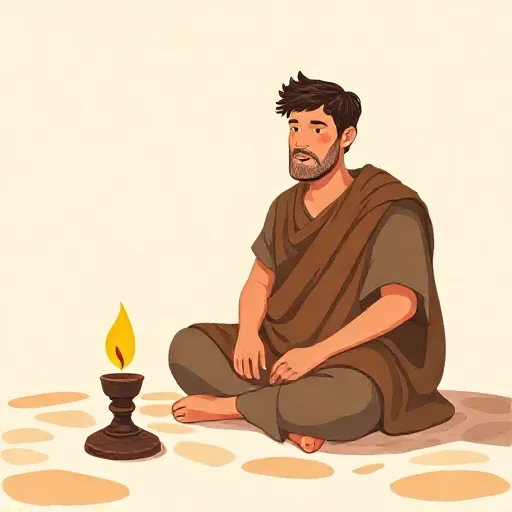
Proclus (412–485 AD) was the kind of thinker who turned his whole day into a careful ritual. Each morning at sunrise, he faced the rising sun and prayed. He repeated the prayer at noon and again at sunset. Then he lectured, held reading seminars, and wrote — an astonishing 700 lines a day, about 20 to 25 modern pages. His student Marinus tells us that Proclus barely slept, as if he were always chasing something just beyond the horizon.
He grew up in a wealthy family in what is now Turkey, originally planning to become a lawyer. But on a trip to Byzantium (modern Istanbul), he discovered philosophy, and it changed everything. At eighteen he arrived in Athens, drawn to the famous Platonic school, where he studied under Syrianus (died c. 437). Soon he became the school’s head and led it for nearly fifty years, though at one point he had to flee into exile for a year to avoid political trouble. For Proclus, philosophy was never just thinking — it was a way of living, a slow climb back toward the source of all things.
Everything from the One — How Can That Work?
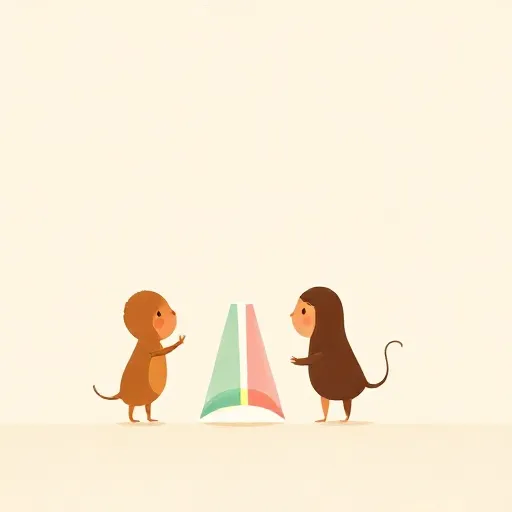
The puzzle that drove Proclus is one that could keep a twelve‑year‑old awake at night. The universe is full of countless different things — stars, stones, thoughts, frogs. How did all that variety begin? For Proclus, the answer could only be something utterly simple and completely unified. He called it the One. The One has no parts, no shape, no qualities you can name. It is not even “something,” because to be something is already to be a particular thing with limits. And yet, Proclus argued, the One is the source of everything else.
That sounds impossible. How can a single, simple cause produce so many different effects without itself having any pieces? Proclus introduced a new kind of being to solve this: henads (from the Greek word for “one”). Think of henads as divine “unities” — gods, in Proclus’s language — that stand between the untouchable One and the world we know. Each henad is a distinct unity, but all of them share in the One’s pure simplicity. They are like different rays of the same sun. The One itself remains completely untouched and unparticipated; the henads are the first things that can be joined or “participated” by what follows.
Proclus built much of his system around a three‑part pattern: remaining (a cause stays whole in itself), procession (something comes out from it), and reversion (the effect turns back toward its source). Picture a rubber band: it rests in your hand, stretches out, then snaps back because it always belongs to where it started. Everything that exists, Proclus believed, follows that rhythm — it flows out from a higher cause and naturally longs to return to it.
The Ladder of Reality: Henads, Intellect, Soul
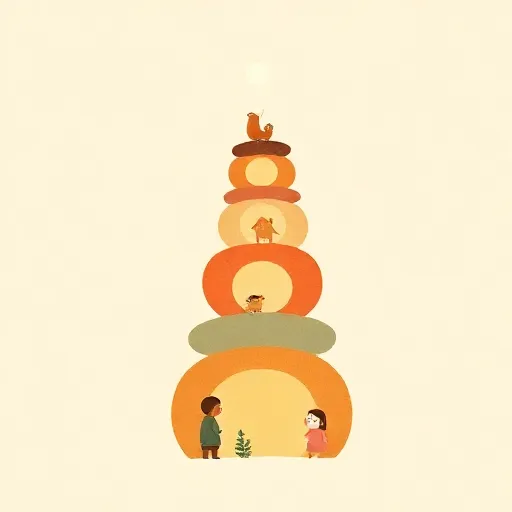
If the One is the peak, what comes next? Proclus imagined the whole of reality as a vast, orderly staircase. Just below the henads sits Intellect (he used the Greek nous), a realm of pure thinking and perfect Forms — the timeless blueprints of everything, like Justice itself or Triangularity. But Proclus split Intellect into three moments that interlock: Being (what is simply there), Life (the active energy that makes being unfold), and Intellect in the strict sense (the act of thinking that turns back and grasps Being and Life). This triad ripples through everything. Where earlier thinkers such as Plotinus (204/5–270 AD) kept Being, Life, and Intellect close together, Proclus gave each its own level and its own inner threefold structure.
Below Intellect comes Soul, which is the principle of life and motion. Soul gives bodies the ability to move, grow, and sense. Because soul belongs to the lower edge of the invisible realm, it can “descend” into a material body and still, through thinking, reach back upward. According to Proclus, every soul contains within itself built‑in reason‑principles (logoi) — copies of the Forms — that make knowledge possible. Learning, for him, is not stuffing new facts into an empty mind; it is recollection, waking up ideas that have been there all along.
At the very bottom is the physical world, a dim reflection of the higher ones. None of these steps could exist without the one above it. Proclus insisted that true causes must be incorporeal — not made of matter — because only something beyond bodies can give bodies their order and purpose. Matter itself is almost nothing: it receives being only from the forms that live inside it.
Why Do Bad Things Happen? Proclus on Evil
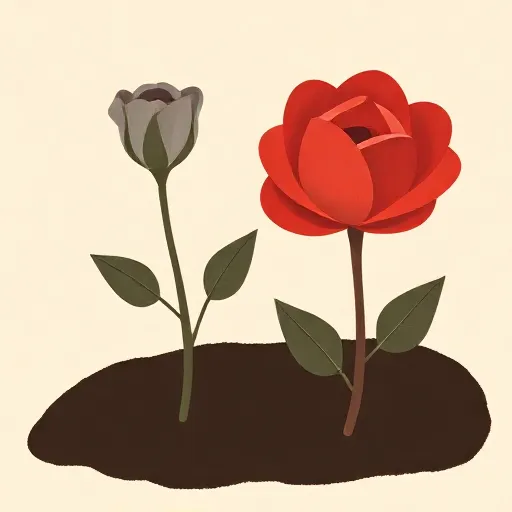
If the world flows from the One through divine henads and Intellect, how does evil sneak in? Proclus’s answer is surprising: evil does not really exist on its own. He called it a parhupostasis — a Greek word meaning “something that sits next to existence” or, to put it plainly, a parasitic existence. Evil is never the direct goal of any cause. It is an accidental by‑product, like a miscalculation in an otherwise beautiful piece of music, or the shadow a tree casts just because a light shines behind it. No tree intends to make a shadow; the shadow simply appears alongside what the tree actually does.
This meant that even when we make bad choices, nothing creates pure evil. A choice is a defect, a twist in something good. Proclus also faced the old problem of providence and free will: if the gods know the future, are our lives already scripted? He replied that a knower’s way of knowing depends on the knower, not on the thing known. A god sees your future choices not as future — the god sees them in a timeless, unified way. That does not force your hand any more than a bird’s‑eye view of a maze forces a runner to turn left instead of right.
Theurgy: Climbing Back to the One
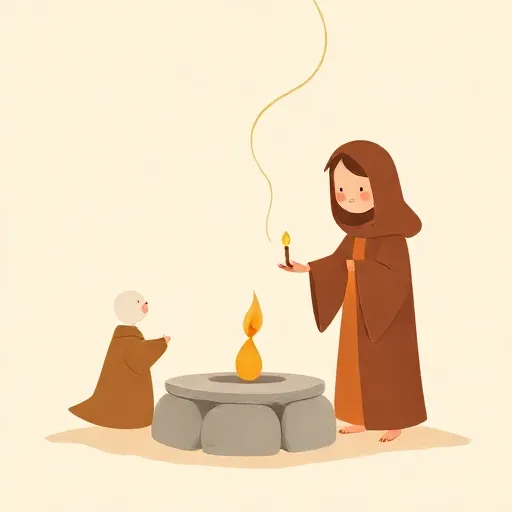
Thinking hard about the One is not enough; Proclus believed the soul also needs a practice called theurgy (theourgia), which means “work of the gods.” Theurgy consisted of sacred rites, hymns, invocations, and the careful use of symbols (stones, plants, images) that secretly correspond to higher divine powers. The idea rests on a principle Proclus took very seriously: “all things are in all things.” Because everything is linked to everything else by hidden threads of sympathy, a small action down here — lighting a lamp, chanting a divine name — can tug on a chain that reaches up to a henad or even beyond.
Proclus distinguished three kinds of theurgy. The first worked with physical objects and statues to obtain oracles or healing. The second helped the soul rise to the level of the gods above the cosmos. The third aimed directly at union with the One itself. At this highest stage, words fall away. Proclus even spoke of faith (pistis) — not a belief in doctrines, but a silent, steady trust that lets the soul close its eyes and rest in the divine light. For him, this was not a retreat from philosophy; it was philosophy’s ultimate fruit.
Why Proclus Still Matters (Even If You’ve Never Heard of Him)
You might never have come across Proclus’s name before, but his ideas traveled far. A Christian writer who called himself Dionysius the Areopagite (around 500 AD) absorbed huge chunks of Proclus’s thought and disguised them as the work of a follower of Saint Paul. That gave Proclus’s metaphysics a backstage pass into medieval Christian theology. Later, an Arabic textbook called the Book of Causes — actually a reworking of Proclus’s Elements of Theology — was translated into Latin and studied under Aristotle’s name. Thomas Aquinas (1225–1274) was one of the first to realize where it truly came from, and he still took it seriously.
Proclus’s fingerprints are all over big questions you might wonder about today. When you ask whether the universe must have a single, simple ground or whether everything can just unfold without one, you are stepping into his territory. When you wonder if evil is a real force or just a twisted absence of something good, you are wrestling with his notion of parasitic existence. And when you notice that learning sometimes feels less like cramming and more like remembering something you already knew, you are brushing against his theory of innate knowledge.
Think about it
- If everything comes from one simple source, are you and a distant star connected in some way? Could a choice you make ripple outward more than you realize?
- Proclus thought evil is like a shadow — not a real thing, just a lack of goodness. Does that idea hold up when you think of something that feels truly bad? Try to imagine an example where the “badness” might really be the absence of something good.
- The theurgists believed that certain rituals could bring them closer to the divine. Without any gods or spirits, could a special daily habit — like walking in the woods or pausing to watch the sunrise — give you a similar sense of being connected to everything?