
Do You Have the Right to Chase Happiness?
A Parchment That Changed the World
In the sweltering summer of 1776, a tall, red-haired man named Thomas Jefferson (1743–1826) rented a small room in Philadelphia. For over two weeks he sat alone, scratching words onto a piece of parchment. Those words began a revolution.
“All men are created equal,” he wrote. He declared that every person is born with rights that no government can take away: life, liberty, and the pursuit of happiness.
It was not a polite letter. It was a declaration of independence from the king of England — and a powerful, controversial claim about how all people everywhere ought to be treated. But the man who wrote those words owned over a hundred enslaved people. How could someone hold those two things together? That tension is the heart of Jefferson’s story, and it’s a puzzle about justice and fairness we still argue about today.
The Ground Rules: Why Government Even Exists
Jefferson did not invent this vision out of thin air. He built heavily on the ideas of English philosopher John Locke (1632–1704), who argued that people are born with natural rights — rights you have simply because you are human, not because any ruler gave them to you. The most basic ones, Jefferson said, are life, liberty, and the right to chase whatever makes your life full and happy.
If you have those rights just by being born, then government is not a boss. It’s more like a caretaker that you hire. Jefferson called this the consent of the governed. A government gets its only just power when the people agree to give it power, and it is supposed to use that power strictly to protect everyone’s rights. If it fails, and especially if it keeps on failing for a long time, the people have a right — even a duty — to throw it off and start fresh.
This idea was not just a theory. Jefferson spelled it out bluntly in the Declaration of Independence. He listed a long train of abuses by the British king, treating them not as random mistakes but as proof of a deliberate plan to crush the colonists’ freedom. For Jefferson, a government that repeatedly tramples rights is not a government at all anymore — it’s a despotism, and the people have a right to revolution.
A Government That Actually Listens
So what should a good government look like once the dust settles? Jefferson spent decades trying to nail that down. Around 1816 he finally put his core idea into one sharp sentence, which he called his “mother principle”: “Governments are republican only in proportion as they embody the will of their people, and execute it.”
Let that sink in. A republic, for Jefferson, was not just a country with elections and a president. It was a government that acts out the actual wishes of its citizens — not the wishes of kings, priests, or the richest one percent. He insisted that every citizen should have a real voice, either directly in local matters or through representatives they could choose and, importantly, throw out quickly if those representatives stopped listening.
But people change. The world changes. So Jefferson had an extraordinary idea: no generation should be able to handcuff the future. He called the living only temporary renters of the earth, using a legal word usufruct — meaning you may use something and enjoy its fruits, but you must pass it on in at least as good a shape as you received it. That meant debts and laws ought not to survive more than about nineteen years, the length he calculated for a single generation. A constitution, he argued, should be open to revision about every generation, so that the people’s will could stay fresh.
This is not just an old political footnote. The question of whether one generation can bind another is alive every time we debate long-term national debt, climate policy, or even which old laws still make sense. Jefferson was arguing that a healthy society needs to be a little uneasy — willing to update its own rules when they start to grind against what people actually believe and need.
Morality Without a Rulebook

If citizens are going to run their own lives and their own government, they need to know how to be good to one another. On this point, Jefferson’s thinking took a very different turn from someone like Locke.
Instead of treating morality as a set of rules you figure out by careful reasoning, Jefferson believed you are born with a moral sense. This is a capacity to feel right and wrong in the same immediate way you see a color or hear a sound. He called it “conscience” in letters to his children, and he insisted that it works best when you don’t overthink it — that reasoning often just gets in the way and lets you talk yourself into bad behavior.
He advised his nephew not to bother attending lectures on moral philosophy. The real trick, Jefferson thought, was to imagine always that the whole world is watching, and to pick moral heroes — people whose example you trust — to help guide your feelings. If someone lacks a working moral sense, he admitted, you can try to teach them to imitate good action using calculation and reward, but that would only make them act as if they were moral, not make them actually moral from the heart.
Where does this moral sense come from? Jefferson pointed to nature, or what he called “nature’s God.” He respected Jesus as the greatest moral teacher, though he cut out anything miraculous from the New Testament — he believed Jesus’ real message was simply love of God and love of neighbor. At the same time, he firmly believed that an atheist could still behave with perfect honesty and kindness. The difference, he thought, was that a religious person sees God’s hand in the goodness, while an atheist doesn’t, but they both can do the same good. It’s a subtle point that still makes philosophers argue: is being morally correct the same as behaving correctly?
The Man and the Contradiction
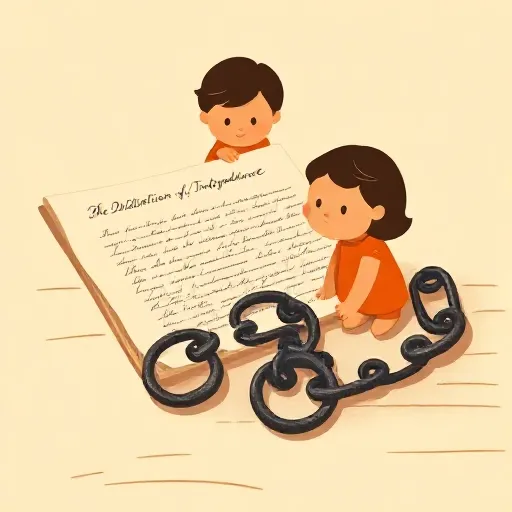
Now we have to face the hardest part. The same Jefferson who wrote “all men are created equal” was a Virginia slaveholder. In his book Notes on the State of Virginia, he listed what he admitted were only “suspicions” — that Black people were probably inferior to whites in reason and imagination, though fully equal in moral feeling. He thought Native Americans, with proper education, could be integrated into the new republic, but he believed Black people, because of the long horrors of slavery, could not live safely and freely alongside whites without decades of conflict. His solution was to propose that all enslaved people be educated, freed, and then sent away from the United States.
Many of his contemporaries, including leading scientists and philosophers like David Hume and the biologist Carl Linnaeus, openly claimed that non-Europeans were naturally inferior. Jefferson shared much of their ignorance, but he also saw the deep evil of slavery itself. As a lawyer he took on cases for enslaved people seeking freedom — and lost. He repeatedly called for slavery’s abolition. Yet as he aged, he said the time was not right, and he left the hard work to a younger generation. He freed only a handful of the people he owned during his lifetime.
This is not a happy ending. It’s a living question. If a founding thinker was so deeply wrong about something so important, does that ruin his whole philosophy? Or can we separate the ideas of equality, rights, and self-government from the deeply unequal man who held them? Philosophers and historians argue this fiercely, and there’s no simple answer.
Why His Big Fight Is Still Yours

For all his flaws, Jefferson planted questions that won’t go away. He believed that a free society only works if ordinary people have enough education, reliable information, and a real voice. That’s why he fought for a system of public schools in Virginia — he called it the most important bill he ever drafted — and why he founded the University of Virginia.
Every time you hear an argument about who gets to vote, whether a protest goes too far, what a school board should decide, or how we deal with an unjust law, you’re stepping into the same debate. Jefferson didn’t give us a finished blueprint. He gave us a set of tools: the idea that rights come before governments, that laws should expire when they stop serving living people, and that a quiet inner feeling might be a better moral compass than a thousand official rules.
The challenge he left behind is hardest and most real. The country he helped build still struggles to make “all men are created equal” actually true for everyone. That struggle is now yours to understand — and maybe yours to carry.
Think about it
- Jefferson thought you should feel right and wrong without a lot of reasoning. Can you think of a time when your gut feeling and your careful thinking disagreed? Which one did you trust, and why?
- If a government repeatedly breaks its own promises to protect people’s rights, at what point do you think citizens have a right to overthrow it? How many violations would be enough?
- Jefferson’s ideas about equality didn’t stop him from enslaving people. Can we keep using the good ideas from a thinker who did terrible things, or do the terrible things poison everything they wrote?