Who Owns Your Brilliant Idea? A 2,500-Year-Old Question
The Chef Who Patented a Dish (or Almost)
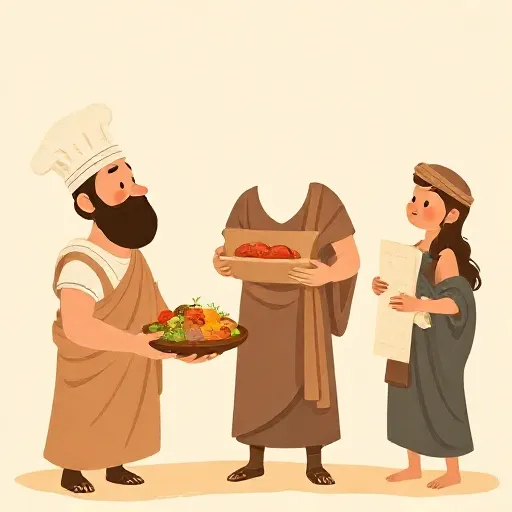
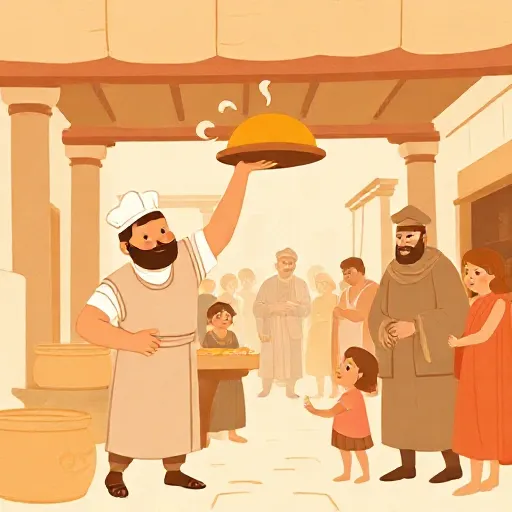
Imagine you’ve just invented the world’s most delicious cookie — crispy outside, gooey-chocolate inside. Your city says, “For the next year, only you can bake and sell these. If anyone else copies, they will be fined.” That actually happened more than 2,500 years ago. In the Greek colony of Sybaris around 500 B.C.E., chefs who created a new culinary delight were given a year-long monopoly — the exclusive right to produce and sell it. It was one of the earliest known attempts to treat an idea as a kind of property.
The ancient world had a few other sparks. The Roman architect Vitruvius (c. 257–180 B.C.E.) once served as a judge in a literary contest in Alexandria and exposed contestants who had stolen others’ words. The poet Martial (first century C.E.) complained about a man named Fidentinus reciting his poems without credit. But no actual Roman law protected such works. Instead, inventors and artists got royal favors or special privileges — grants that took something from the public domain and handed it to a favored person. A real intellectual property system, scholars argue, is different: it gives a creator rights over something new that did not exist before, so the public loses nothing it already had.
The first true patent law appeared in the Republic of Florence in 1421, for the famous architect Filippo Brunelleschi. His design for a ship to transport marble was considered so clever that the city gave him an exclusive right to use it, along with a built-in reward — an early version of the incentive models we still use. The Venetian Republic went further in 1474, creating a sophisticated statute that recognized inventors’ rights, offered compensation for infringement, and set a time limit. That idea crossed into England: the Statute of Monopolies in 1624 gave 14-year monopolies to authors and inventors for genuine new works, not things already known. Then, in 1710, the Statute of Anne gave book authors a 14-year copyright, renewable if they were still alive, aiming to “encourage learned men to compose and write useful books.” Over time, these rules spread and now cover most of the globe through international agreements.
What Can You Actually Own? Copyright, Patents, and Secrets
Today, intellectual property (IP) covers several kinds of creations, each with its own rules. The main types are copyright, patent, trade secret, and trademark. Plus, in many European countries, the law also protects moral rights (droits morals), which are about the creator’s personal connection to the work.
Copyright protects original works of authorship once they are fixed in a tangible form. That means a song, a poem, a movie, a computer program, a photograph — anything creative that you can write down, record, or save. Protection does not cover the ideas themselves, only the specific expression. You cannot copyright a short phrase or a title, because it does not have enough original authorship. Copyright owners get five exclusive rights: to reproduce the work, to adapt it, to distribute copies, to display it publicly, and to perform it. In the United States, these rights generally last for the author’s lifetime plus 70 years. Important limits exist: fair use lets you quote small bits for criticism, news, teaching, or research; and the first sale rule means that once a copy is sold, you can resell it or give it away. If two people independently write the exact same poem, both can hold a copyright — no one has a monopoly over the idea.
Patents are stronger and stricter. They protect any new, useful, and nonobvious process, machine, manufactured article, or composition of matter (and certain plants). To get a patent, you must fully disclose how the invention works. In return, you get a 20-year exclusive right to make, use, or sell it. Nobody else can market the same invention, even if they thought of it independently — that’s a major difference from copyright. The invention must pass three tests: usefulness (it does what it is supposed to do), novelty (it was not already public knowledge), and non-obviousness (it would not be an obvious next step to an expert in the field). For example, you cannot patent the ancient formula for stained glass, even if you discovered it on your own.
Trade secrets are almost anything valuable that a business keeps confidential: a recipe, a manufacturing method, a customer list. They do not expire as long as the secret is maintained. But if the secret is lawfully discovered independently or accidentally becomes public, protection disappears. Courts can punish misappropriation — someone stealing a secret and posting it online, for instance.
Trademarks protect words, names, or symbols that identify a brand, like the Nike swoosh. The right can last forever unless the mark becomes the common name for a product — like “aspirin,” which was once a trademark.
Moral rights let a creator be named as the author, prevent distorting or destroying the work, and sometimes even withdraw it from public circulation. These rights belong to the creator regardless of who owns the economic rights.
Why Should Ideas Be Treated Like Property?
Why give anyone such powerful controls over something that can be copied without being used up? Three main arguments — plus a newer one — have shaped the debate.
The personality view The German philosopher G.W.F. Hegel (1770–1831) argued that creative works are extensions of the creator’s personality. When you paint a picture or write a story, you pour part of yourself into it. Controlling the object lets you express your freedom and develop your own character. On this view, defacing someone’s painting without permission is wrong not just for economic loss, but because it distorts who that person is. Critics note that many inventions — a list of customers, for instance — show little personality, so this view may not justify all IP. Still, it captures a strong intuition: if someone draws mustaches on a painting you made, most people feel a violation that goes beyond money.
The incentive (utilitarian) view Most Anglo-American law rests on a practical idea: giving creators limited monopolies encourages them to keep inventing and making art. Without the promise of a reward, someone might not spend ten years developing a new medicine or months writing a novel, because others could instantly copy the result and undersell them. This view does not claim IP is a natural right; it claims society as a whole is better off if we grant these temporary controls. The big debate is whether evidence actually shows this works. Some economists argue IP protection sparks innovation; others say trade secrecy, being first to market, or government-funded prizes could do the job without monopolies. The question is still unsettled.
John Locke’s labor argument The English philosopher John Locke (1632–1704) famously argued that you own your own body and your labor. If you mix your labor with something unowned — clearing a field or inventing a recipe — you gain a property right in it, as long as you leave “enough and as good” for others and do not let anything go to waste. For ideas, waste is not an issue (ideas do not rot), and creating a new recipe usually does not stop anyone else from inventing their own. So, prima facie, you might deserve ownership. Many philosophers challenge this: they say labor is not literally mixed with an idea, and all inventions borrow from shared knowledge. Yet a modern version says: if your creation makes no one worse off, you have at least a strong moral claim. Imagine Ginger invents a spicy noodle recipe after weeks of trial. Almost everyone would agree she has some right to decide who uses it, at least at first.
The prisoner’s dilemma of copying Imagine two friends, Beren and Lúthien, each make a new video game. If both share their games and let the other copy freely, each gets to play both but earns no income. If one copies while the other holds back, the copier gains an advantage. If both withhold and neither copies, they can still sell their games to each other. The worst outcome for everyone is a world where everyone copies everything, because then nobody can afford to make new games at all. In this scenario, it is in everyone’s rational self‑interest to agree to some kind of intellectual property rules — not out of fairness, but out of prudence.
But Wait—Powerful Arguments Against Owning Ideas
Despite these justifications, many thinkers argue that intellectual property is a mistake. Here are the most important objections.
Information is non-rivalrous. When you take my bike, I no longer have it. But when you copy my song, I still have my original file. Information can be used by countless people at the same time. So why restrict it? One reply is that the same is true of your private diary or medical records: non‑rivalry alone does not mean everyone has a right to access them. The real harm of unauthorized copying is not that the owner loses the original, but that they lose control over who uses it and may lose income they could have earned from selling copies.
Free speech and the right to know. Copyright and patents restrict what you can express and build. If a critic cannot quote a novel without permission, debate shrinks. Trade secrets can hide important knowledge. However, copyright law has a built‑in idea/expression rule: you cannot own the underlying ideas, only your unique way of writing or filming them. So you are free to rewrite Einstein’s theory of relativity in your own words. And fair use allows limited copying for education, news, and parody.
Ideas are social products. Every invention and story builds on the shared knowledge, language, and culture of a community. If we all contributed to the “bricks” of knowledge, how can one person claim ownership of the wall? Critics answer that we already pay for our share of that collective knowledge through education and taxes, and that this argument, if pushed, would also deny students credit for their own hard work — something few people want to do.
Digital costs. Copying a digital song or e‑book costs almost nothing per user. Some say the price should therefore be close to zero. But that ignores the enormous upfront costs of creating the music or writing the book — costs that must be recovered if creators are to keep creating.
The liberty objection. IP laws restrict what you can do with your own stuff: you cannot legally use your printer to copy a textbook you bought and sell the copies. But all laws limit liberty in some way; you are not allowed to punch someone with your own fist either. The question is whether IP restrictions are a reasonable trade‑off.
None of these critiques have ended the argument, but they have shaped where lines are drawn — pushing for shorter copyright terms, broader fair use, and exceptions like the Creative Commons licensing movement.
So Who Decides? What It Means for You Today
You might think all this belongs in dusty law books, but it is right in your pocket. When you sample a song in a TikTok video, or download a PDF of a manga that has not been officially translated, you are living inside this debate. The same arguments that began with a Greek chef now shape whether you can share your fan art online, copy a homework‑helper program, or build on someone else’s open‑source code. The bright side: the system is not set in stone. New models like Creative Commons let creators say “yes, you can share, as long as you credit me” without giving up all rights. The ancient question — who owns an idea? — is still being answered, and you are part of that story.
Think about it
- If you spent months creating an original comic, would it be fair for someone to sell copies without paying you? What if they were giving copies away for free?
- Suppose scientists invent a life‑saving medicine. Should they be allowed to charge a high price to recover their costs, or should the formula be shared with everyone regardless? Who should decide?
- Is there a difference between downloading a song your friend already bought and sneaking into a movie theater without a ticket? Why or why not?