A Universe That Never Began? Averroes' Dangerous Idea
The Burning Book and a Forbidden Idea

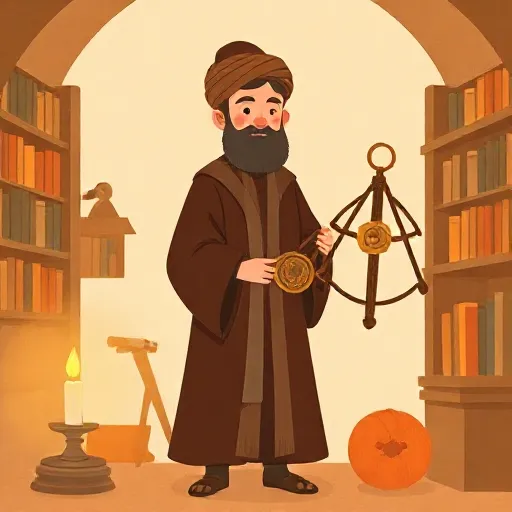
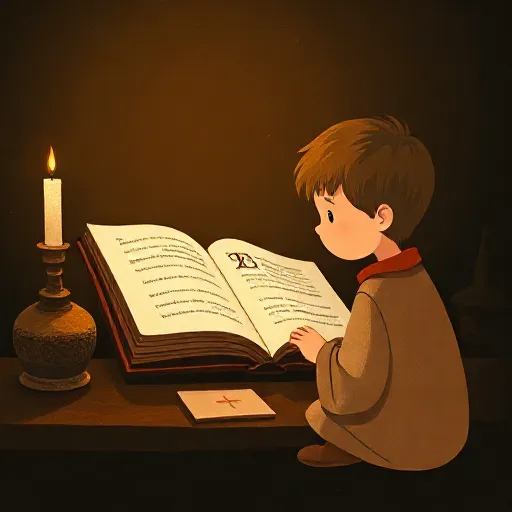
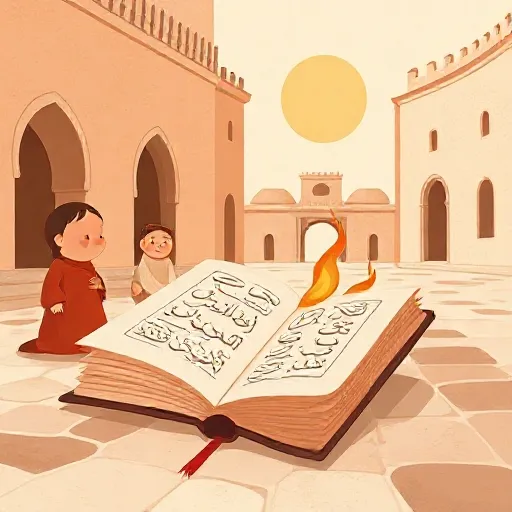
One morning in 1195, copies of a book written by the judge and physician Ibn Rushd — known in the West as Averroes (1126–1198) — were dragged into the streets of Córdoba and set on fire. The city’s religious scholars said his ideas were dangerous. They were furious because Averroes believed something that sounded impossible: the universe had no beginning. It had always been here.
For Averroes, this was not just a wild guess. It was the conclusion of a lifetime spent studying natural philosophy — what we would now call physics and the science of the natural world. Following Aristotle (384–322 BCE), Averroes argued that the study of nature deals with everything that changes, from a falling leaf to a growing child. And he insisted that when you truly understand the way things move and change, you grasp something that can make your mind complete. Philosophy, he wrote, “the perfect acquisition of the theoretical sciences brings man to his ultimate perfection and entire essence”. It is the only road to genuine happiness. The book‑burners thought this was a threat to religion. Averroes believed it was its deepest ally.
Nothing Comes from Nothing
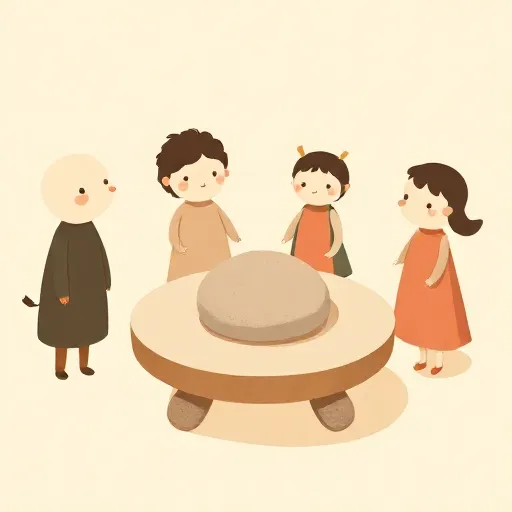
If the universe had a first moment, then before that moment there was absolutely nothing. But can anything really come from nothing? Averroes thought the answer was a firm no. He pointed out that Aristotle and all the ancient thinkers agreed that whenever something new appears, there has to be something underneath that stays and takes on a new shape. You cannot bake a cake without flour, eggs, and sugar. You cannot make a statue without a block of marble. In the same way, every natural change needs an underlying subject — something that is there before, during, and after the change.
Averroes called this underlying subject Prime Matter (or first hyle). It is not a body you can see. It has no colour, no heat, no size. It is pure potential — a sort of shapeless “stuff” that can receive any form but never disappears. A seed becomes a tree; the matter was already there, just in a different arrangement. If God were to create the world out of absolute nothing, Averroes argued, there would be no subject at all — and that, he thought, was logically impossible. The Muslim theologians of his day, known as the Ash‘arites, insisted that God does create from nothing, because divine power has no limits. Averroes called this a bad habit of speech: people had repeated it so often that they forgot to think about what “nothing” actually means.
The Eternal Dance of Motion
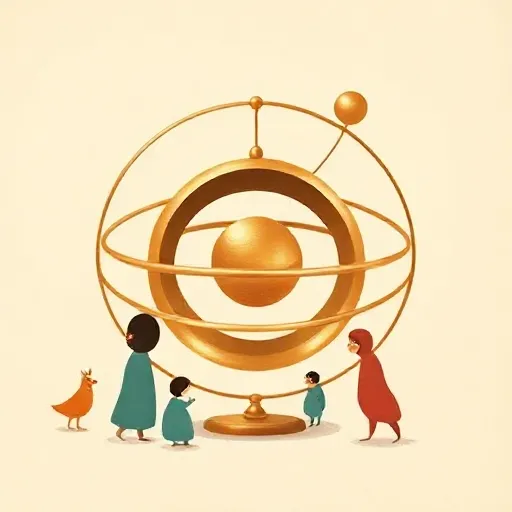
The Ash‘arites had another argument. If you try to count backwards through every change that ever happened — every tick of time, every falling leaf — you would never reach a starting point. An infinite chain of past events is impossible, they said, so there must have been a very first motion, a beginning that God brought into being. At first glance, this seems to trap Averroes. Maybe motion did have a birthday after all.
But Averroes spent years wrestling with Aristotle’s Physics and arrived at a different picture. He realized that “before” and “after” work differently for different kinds of motion. Think of a spinning wheel. The wheel itself can turn forever without a first push. The individual spokes that pass a mark — one after another — form a sequence, but that sequence is just an accident of the wheel’s single, continuous rotation. The sequence of spoken‑by‑spoke events is what Averroes called accidental (per accidens). The wheel’s rotation itself is essential (per se) — it is the real, permanent motion that makes the accidents possible.
For Averroes, the whole universe works the same way. The outermost heaven is in eternal circular motion, like a cosmic spinning wheel. The coming‑to‑be and passing‑away of things on Earth — a baby elephant being born, a campfire burning out — are just accidental parts of that one grand, unbroken turn. So when a theologian says “an endless chain of past events is impossible,” Averroes replies: the chain is accidental; the essential motion behind it has no first link. It just is, and it always has been.
The Unmoved Mover
Still, Averroes knew that even an eternal motion needs an explanation. If the heavens spin forever, what keeps them going? Aristotle had already shown that no finite body can cause motion for an infinite amount of time. A horse can pull a cart for a few hours, but not for eternity. A finite engine must eventually run out of power.
So the cause of the eternal spinning cannot be material at all. It must have infinite power, and since no body — not even the huge celestial sphere — can hold infinite power, the cause must be something non‑physical. Averroes called this the First Mover. It is pure activity with no matter, no parts, and no size. It does not push like a hand; it moves things by being the ultimate goal of their motion, like a perfect work of art draws a sculptor to create.
Averroes admitted that figuring this out took him “great pains and no small part of my life.” The tricky problem was the heavenly sphere itself: if it is a limited, finite body, how can its motion be eternal? His solution was to say that the celestial sphere is not composed of matter and form the way things on Earth are. It is simple, immaterial form — so its power to be moved never wears out. The First Mover, however, is even beyond that: it is the pure, incorporeal source that keeps the whole cosmic dance alive without ever being changed by it.
Why It Still Matters
In the 21st century, scientists talk about a Big Bang — a moment roughly 13.8 billion years ago when everything we see began expanding from an incredibly dense state. Does that settle the argument? Not quite. The Big Bang describes how the universe developed from that state onward, but it does not tell us whether something existed before, or whether “before” is even a meaningful word. Philosophers and physicists still ask: could there be a cause that is not in time? Is it possible for something to come from literally nothing? These are exactly the questions that made Averroes’ books burn eight hundred years ago.
Averroes himself would probably smile at the modern debate — and then pick up a copy of Aristotle. He believed that reason and faith do not have to fight. The same God that believers worship, he argued, is the First Mover that keeps the universe in motion. The burning of his books did not silence him. His ideas were later translated into Latin and Hebrew, and they helped shape Jewish and Christian philosophy for centuries, sparking fresh arguments about the eternity of the world in universities like Paris and Oxford. Every time you look up at the night sky and wonder whether it has always been there, you are stepping into a conversation that Averroes helped to start.
Think about it
- If you had to prove the universe had no beginning, what kind of evidence would you look for? Could you ever be certain you found it?
- Imagine a world where everything new requires a physical cause. Is it harder to believe in a very first moment, or in a chain of causes that has always been going?
- Does it matter for how you live your life whether the universe had a beginning, or is that question just a puzzle for scientists and philosophers?