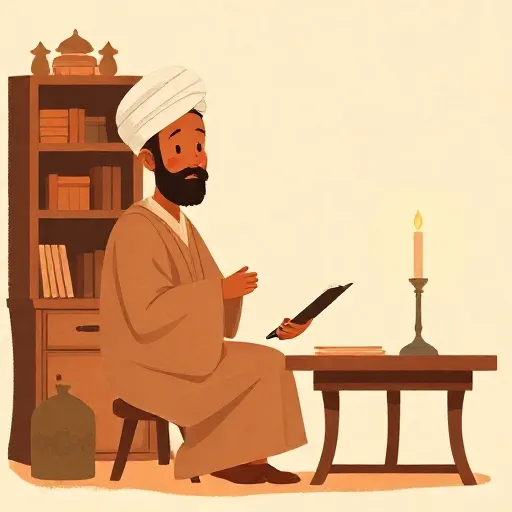

Can You Trust Both the Qur’an and Aristotle? Ibn Rushd Said Yes.
The Judge and the Caliph’s Question

In 1168, a 42-year-old judge named Ibn Rushd (1126–1198) was summoned from Cordova to the Almohad caliph’s palace in Marrakesh. The caliph, Abū Yaʿqūb Yūsuf, had an unexpected request: explain the works of the ancient Greek philosopher Aristotle so that educated Muslims could understand them. Ibn Rushd accepted, and that task became his life’s work. Over the next three decades he wrote dozens of commentaries on Aristotle, from short summaries to massive line-by-line explanations. He also defended the bold idea that philosophy—using your reason to study the world—is not opposed to Islam, but is actually required by it.
In Ibn Rushd’s day, many religious scholars thought philosophy was dangerous. They worried that Greek ideas would undermine faith. Ibn Rushd disagreed. He believed that demonstration—the most rigorous kind of logical proof—leads to certainty, and that God’s creation, studied carefully, can never conflict with God’s word. His famous phrase sums it up: “Truth does not oppose truth, but rather agrees with and bears witness to it.”
One Truth Under Two Names

In his short but powerful book The Decisive Treatise, Ibn Rushd argued that Islamic law itself commands those who are able to study philosophy to do so. He noted that the Qurʾān urges believers to reflect on the natural world as a sign of God’s wisdom. That kind of reflection, he said, is exactly what philosophers do. The difference is only in method: most people are persuaded by rhetoric or dialectic, but a few can follow demonstrative arguments that give absolute certainty. The Qurʾān works for everyone; philosophy works for those with the training and ability.
If a philosopher ever seems to reach a conclusion at odds with scripture, Ibn Rushd insisted that the apparent conflict comes from a mistake in reasoning or from interpreting the holy text too literally. Scripture often uses symbols and images, he explained, because it must speak to ordinary people. The philosopher’s job is to uncover the hidden meanings, not to discard the text. This view gave scholars permission to study Aristotle without feeling they were betraying their faith. It also created a framework for natural theology: using reason to learn about God from the world around us.
Did the World Always Exist?

One of the hottest debates of Ibn Rushd’s time was whether the universe had a beginning. Most theologians said God created the world out of nothing, at a moment in the past. Ibn Rushd, following Aristotle, held that the world is eternal—it has always existed and always will. That sounded shocking, but he thought it followed from the nature of God.
Ibn Rushd distinguished between two kinds of causal chains. An essentially ordered chain is like a hand pushing a stick that pushes a stone: if the hand stops, everything stops at once. An accidentally ordered chain extends over time, like a series of rains, clouds, and vapors that cycle endlessly. The universe, he said, is an accidentally ordered chain stretching infinitely backward, so there is no first moment. Even so, the entire system depends on a First Cause that is essentially ordering it right now—an unchanging, immaterial mover.
Why must the First Cause be eternal? Ibn Rushd reasoned that if God is completely perfect and changeless, God cannot suddenly decide to create after an eternity of not creating. That would be a change, and a perfect being doesn’t change. So creation must be eternal, too. The heavenly spheres—the sun, moon, and stars—move in ceaseless, joyful circles, and their motion sustains all life below. This idea challenged literal readings of scripture but preserved a central role for God as the ultimate source of existence.
The Shared Mind

Ibn Rushd’s most controversial theory concerned the human intellect. You might think your thinking is your own, happening inside your brain. Ibn Rushd agreed that your senses, imagination, and memory are individual and tied to your body. But when you grasp a universal concept—like the idea of a triangle, or justice—you are using a power that cannot be physical. A physical organ, he argued, would be limited and unable to understand all bodies, so the material intellect that receives abstract ideas must be immaterial.
And here is the startling move: Ibn Rushd concluded that this immaterial intellect is not divided among people. It is one single, separate substance shared by all human beings. When you learn geometry, you are not building private concepts; you are connecting your personal imagination to a common intellect that contains the forms. This explains how teachers can transmit knowledge to students—they are literally putting their pupils in touch with the same intelligible objects.
His view is an early version of what some modern philosophers call the extended mind: the idea that our thinking system reaches beyond our individual organism. He knew it sounded strange. He himself once called it “repulsive,” but over years of study he came to believe no other theory could explain how we reason abstractly while remaining physical creatures. The shared intellect does not erase your individuality, because your memories, senses, and choices are still your own. But the act of understanding something universal is a participation in a single thinking power.
Why Ibn Rushd Still Matters

Ibn Rushd died in exile in 1198, having fallen out of favor with the Almohads. But his ideas traveled far. Jewish scholars translated his commentaries into Hebrew; Christian scholars in Europe read them in Latin. For centuries, he was simply “the Commentator,” the indispensable guide to Aristotle. Some of his views, like the unity of the intellect, were fiercely condemned by the Church, but his way of balancing philosophy and religion left a deep mark. Even today, thinkers in the Muslim world, in the West, and everywhere seek to follow his principle: that the search for truth, wherever it leads, is a form of worship.
When you find yourself wondering whether science conflicts with your beliefs, or whether it’s okay to question what you’ve been taught, you are walking a path Ibn Rushd helped clear. He shows that curiosity is not a threat to faith, and that the universe, studied honestly, can deepen your sense of awe. The best tribute to him is not to agree with everything he said, but to take his method seriously: use your reason carefully, trust that truth is unified, and never stop asking.
Think about it
- If a scientific discovery seems to contradict a religious teaching you grew up with, what steps could you take to figure out what to believe?
- Imagine that all humans really do share one universal intellect for understanding. Would that change how you think about learning something new or teaching a friend?
- Why might a ruler or community try to stop philosophers from asking questions? Can you think of situations today where free inquiry is discouraged?