
Is There a Double Truth? Isaac Albalag's Bold Idea
A Scholar’s Dangerous Translation
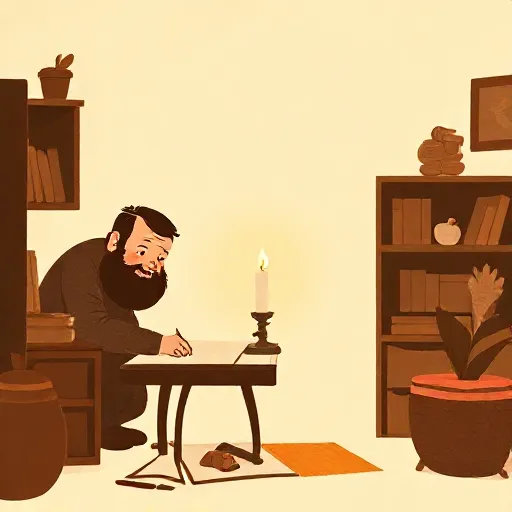
In the late 1200s, somewhere in Catalonia or Provence, a Jewish thinker named Isaac Albalag sat down with a book by a Muslim theologian. He planned to translate it and add his own comments. But he was not just a translator. He was a philosophical firefighter. He believed many smart people had misunderstood the greatest philosopher, Aristotle. Albalag wanted to fix those mistakes. His work led him to a shocking idea. A single claim could be true in philosophy and false in religion. Yet both could be held as “true” on each side.
Albalag (13th century) wrote only one book, the Tiqqun ha-Deʿot (The Emendation of the Opinions). In it, he translated part of al-Ghazali’s (1058–1111) summary of philosophy. Then he added his own corrections. His goal? To restore what he saw as Aristotle’s real teachings. For Albalag, the main villain was Avicenna (980–1037), a Persian philosopher. Albalag thought Avicenna had twisted Aristotle’s ideas. He used the works of Averroes (1126–1198), a Muslim commentator from Andalusia, as his guide to the true Aristotle.
Fixing Philosophy: The Long Way Back to Aristotle

Albalag’s main corrective tool was demonstration. This is a kind of proof that gives absolute certainty. If you have a demonstration, you do not just believe something. You know it with no room for doubt. For him, only Aristotle’s method from natural philosophy could properly prove God’s existence. Avicenna had a famous proof. It started from the ideas of “necessary existence” and “possible existence.” Albalag said that approach was wrong. Why? Because you cannot prove God inside the special science of metaphysics. You must start with motion in the physical world, just as Aristotle did.
This might sound like a dusty argument. But it had huge stakes. If you get the proof wrong, you might misunderstand God’s nature. Albalag thought Avicenna’s method led to mistakes. For example, it attributed human-style knowledge to God. For Albalag, God’s knowledge is so utterly different that human terms do not apply. He used the theory of equivocation. When we say God “knows” something, the word “knows” means something completely different from when a person knows. It shares only a name. This keeps God genuinely transcendent—beyond our full grasp.
The World: Eternal but Still Made?

One of Albalag’s boldest moves was his theory of eternal origination. Most Jewish thinkers of his time held that God created the world at a moment in the past. This is temporal creation. Aristotle seemed to say the world was eternal, having no beginning. Albalag split the difference. He argued the world has no temporal start. Yet it is still originated by God at every moment. Imagine a potter’s wheel that has always spun. At no time did a potter say, “Let there be a wheel.” But the spinning never stops depending on the potter’s continuous action. If the potter stopped, even for an instant, the wheel would vanish. For Albalag, the entire universe is like that wheel. Its motion proves it relies on a Prime Mover. This is a cause that is not a body or a force in a body. That Mover, he said, is the true creator.
This view made some people furious. Al-Ghazali had charged that philosophers who believe in an eternal world accidentally deny real creation. Albalag countered that temporal creation actually limits God. A perfect being, he reasoned, must act perfectly. And that means with no temporal bounds. An eternal act of creation fits God better. Albalag also claimed this eternal-origination idea was hidden inside the Torah’s deeper meanings. You just needed the right philosophical key to unlock it.
When Philosophy and Scripture Clash

Here we reach Albalag’s most famous and dangerous doctrine. It is the so-called double truth. He saw that a demonstrative philosophical conclusion can flatly contradict a plain reading of Scripture. What do you do then? Some philosophers, like Maimonides (1138–1204), tried to show the contradiction was only apparent. They reinterpreted Scripture to fit philosophy. Albalag thought this approach had failed. He said Maimonides and his followers harmed both faith and wisdom. They watered down philosophy to satisfy theology. And they forced meanings onto Scripture that the prophet never intended.
Albalag proposed a different rule. First, you seek truth through demonstration. That means through philosophy. Then you look for support in Scripture. If you find a knock-down philosophical proof that contradicts a biblical verse, you do not toss out either one. You accept both as “true.” The philosophical truth is true by reason and demonstration. The scriptural truth is true by prophetic authority and simple faith. They coexist, even though they point in opposite directions. Albalag applied this double truth mainly to the question of the world’s origin. He accepted both eternal origination, based on philosophy, and temporal creation, based on Scripture. This was a radical move. It suggested truth is not a single, tidy package.
The Prophet’s Secret Knowledge

How could a prophet know the opposite of what a philosopher demonstrates? Albalag had a distinctive answer. The common view was that prophets are super-philosophers with powerful imaginations. He rejected that. Instead, he said prophets have a completely different way of knowing. A philosopher starts with senses and works upward through reasoning. A prophet, in reverse, perceives sensory things through pure intelligibles directly from the divine realm. This makes prophetic knowledge qualitatively different. It is not just deeper; it is other. Imagine a climber who reaches a mountaintop by hiking. Compare that to someone lifted there by a flash of lightning. No wonder their reports can clash.
Albalag’s stance carved out a protected space for religion. Prophetic knowledge, he held, often stays hidden from non-prophets. So when a philosopher offers an allegorical reading of Scripture, they might just be guessing. The real inner meaning belongs to the prophet alone. This skeptical note kept Albalag’s double-truth approach from becoming a simple “philosophy wins” formula. Both discipline and mystery have a seat at the table.
Why This Still Matters

You have probably bumped into a version of Albalag’s problem. Maybe a science class taught you the universe began with a Big Bang. At home, you learned a different story about how everything started. One part of your mind accepts the scientific account. Another part treasures the family tradition. Can you honestly hold both? Albalag did not say it would be easy. But he believed a person could, with intellectual honesty, say “yes” to both domains. The key is that truths can serve different purposes. Philosophy aims for the mind’s perfection. Religion aims for a community’s well-being and the soul’s guidance. In Albalag’s scheme, the Torah’s commandments exist to build a just society. They are not a physics textbook.
Of course, people argued fiercely against him. Some accused him of heresy. Others admired his intellect. The double-truth doctrine has been picked apart for centuries. Did Albalag really mean it as a final position? Or was it a shield against persecution? We do not know for sure. But the question he raised will not go away. In a world where scientific and religious worldviews often point different ways, Albalag’s move feels fresh. He suggests that living with tension is not a failure of thought. It might be a sign of deep honesty.
Think about it
- If a scientist proves something that contradicts what your family has always believed, what should you do? Can both be right in some sense?
- Suppose two friends see a painting. One says, “It is beautiful.” The other says, “It is ugly.” Are both statements true? How is this like or unlike Albalag’s double truth?
- Is it ever okay to believe something based on faith alone, even if you cannot prove it? Where do you draw the line?