How Can You Be Free If God Already Knows Your Choice?
Two Lamps That Refuse to Burn Together

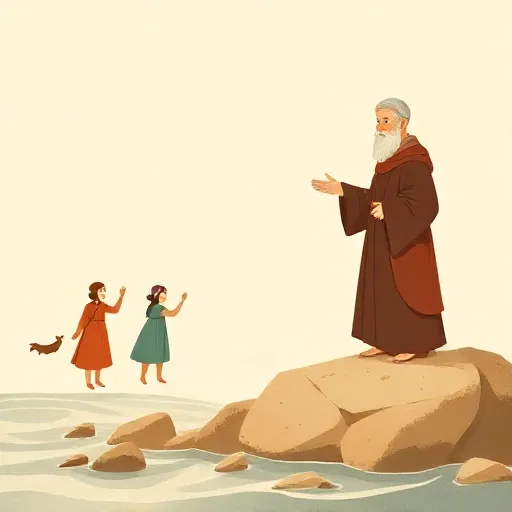
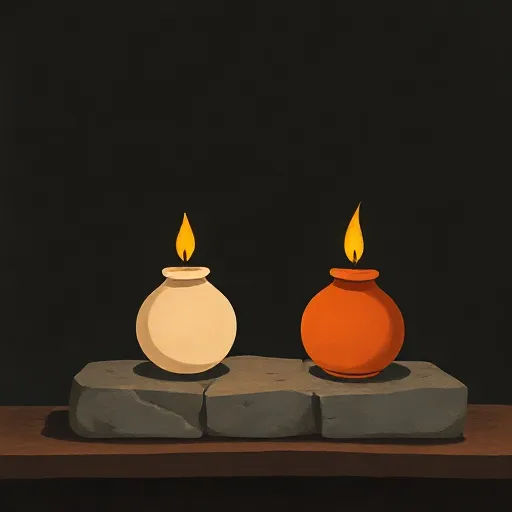
One evening in the year 1160, a rabbi named Abraham ibn Daud sat in his study in Toledo and stared at a stubborn problem. He had watched too many students try to light two lamps at once: the lamp of philosophy and the lamp of religion. Whenever they stoked the flame of reason — Aristotle’s logic, careful proofs, big questions — the lamp of religious faith flickered and went out. And when they held on tight to faith without thinking, the other lamp went dark instead.
Ibn Daud was sure that both lamps could burn. He wrote a book, Ha-Emunah ha-Ramah ( The Exalted Faith ), to prove it. His target was a puzzle that had tangled the brains of readers of the Hebrew Bible for centuries: some verses seem to say that God controls everything, while others insist that human beings make real choices and are responsible for them. How can both be true? Ibn Daud believed that philosophy — the love of wisdom, practiced with clear step-by-step reasoning — could show which verses to take literally and which needed a deeper explanation. The problem was urgent because ordinary Jews were losing their grip on their religion when they couldn’t solve it. And Ibn Daud thought that using your intellect was not a threat to faith; it was a duty.
Philosophy to the Rescue: A Plan for Harmony

To make his argument, Ibn Daud did something new in Jewish thought. Earlier Jewish thinkers like Saadya Gaon (882–942) or Solomon ibn Gabirol (1021–1058) had used philosophy, but Ibn Daud was the first to build a complete Jewish system out of the Aristotelianism taught by Muslim philosophers, especially al-Farabi (870–950) and Ibn Sina (980–1037). He even used the kind of strict, syllogistic arguments that looked like geometry proofs. Some readers later called his style cold and analytical, but he wanted precision, not poetry.
His book had three parts. First, he walked students through the basics of Aristotle’s physics and metaphysics (the study of what exists). Then, he discussed God, divine attributes, angels, prophecy, and the knot of free will. The last part was about ethics — how to live. In every chapter up to the one on prophecy, Ibn Daud would give the philosophical lesson first and then produce Bible verses that, in his view, confirmed it. After that, the verses became the heart of the discussion. He was showing, step by step, that true philosophy does not contradict revelation — it is already hidden inside Scripture.
What Is the Soul? A Real Substance, Not a Puff of Air

To understand how a human being can be free, Ibn Daud first needed to explain what a human being is. Everything that exists, he said, is either a substance (something that stands on its own, like a person or a rock) or an accident (something that belongs to a substance, like the color of that rock). He insisted, against earlier Jewish Platonists, that you can’t be both at once — a thing is either a substance or an accident, end of story.
This mattered because he wanted to prove that the soul is a substance, not a mere accident or a temporary mixture of bodily humors. If the soul were just an accident — like blushing or feeling cold — it would vanish when the body dies. But Ibn Daud argued that the human soul is a form, the organizing principle that makes a living body what it is, and that it contains a hierarchy of powers. The lowest powers (vegetative and animal) serve the highest: the speculative intellect, which reaches for knowledge of incorporeal things. That intellect can move from potentiality (being able to know) into actuality (actually knowing) with the help of higher minds, and once it becomes an acquired intellect, it no longer depends on the body. It survives.
So the soul is immortal, not because of a miracle, but because enough true knowledge turns it into an indestructible substance. Ibn Daud called this “the ultimate purpose” of bodies in the physical world: to purify immortal, rational souls.
If God Is Absolutely One, How Did Everything Else Appear?

A harder puzzle comes next. Ibn Daud’s God is a necessary being — a being whose very essence makes it exist, unlike everything else that is contingent and depends on a cause. God is also absolutely one: not just unique, but simple, without parts, not composed of anything. If that is true, how can a many-splendored world of stars, rocks, and people flow from something so simple without multiplying the divine essence?
The Muslim philosophers Ibn Daud read had a story for this: emanation. From the One, a first intelligence overflows; that intelligence, by thinking about God and about itself, produces a second intelligence, a sphere-soul, and a heavenly sphere. The chain repeats down to the sphere of the moon, where the Active Intellect — the lowest incorporeal intelligence — lives. All the variety we see in the lower world ultimately trickles down through these pure minds.
Ibn Daud accepted the chain but refused to call it a proven fact. He said the philosophers had no airtight demonstration for emanation, and he noted dryly that they “escaped from one defamation but fell into others.” He never resolved the clash between the emanation story and the Bible’s talk of God creating matter directly. On the big question of creation vs. eternity, he stayed vague, preferring to say that the human intellect is too limited to grasp how many things can come from the One.
He did, however, identify these incorporeal intelligences with the angels of Scripture. Angels became the middle managers of the universe — they run the day-to-day details, pass down knowledge, and ensure that God’s absolute oneness stays undisturbed. This allowed him to interpret Bible passages that seemed to show God changing his mind: those verses, he said, aren’t about God at all; they’re about the angels.
The Problem That Started It All: Free Will
Finally, near the end of the book, Ibn Daud turned to the question that had motivated him from page one. If God is the ultimate cause of everything, is God responsible for evil? No, he answered: good comes from God, but evil is a privation — an absence of good, like darkness is an absence of light. Physical evil is due to matter, which can block goodness. Moral evil comes from our own lack of knowledge and our failure to choose rightly.
The heart of his solution rests on a clever distinction. Some things are possible only because we are ignorant. If I don’t know whether the king of Babylon died today, the answer seems possible to me, but in reality it is already settled one way or the other. That’s not the kind of freedom Ibn Daud wants. The kind that matters he describes this way: God created certain things as genuinely possible, “something that admits of two contrary attributes.” A human being’s moral choice — between good and evil — is exactly that sort of created possibility.
Ibn Daud then borrows a fourfold scheme of causes he found in the poet Judah Halevi (c.1075–1141). Some events have necessary causes (they must happen), some have natural or accidental causes (handled by the angels and the spheres), and some have free causes, or causes of choice. Human moral decisions fall into the fourth box. And here is his most startling move: God does not have foreknowledge of what you will freely choose. If God knew your choice ahead of time, it wouldn’t be a real possibility — so God, he says, knows it as possible, not as settled. This is not ignorance, he insists; it’s just how possibility works.
After you choose, the angels assist you in carrying out your decision. That, Ibn Daud argues, is what the Bible means when it says God “hardened Pharaoh’s heart.” The angels didn’t force Pharaoh; they helped him persist in the evil choice he had already made on his own.
Using Your Brain to Serve God

Once free will is secured, Ibn Daud can explain what the best life looks like. Against the backdrop of Halevi’s worry that philosophers merely want to merge with the Active Intellect and don’t care which religion they practice, Ibn Daud builds a bridge from thought to action. True knowledge of God, he argues, produces love, and love naturally demands action — that means divine worship by keeping the commandments of the Torah.
His ethics follow both Plato and Aristotle, adapted from Muslim sources. The highest virtue is not wisdom, as Plato might have it, but justice. Justice balances the different parts of the soul and binds us to other people. It is also the reason we owe God worship: since only good flows from God, it is a matter of justice to require our benefactor by serving him.
This is why the study of philosophy is not an enemy of religion. Philosophy, correctly done, leads you to accept the commandments — even the ones whose purpose you can’t figure out — because you have already established through reason that they come from a true and morally perfect prophet. Ibn Daud’s whole enormous book, packed with physics and metaphysics, was ultimately a work of practical philosophy. It aimed to change how you live.
Think about it
- If a scientist could show that all your choices are caused by brain activity you don’t control, would it still be fair to punish people for doing wrong?
- Ibn Daud thought that learning truth about the world leads naturally to loving God and treating others justly. Can you think of a time when learning something made you a kinder or fairer person?
- If you had to choose between knowing all the answers ahead of time and being genuinely free to decide, which would you pick — and why?