Can Philosophy Settle Religious Fights?
A City of Disputes
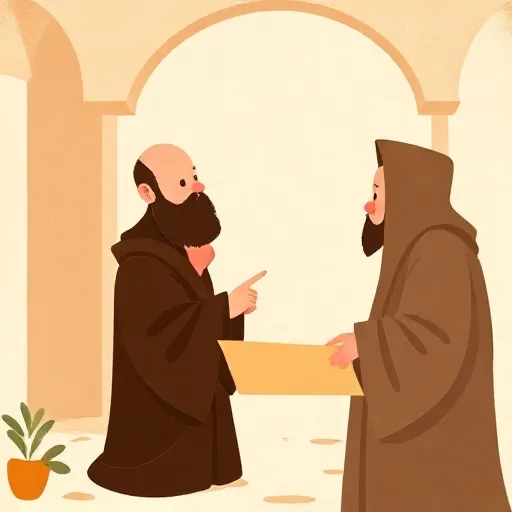
In the tenth century, Baghdad hummed with libraries and schools. Religious scholars argued fiercely about God: Was the world created in time or eternal? Does God have parts or separate attributes? What happens to the soul after death? But these debates, called kalām (dialectical theology), had a stubborn flaw. Each side could build a clever case, yet neither could knock down the other’s with unshakable proof. The arguments felt like a game of endless back‑and‑forth.
Abū Naṣr al‑Fārābī (c. 870–950), a Muslim philosopher from Central Asia, walked into this noisy room with a quiet, audacious claim. He said that if you want to settle the biggest religious questions, you need a much sharper tool than ordinary argument. You need the demonstrative method of Aristotle’s metaphysics — a special science of being itself. He dedicated his life to building that tool in Arabic, for his own world.
The Search for Indisputable Proof
Al‑Fārābī admired the ancient Greeks, especially Plato and Aristotle, but he believed their real knowledge had been damaged or lost in translation. He did not just write commentaries; he tried to rewrite Aristotle’s lost books as if the Greek master were speaking to a Muslim audience in Arabic. His goal was to revive metaphysics (literally, “what comes after physics”), the science that studies being as such — not just this or that kind of thing, but what it means for anything to be.
He claimed he was the first philosopher in the Muslim world to truly understand Aristotle’s Posterior Analytics, a work that explained how to build a chain of reasoning that starts from rock‑solid principles and leads to unavoidable conclusions. Such demonstrative proof, al‑Fārābī thought, could end the endless quarrels of kalām. It would establish truths about God, the soul, and the world that any rational person would have to accept — not because of faith or tradition, but because the logic forced their hand.
What Does “Is” Really Mean?

But before you can prove anything about God, you have to be brutally clear about the words you use. Al‑Fārābī noticed a sneaky trap in the Arabic word for being or existence — mawjūd. It looks grammatically like a word for an accident, something like “white” suggests a whiteness that sits in a thing. That might trick you into thinking that for a thing to exist, it must have an extra accident called existence (wujūd) attached to it. Then you would imagine existence as a little ghost‑property that gets added to a thing — and that leads to plenty of nonsense.
So al‑Fārābī carefully distinguished several senses of being. First, there is being‑as‑true. A thought in your mind (say, your idea of an apple) is true if there really is an apple outside your mind that matches it. Here “being” is about the relation between a concept and reality, not a quality of the apple itself. Second, there is being‑as‑having‑a‑quiddity — a real thing defined by a quiddity, its “what‑it‑is‑ness.” When you ask what a horse is and give its definition, you are describing the quiddity that fixes it as a horse. For al‑Fārābī, the existence of a composite thing like a horse is its quiddity (or parts of that quiddity). Existence is not a mysterious extra layer glued onto things. This careful dissection of language protected him from verbal traps and paved the way for a scientific investigation of causes.
Climbing the Ladder of Causes

Once you have those clear distinctions, you can ask a deeper question. When we understand what something truly is, we often discover it depends on other things for its quiddity. A horse’s essence involves life, which comes from a soul; a species depends on broader genera and specific differences. Trace these dependencies backward, and you get a chain of “causes of existence.” For al‑Fārābī, a definition that went on forever without reaching any first principles would be impossible — like a ladder with no floor. So the chain cannot be infinite. There must be a first being whose quiddity does not depend on anything else, something entirely simple and self‑sufficient.
He calls this the First (one of the traditional names for God in the Qurʾān). Using his sharp analysis of being and unity, he shows that the First must have no partner of equal rank, no contrary force opposing it, and no composition whatsoever — no matter, no form, no genus plus differentia, not even quantitative parts. If it had any parts, they would be prior to it and would explain its existence, and then it would not truly be first.
The Thinking First Cause

From the First’s complete lack of matter, al‑Fārābī draws a startling conclusion. According to Aristotle’s theory of knowledge, matter is what makes a thing resist being fully understood. Remove matter, and you have something that is automatically intelligible — an object of thought. But if the First were known only by something else, it would depend on that knower. So it must know itself: it is a pure act of intellectual cognition of its own perfect essence. Its thinking, its being thought, and its very existence are all one and the same.
This gives a philosophical version of God’s traditional attribute of knowledge or truth. And because the First is completely simple and depends on nothing, its existence alone must be enough to cause existence in other things — not by moving them, but by being the ultimate ground of every quiddity. It explains why there is a universe at all, not just how it moves. The First produces a second intelligence, which produces others, each like a link in an ordered chain of being, until finally even the world of plants, animals, and humans receives its share of existence.
Why It Still Matters

Al‑Fārābī’s project did not become the official language of Islamic theology, as he had hoped. But his work changed the map. He showed that careful analysis of concepts like being, unity, and cause is not dry logic — it is the only way to grab hold of the biggest questions. His distinction between “being‑as‑a‑mental‑match” and “being‑as‑having‑a‑real‑essence” traveled far, influencing later Christian thinkers and, in a new form, modern philosophers who ask what existence really adds to a thing.
Today, when people argue about whether God exists or what it means for something to be real, they are walking on ground al‑Fārābī measured. And if you ever find yourself stuck in a circling argument, you might pause and ask: have we been clear about what the key words actually mean? That trick, borrowed from a quiet tenth‑century philosopher, can sometimes cut through the noise better than shouting ever will.
Think about it
- If every composite thing needs an outside cause, could there be a first simple thing that caused itself? Why or why not?
- Think of a made‑up creature, like a unicorn. Does the idea “match” something outside your mind? How would you test whether the unicorn’s quiddity belongs to a real being or just a story?
- Al‑Fārābī believed that clarifying the many meanings of “being” could settle religious arguments. Can you imagine a modern fight where pinning down one slippery word might change the whole debate?