Is a Donut Hole a Thing? The Fight Over Nothing
A Donut and a Question
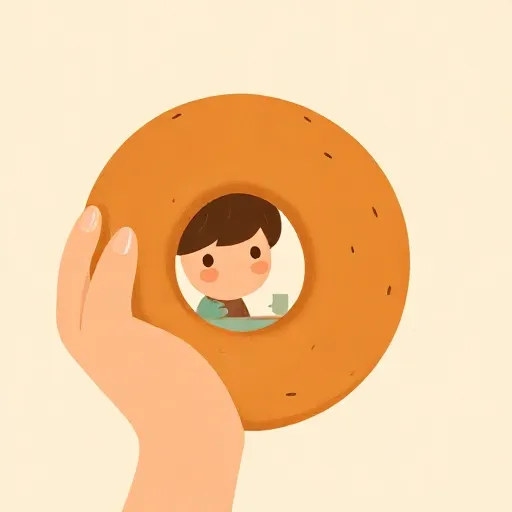
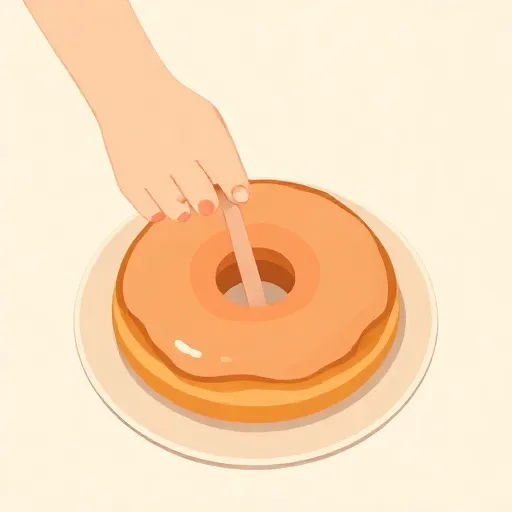
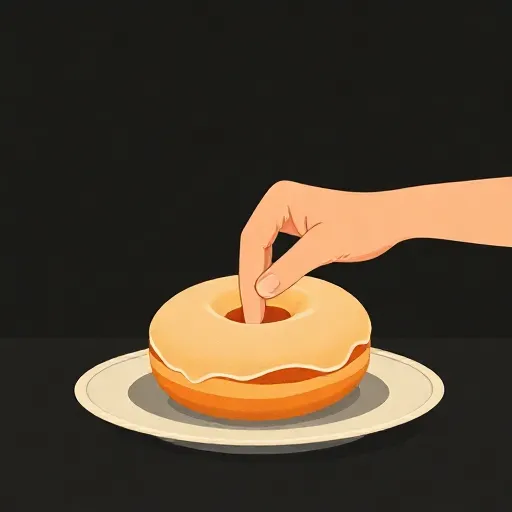
You are holding a freshly baked donut. You can see its sweet, bready ring, and right in the middle there is a hole. You can poke your finger through it, count it, maybe even describe its shape. But try this: what exactly is the hole itself made of? Not the dough — that is the stuff that surrounds the hole. What is the hole? If you said “nothing,” you are on the trail of a riddle that has tangled up philosophers for centuries.
If holes are nothing at all, why do we talk about them as if they are something? We say “the hole is round,” “I counted three holes in that cheese,” or “the hole got smaller after I glued the crack.” As writers Douglas Hofstadter and Daniel Dennett once put it, “These things have birthplaces and histories. They can change, and things can happen to them.” That sure sounds like we are talking about real objects. So are holes real? And if they are real, what kind of thing can be made of nothing?
Three Ways to Think About Holes

When philosophers study what exists, they call that branch of thinking ontology. Ontology asks: what kinds of things are there in the world? A hole is a strange candidate for their list, so over time three very different answers have emerged.
Answer 1: Holes are not real at all. Some philosophers say that sentences about holes are just a loose way of talking. Frank Jackson (born 1943) and Peter van Inwagen (born 1942) argue that all true statements about holes can be translated into statements about ordinary objects. Instead of saying “There is a hole in the carpet,” you can say “The carpet is perforated.” Instead of “There are three round holes in that piece of cheese,” you could say “That piece of cheese is triply-roundly-holed.” On this eliminativist view, holes do not truly exist. We only talk as if they do because it is convenient.
Answer 2: Holes are real, but they are made of dough (or whatever surrounds them). David Lewis (1941–2001) and Stephanie Lewis proposed a surprising idea: a hole just is the lining of its host — the thin layer of material that touches the empty space. For every hole there is a hole‑lining, and the hole and the lining are the very same thing. So a donut’s hole isn’t nothing; it is the dough right at the inner edge. This turns our everyday picture upside down: filling a hole would mean filling the space outside the lining, and enlarging the hole would mean adding more lining.
Answer 3: Holes are genuine objects made of nothing. The naive realist view — defended by Roberto Casati (born 1961) and Achille Varzi (born 1958) — is that holes are exactly what they seem to be: immaterial particulars. They are real things in the world, they have shapes and sizes and locations, but they are not made of any stuff. A hole is deeply dependent on the matter around it (its host), and it can sometimes be occupied by a guest (like water filling a cavity), but the hole itself is not matter. This view takes the donut’s hole seriously, but it must explain how a nothing can behave like a something.
The Problem of Seeing Nothing

If holes really are immaterial, then how do we ever see them? Philosophers have often thought that seeing something requires that the thing causes light to reach our eyes. A donut’s dough does that, but the hole — if it’s made of nothing — can’t push light around. So a causal theory of perception seems to say that we never truly see a hole. Our impression of a hole would be a kind of useful illusion.
On the other hand, maybe absences can have effects. Some philosophers argue that an empty space can be causally relevant: a hole can let water leak out, or allow a key to open a lock. If absences can drive events, then our visual system might pick up on holes as genuine features of the world. The debate is still open. It forces us to reconsider what counts as “seeing” and whether causality needs stuff.
When Does a Hole Stay the Same?
Try this experiment in your mind. You have a piece of Swiss cheese with a hole in it. Over time, you start replacing tiny bits of cheese around the rim with fresh cheese, atom by atom. Eventually, none of the original material that touched the hole remains. Is it still the same hole? It seems to be. But if the hole isn’t made of cheese, and isn’t made of anything, what tracks its identity through all those changes?
Philosophers call this the identity conditions problem. For a normal object, like a bicycle, you can identify it by its parts. For a hole, you can’t point to any parts made of matter. You cannot rely on the host, because you can change the host without destroying the hole. You cannot rely on a guest, because you can empty out whatever was inside and the hole stays put. So what makes the hole at 5 o’clock the same hole that was there at 3 o’clock? This puzzle has no easy solution.
Counting Holes and Splitting Holes

Grab a blank card and a hole punch. Punch once. You made one hole. Now punch again, right next to the first hole. Did you make a second hole, or did you just stretch the first hole into a bigger, two‑part hole?
Everyday thinking says you now have two holes. But ordinary material objects can have disconnected parts: a bikini is one swimsuit even though it has two pieces. A lowercase letter “i” is one letter, yet the dot and the stem are separate. Perhaps holes can be disconnected too. Maybe your two punches didn’t create two holes, but a single hole that comes in two disconnected parts. The study of how things have parts is called mereology, and when applied to holes it produces these weird puzzles. How you answer might depend on whether you think a hole is a real thing, a shape in the host, or something else entirely.
Why It Matters: Thinking About Existence

You might think, “Who cares? It’s just a hole.” But the hole puzzle is a lot like a microscope for big questions. It shows that our everyday words can hide deep confusions about what is real. Every time you say “there is a hole here,” you are making a claim about what exists. Philosophy pushes you to check whether that claim holds up under pressure.
The fight over holes also connects to how you think about emptiness, gaps, and nothingness. The German writer Kurt Tucholsky once joked, “There is no such thing as a hole by itself.” And yet you and I seem to see holes everywhere — in doughnuts, keyholes, tunnels, and sponges. Wrestling with holes is a way of wrestling with the limits of “thing” and “nothing.” So the next time you bite into a donut, you might pause and wonder: am I eating around a real object, or am I just eating a shaped piece of dough? That quiet puzzle is philosophy doing what it does best — making the ordinary strange.
Think about it
- If a hole is only where the cheese isn’t, can you destroy a hole without ever touching the cheese? Try to describe a situation where the hole disappears even though the cheese stays exactly the same.
- If you stand in a doorway, are you inside a hole? Does that make the doorway a hole in the wall, or are you just standing in an empty space? What would change your mind?
- Suppose you have a sponge full of tiny connected gaps. Is that one enormous tangle of a hole, or millions of separate holes? How would you count them?