When the World Shrinks, Who Gets a Say in What’s Fair?
When Trains Made the World Feel Claustrophobic
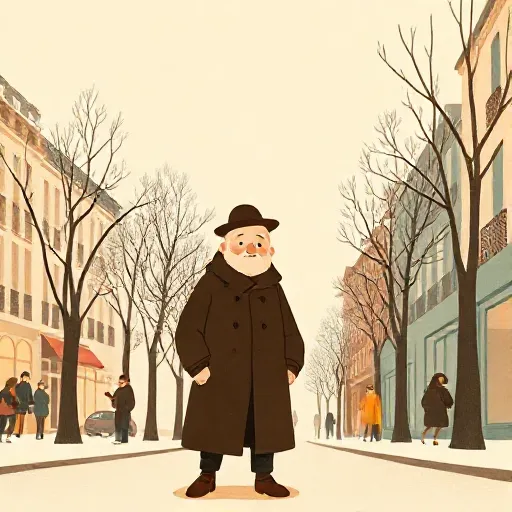
In 1843, the German poet Heinrich Heine (1797–1856) stood on a Paris street and felt something strange. The world was getting smaller. New steam trains were slicing up the countryside at speeds no one had dreamed of. Heine sensed that distance itself was being destroyed. He imagined the mountains and forests of all countries rushing toward him, as if the linden trees of Germany and the waves of the North Sea were crashing at his door.
Heine was not the only one with such jitters. In 1848, Karl Marx (1818–1883), a young German thinker, saw the same shrinking effect but gave it a harder edge. Marx argued that industrial capitalism — the system of factories, profits, and global trade — forced business owners to spread everywhere, build connections in every corner of the planet, and pull far-off places into one frantic web. For Marx, the new technologies that killed distance were also tools of exploitation, but he believed they would eventually help workers unite across borders and build a fairer world.
Across the Atlantic, Americans had similar moments. The writer Henry Adams (1838–1918) diagnosed a “law of acceleration.” He thought society was speeding up so fast that people could barely make sense of it. The philosopher John Dewey (1859–1952) went further in 1927. He saw that trains, steamships, telephones, and automobiles were ripping apart the old, slow rhythms of village life. A farm family in Vermont used to live in a world where almost everything that mattered happened nearby. Now their son might work at a factory in a distant city, their daughter might read news from London, and the price of their grain might be decided by a bank in New York.
Dewey asked a question that still echoes: if everyone and everything is moving so fast, how can people come together to make decisions about what affects them? The world felt like it was sprouting spider‑legs of connection everywhere, and the little local town — where democracy had once seemed cosy and manageable — was suddenly too small to handle the forces swirling around it.
Four Big Ideas That Make Up Globalization
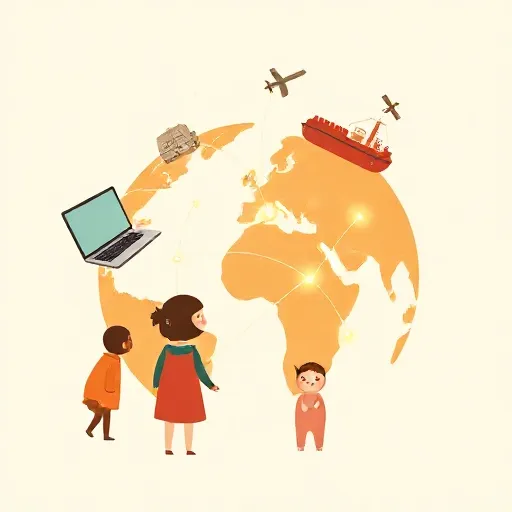
What those 19th‑century observers glimpsed through train smoke and telegraph clicks is now called globalization. Even though scholars still argue about which engine powers it most, they largely agree on four features.
First, deterritorialization. A growing number of activities happen without a fixed “where.” You and a friend on another continent can play the same video game at the same moment, make a video call, or build a digital model of a city together. Your actual latitude and longitude are almost irrelevant. The social space you share is not drawn on any physical map.
Second, interconnectedness. Most people still live in real places — you sleep in a bed, eat food grown somewhere, go to a school with a street address. But those places are now tied to distant events in ways that would stagger Dewey. A financial panic in one country can close the factory your aunt works in. A decision by a faraway government about fishing quotas can mean your favorite seaside town loses its main business. Interconnectedness is not just a feeling; it is a measurable thickening of the links between happenings far apart.
Third, social acceleration. Deterritorialization and interconnectedness rely on speed. Money, information, goods, and even people rush across borders faster than ever. A century ago, a letter from Australia to Brazil took weeks. Now you can send a message and get a reply before you finish your breakfast. High‑speed technology is the obvious cause, but habits matter too — Dewey’s “mania for motion and speed” has not gone away.
Fourth, globalization is a long‑term process. It did not start with TikTok. Nineteenth‑century thinkers noticed the planet shrinking, but the deep roots run even further back. What changes is the intensity. Today’s digital technologies have amped up all three earlier trends to a level that earlier generations could not have imagined, but the direction of travel has been recognisable for at least two centuries.
Taken together, these four features push us to ask: if our lives are tangled up like this, do our old rules about fairness, belonging, and self‑rule still work?
The Town Meeting That Couldn’t Keep Up
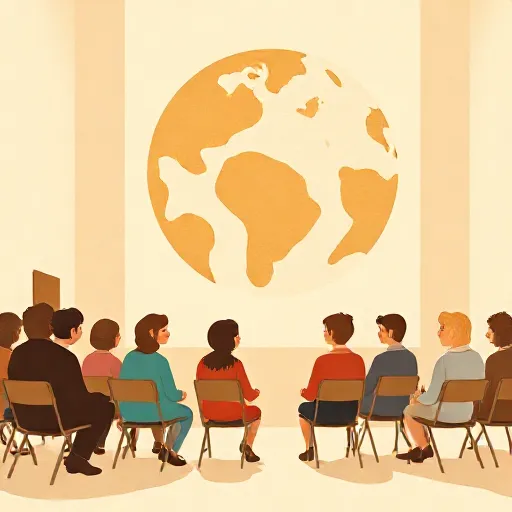
John Dewey put his finger on the heart of the trouble. Democracy, he thought, works best when people meet face‑to‑face, argue respectfully, and decide together. A New England town meeting where neighbours hash out a school budget is a portrait of that ideal. But what happens when the decisions that shape your life are made in boardrooms and parliaments thousands of kilometres away? Dewey asked, “How can a public be organized when literally it does not stay in place?”
For a long time, Western political philosophy took it for granted that political communities were bounded — that you could draw a clear line around “us” and separate domestic affairs from foreign ones. Thinkers like John Rawls (1921–2002) described nations as self‑sufficient schemes of cooperation that provide everything essential for human life. In that picture, justice and democracy were things you built inside the borders. Outside, among nations, rules were thinner and more rough‑and‑tumble.
Globalization cracks that picture. When a financial market can drain jobs out of your region with a keystroke, you are not self‑sufficient. When a cloud of pollution crosses three countries, the line between domestic and foreign blurs. The tidy division of “inside” and “outside” no longer holds. That makes the old assumption — that we can get justice at home and not worry too much about abroad — look shaky. If foreign affairs now crash into the living room, maybe we have to extend our ideas of fairness to the global level simply to protect what we value at home.
Do We Owe the Stranger the Same as the Neighbour?
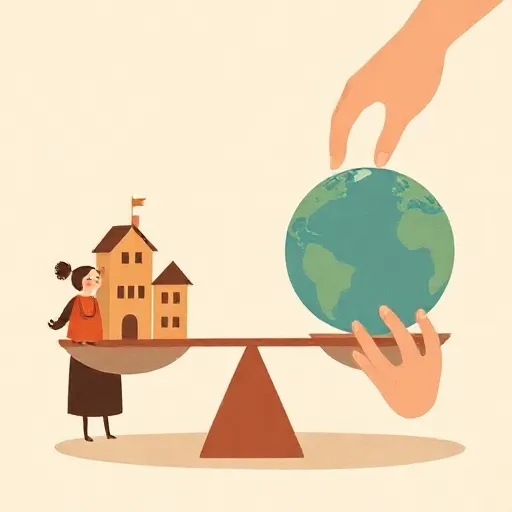
This is where the debate gets personal. Think about a real‑world dilemma: a child born in a wealthy country has access to clean water, vaccines, and education, while a child the same age in a much poorer country faces malnutrition or treatable diseases. Does the wealthy child’s society have strong obligations to fix that, or is its first duty to its own neighbours?
Those who answer “yes, strong obligations” are often called cosmopolitans. The name comes from the Greek word for “world citizen.” Cosmopolitans argue that every human being counts equally, no matter where they were born. Borders, they say, are accidents of history, not moral fences. If you accept that it is wrong to let a nearby toddler drown because you don’t want to muddy your shoes, then the same principle should apply to a toddler far away whom you can help with a donation. In a globalised world, cosmopolitans point out, the threads tying rich countries to poor ones are so thick that pleading “I didn’t know” or “it’s not my business” becomes disingenuous. Climate change — caused mostly by the decisions of wealthy nations — already harms the world’s poorest people. How can we then say we have no special duty to them?
On the other side, critics push back. They do not deny that we should help, but they doubt that distant strangers can command the same level of loyalty and sacrifice as family, friends, and fellow citizens. Real communities, they argue, are built on shared history, language, and trust — things that are thin or missing at the global level. If you try to stretch a sense of “us” to cover all seven billion people, you might end up weakening the real, liveable communities that actually make life good. Some also warn that grand talk of global justice can become a mask for powerful countries to meddle in others’ affairs. A strong national community, they insist, is the sturdiest raft we have, and we should mend it rather than dream of an ocean‑spanning cruise ship that might never sail.
Can Democracy Go Global?
The same split runs through the question of democracy. Some cosmopolitan thinkers, such as Daniele Archibugi and the late David Held (1951–2019), argue that we need to extend democratic institutions — elections, parliaments, courts — to the level where power actually operates. If greenhouse gases don’t stop at any border, then neither should the decisions about regulating them. The European Union is one real‑world laboratory: its supporters, like the philosopher Jürgen Habermas (born 1929), see it as a stepping stone toward post‑national democracy, a chance to prove that people from different nations can govern together without losing their freedom.
Critics, however, call these plans hopelessly utopian. Democracy, they argue, is not just a set of procedures. It needs a pre‑existing sense of shared fate, a public that reads the same newspapers and argues in the same language. At the global level, that kind of thick community does not exist. Pushing for a world parliament, sceptics say, could backfire by creating a remote, unaccountable elite that speaks in the name of humanity but answers to no one. Others from the tradition of political realism add a darker warning: in a world of clashing interests, a universalist creed can become a banner for new forms of conquest.
Between these two visions, the present sits uneasily. For a while, the growth of supranational institutions seemed to confirm the cosmopolitans’ hopes. Lately, a wave of nationalist and populist movements has pushed back hard, blaming free‑trade deals, migration, and distant courts for local anxieties. Even if no one can fully reverse the deep trends of deterritorialization and interconnectedness, the backlash shows that the shape of our global future is still being fought over.
Why Your Phone Makes You a Global Citizen

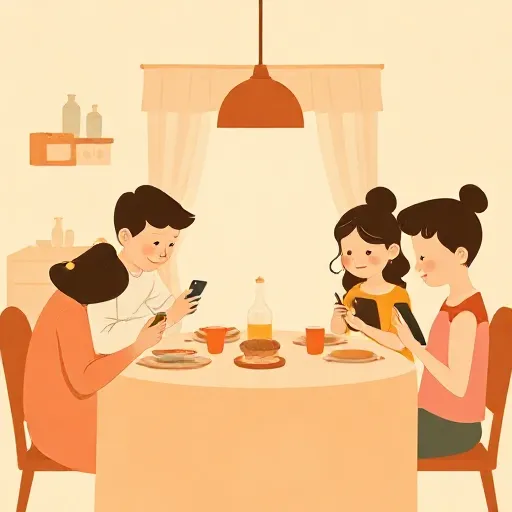
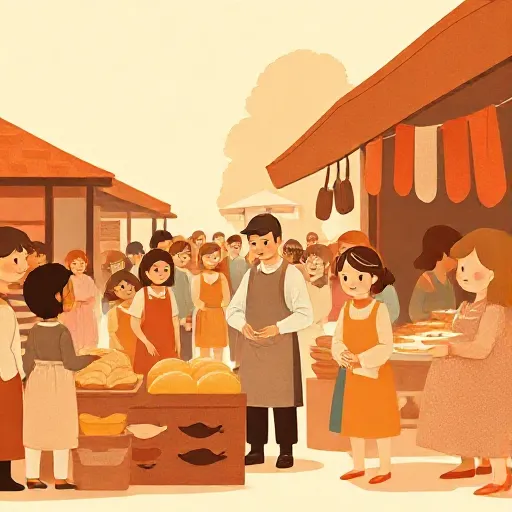
You may not spend your mornings worrying about deterritorialization, but you live inside it every day. The clothes you wear were likely stitched in several countries. The chocolate you snack on begins as cocoa pods in West Africa, is processed in Europe, and lands in your local shop. The music you stream, the games you play, the news memes you laugh at — they zip across borders so easily that you barely notice. Even the air you breathe carries traces of decisions made on other continents.
This means you already have a stake in the questions Dewey and the cosmopolitans raised. When a hurricane strengthened by a warming ocean floods a coastal city, was it a “foreign” disaster or a product of a global system you are part of? When you hear workers in another country are paid unfairly to make something you use, does that tug on your sense of right and wrong? These are not just classroom puzzles. They are the shape of a world in which the distance between “here” and “there” has collapsed, but our habits of caring still lag behind.
That gap — between how connected we already are and how far we are willing to extend our circle of concern — is the unsettled heart of the globalization debates. No one can predict which side will gain the upper hand. But understanding the argument means you are better equipped to decide, for yourself, who belongs in “us.”
Think about it
- If your favourite snack stopped being sold in your country because a faraway government made a trade decision, would that be unfair — and who would owe you a reason?
- Should a student in one country be allowed to vote on a school policy in another country if the two schools are connected online and share the same problems?
- When you hear about a crisis on the other side of the world, do you feel the same urge to help as you would for a crisis in your own neighbourhood? What makes the feelings different?