
Does Social Media Bring Us Together — or Pull Us Apart?
Why Do You Feel Lonely Even With Hundreds of Friends?

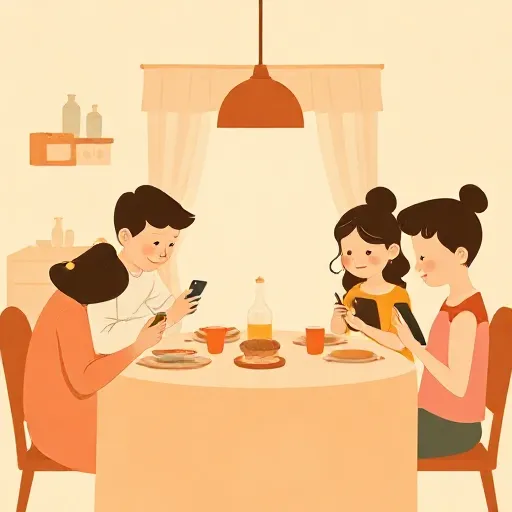
You’re at the dinner table. Your phone vibrates: a new like on your photo, a funny meme from a friend, a breaking news alert. You glance up. Your brother is scrolling. Your mom is answering a work message. Your dad is watching a video with the sound off. You are all together, but it doesn’t feel like it.
For centuries human beings have built social networks — clubs, churches, letter-writing, phone calls. But something changed when websites and apps designed for social networking arrived in the early 2000s. Suddenly you could carry hundreds of friends in your pocket, share your life in seconds, and never be alone with your thoughts. Is that a good thing? Two philosophers who thought hard about this question in the earliest days of the internet said no. Albert Borgmann and Hubert Dreyfus warned that online social life was a dangerous fake — a shiny trap. Many others pushed back, arguing that their grim predictions missed the real story. The fight is still alive, and it is about your life today.
Borgmann’s Warning: The Shiny Trap of Hyperreality
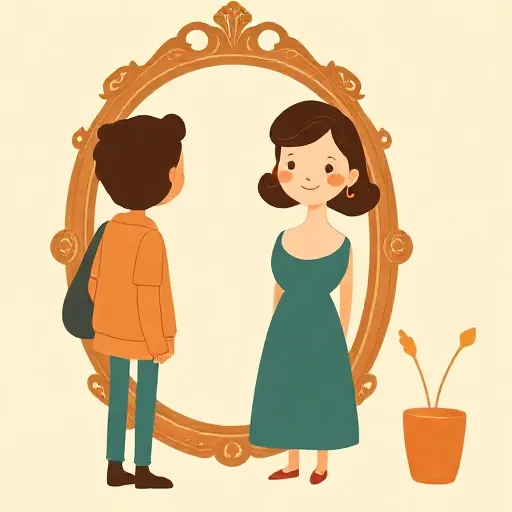
Albert Borgmann (1937–2023) believed that modern technology often tricks us into choosing easy, frictionless experiences over the harder, richer ones that actually make life meaningful. He called this the device paradigm — a push-button world where we become passive consumers. When he looked at early internet communities, he saw something worse. Online, we could offer one another “stylized versions of themselves” — curated, edited, perfect. He called this online social world hyperreality — a space that feels more attractive than the messy, physical world we actually live in.
What’s so bad about that? Borgmann’s worry was not that hyperreality is evil but that it is too comfortable. When you can always escape to a shiny digital space where you are liked and admired with little effort, returning to real life — where friends sometimes annoy you, you make mistakes, and things are awkward — feels disappointing. Over time, he feared, we would stop showing up in the physical world at all. We’d stop going to concerts and plays to watch a real performance together, because we’d prefer to scroll through highlights. We’d stop having difficult, face-to-face conversations that teach us patience and courage, because we could text instead. Borgmann predicted a “disconnected, disembodied, and disoriented sort of life” that would weaken our communities and make us less thoughtful citizens.
Dreyfus and the Missing Risk: Can You Really Commit Online?

Hubert Dreyfus (1929–2017) focused on a different danger. He argued that anything truly meaningful in life — a deep friendship, a serious promise, a moral stand — requires genuine risk. If you cannot really lose something, you cannot really commit to it. In the physical world, if you mess up and hurt a friend, you can’t just tap “block” and make them vanish forever. You have to face the consequences, apologize, and do better. That’s what builds character and trust.
Dreyfus believed the internet lured us with the opposite promise: a space where you can play with your identity without paying a price. You can try on different personalities, flirt without ever meeting, join a furious argument and then log off, and the worst that can happen is you lose an account. He drew on the Danish thinker Kierkegaard, who said that a self needs “firmness, balance, and steadiness,” not endless variety. Dreyfus argued that anyone who honestly wanted to develop a real identity would have to “act against the grain of what attracted him or her to the Net in the first place.”
The Plot Twist: How Social Media Surprised the Critics

Soon after Borgmann and Dreyfus issued their warnings, the internet changed in ways they didn’t expect. The philosopher Andrew Feenberg and others pointed out a major blind spot: physical social spaces aren’t equally welcoming to everyone. If you live in a remote area, if you are disabled, if you are neurodivergent, or if you belong to a marginalized group, the “real world” can be a place of isolation, not connection. For many such people, online communities became spaces of genuine belonging and democratic power — the exact opposite of Borgmann’s vision of passive detachment.
Then social networking services like Facebook shifted the rules entirely. Early internet culture was full of anonymous or pseudonymous users; Dreyfus worried we’d skip merrily from fake identity to fake identity without ever planting roots. Instead, platforms began tying accounts to real names, real photos, and real-world networks of family, coworkers, and school friends. Your online presence became in some ways less temporary than a face-to-face conversation — something that could be screenshotted, shared, and never scrubbed away.
And Dreyfus’s missing risk? It came roaring back. Today, a tweet can get someone fired, a leaked video can bring a mob to your doorstep, and public shaming online can follow you for years — a phenomenon sometimes called doxing. Far from being consequence-free playgrounds, social media can be where your identity is most exposed to risk, judgment, and danger. The critics had misjudged the direction the technology would take, but that didn’t mean everything was fine.
When the World Splinters: Filter Bubbles and Lost Truth
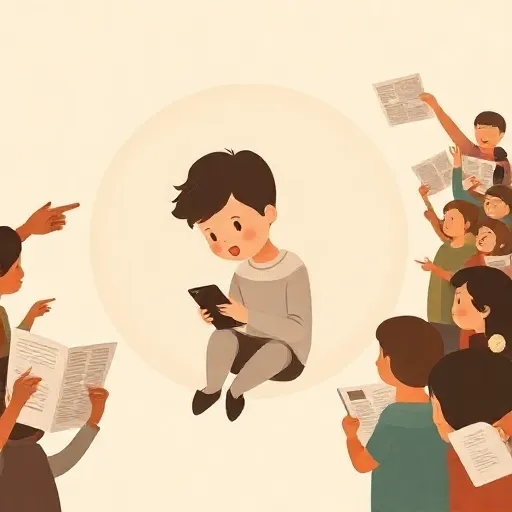
One of Borgmann’s darkest predictions turned out to be frighteningly relevant: the rise of a distorted, hyperreal political world. He worried that citizens immersed in online feeds would lose a grip on shared facts and stop being able to act together wisely. In recent years, that worry exploded into view. False rumors, conspiracy theories, and deliberately crafted disinformation now spread on social media at lightning speed — about elections, vaccines, climate change, and even who is alive or dead.
This is not just an accident of human nature; platforms are designed to keep us scrolling. Their algorithms learn what grabs your attention and show you more of it. If you always click on news that confirms your opinions and skip posts that make you uncomfortable, the feed narrows into an echo chamber or filter bubble — a world where everyone seems to agree with you and facts you don’t like never appear. The result can be a deep split in society, where groups can’t even agree on what happened, let alone what to do about it. Borgmann’s warning that hyperreality could suffocate reality doesn’t sound like moral panic anymore; it sounds like a description of a fractured democracy.
Choosing Your Best Self: Friendship, Authenticity, and What Really Matters

At the same time, the early fears that online friends could never be “real” have softened. Most teenagers today use social media to stay close to people they already know offline — to plan hangouts, share jokes, and support one another through hard times. Mobile apps let you find your friends at a concert or a park, sparking spontaneous meetups that Borgmann thought would vanish. In that sense, the technology isn’t automatically isolating.
Yet a nagging worry remains. You’ve probably felt it: the family dinner where everyone scrolls silently, the concert where half the crowd watches through a phone screen, or that hollow feeling after hours of liking and commenting without really talking to anyone. Sherry Turkle, a researcher who once celebrated the internet’s social possibilities, later called this “alone together” — physically present but mentally elsewhere.
There is also the puzzle of authenticity. On Instagram or TikTok you can carefully shape the person you appear to be: only the best moments, only the wittiest captions, only the version of you that gets the most likes. Yet when your grandma, your crush, and your soccer team all see the same profile, you can’t be a completely different person to each. That weird collision can actually push you to be more honest — to show a self that is more complex but more real. Some philosophers believe that’s a genuine ethical opportunity: social media can be a gym where you practice virtues like honesty, courage, and empathy, or a couch where you hide from the work of growing up.
Think about it
- If you knew that an algorithm planned your day’s social media feed to keep you scrolling, would you still trust your own beliefs about the world? Why or why not?
- Imagine you are designing a new social app. What one feature would you build to encourage users to be kinder or more truthful, while still having fun?
- Do you think a friendship that exists mostly through screens can ever be as deep as one where you share meals, silences, and a physical space? What might be missing?