
Hawks, Doves, and the Evolution of Cooperation
The Puzzle of the Lazy Males

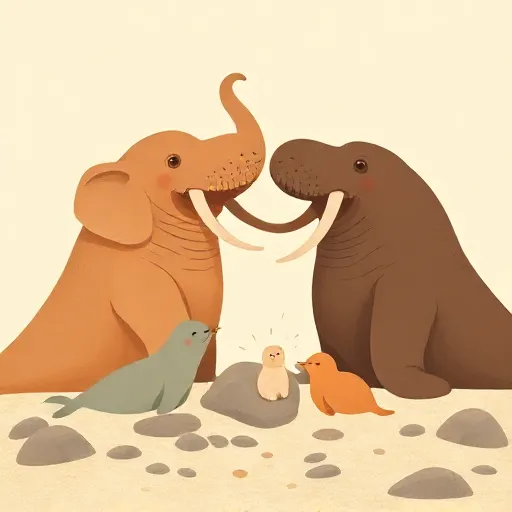
On a foggy morning, the beach rumbles with deep bellows. Two bull elephant seals slam their chests together, biting and shoving. They fight for the right to mate, yet most males on that beach will never have a chance. Why, then, are male and female pups born in almost equal numbers? In many species, a lot of males seem like dead weight — extra mouths to feed with no payoff for the group.
The biologist R.A. Fisher (1890–1962) cracked this puzzle in 1930. He saw that if you measure an individual’s success by the number of grandchildren they leave, the value of being male or female depends on how many of each already exist. When females are scarce, a male can have many offspring; when males are scarce, a female’s offspring have a better shot. This back-and-forth pushes the sex ratio toward a balanced point. Fisher’s insight was that fitness is not a fixed number — it changes depending on what everyone else is doing. That is a strategic situation, much like a game.
Fisher didn’t use the language of game theory, but later scientists did. They built evolutionary game theory, a way of studying how behaviors spread when the payoff for a behavior depends on the strategies others use. No one needs to think through the options; evolution simply favors behaviors that do well against the current crowd.
Hawks, Doves, and an Unbeatable Mix
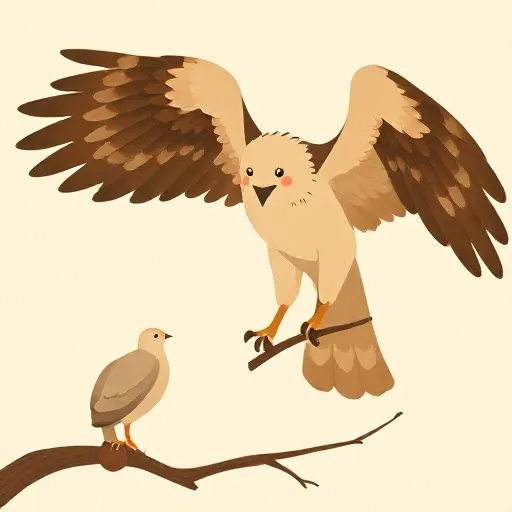
Imagine two animals squaring off over a piece of food. Each can act like a Hawk — fight until someone gets hurt — or like a Dove — puff up but back down if the other attacks. If two Hawks meet, they fight, and each gets injured. If a Hawk meets a Dove, the Dove retreats and the Hawk takes the prize. Two Doves share it peacefully.
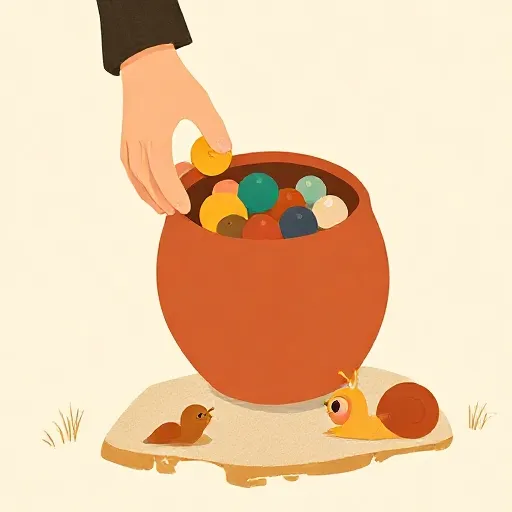
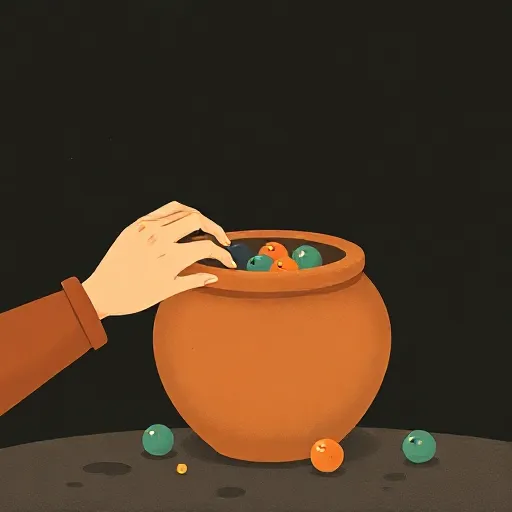
The prize is worth some value V, and an injury costs C. If C is bigger than V, then always fighting is a bad idea. But if everyone is a Dove, a single Hawk cleans up. So what mixture survives? In 1973, John Maynard Smith (1920–2004) and George R. Price (1922–1975) introduced the idea of an evolutionarily stable strategy, or ESS.
An ESS is a strategy that, once most of the population uses it, cannot be invaded by any rare mutant. It works like this: if a mutant appears playing a different strategy, the ESS must do better against that mutant than the mutant does against itself. In the Hawk‑Dove game, the only ESS is a mixed strategy — play Hawk some of the time, Dove the rest. If too many fight, the cost of injury makes Dove pay off; if too many back down, Hawk sweeps in. The population balances at a point where neither aggressive nor peaceful players can take over completely. This explained why many animal conflicts are ritual displays rather than all-out brawls: restraint is part of an unbeatable mix.
When the Game Keeps Running
An ESS is a snapshot — it tells you what’s stable, not how you get there. To watch the process unfold, researchers built replicator dynamics, a model where strategies that earn above-average payoffs grow in frequency, while poorly performing ones shrink.
The Prisoner’s Dilemma is the classic test. Two players each choose Cooperate or Defect. If both cooperate, they get a reward R; if both defect, they get a small punishment P; if one defects while the other cooperates, the defector gets the highest payoff T and the cooperator gets the sucker’s payoff S, with T > R > P > S. No matter what the other player does, defecting always gives you a higher personal score. So in the replicator dynamics, cooperators vanish — defectors take over. That matches the ESS prediction: defect is the only stable outcome.
But the real world isn’t a well-mixed soup where everyone bumps into everyone else equally. In 1992, Martin Nowak and Robert May built a model where individuals sit on a grid and play only with their neighbors. When cooperators cluster together, they mainly meet other cooperators and enjoy high payoffs, while defectors on the fringe exploit them but then run out of victims. Depending on the exact payoff numbers, stable checkerboard patterns can emerge where cooperators persist in patches, or even chaotic waves where both strategies ebb and flow forever. So the dynamics can preserve cooperation that the static ESS said was impossible. The way people connect to each other matters as much as the game itself.
From Cake to Language

Divide a cake with a stranger. You each write down how much you want; if the sum is more than the whole cake, you both get nothing. There are infinitely many Nash equilibria — any pair of demands that exactly uses up the cake — but which one actually evolves?
Brian Skyrms (b. 1938) studied this with replicator dynamics. If people simply copy strategies that do better, the demand for exactly half the cake evolves in about 62% of computer runs when everyone mixes randomly. Add just a tiny amount of correlation — a tendency to interact with others like yourself — and fair division becomes nearly certain. No one needs a sense of justice to start with; fairness can bubble up from self-interested rules.
Something similar happens for language. In a sender‑receiver game, one player sees a state of the world (say, a predator or food) and sends a signal. The receiver sees only the signal and performs an action. Both get a reward only if the action fits the true state. Without any plan, populations can evolve signaling systems — reliable pairings of signals and states, like a simple language. Even when thousands of possible strategies exist, the replicator dynamics often locks onto a perfect signalling system. This suggests that the basic machinery of communication can appear even in minds that are far from hyper‑rational.
Why This Matters for You

Evolutionary game theory changes how we think about human behavior. Traditional game theory often assumed flawless reasoning — as if everyone had a supercomputer in their head. But real people, and certainly animals, make choices with simpler rules. The models in this field show that you don’t need to be a perfect logician to end up sharing, cooperating, or using words.
When you split a treat with a friend or settle an argument without anyone stomping off, you might be living inside a dynamic that Fisher, Maynard Smith, and Skyrms mapped out. The fascinating part is that fairness can appear from plain self-interest, as long as individuals interact with some pattern and adapt over time. The same goes for the language you use without even thinking about it. These studies don’t prove that everything is selfish; they reveal that cooperation and meaning can sprout from surprisingly humble roots. Understanding those roots helps us see why some groups thrive and others fracture — and how we might nudge our own world toward more cooperation.
Think about it
- If a computer simulation showed that cheaters always win unless people live in tight clusters, would you organize your friendships differently? Why or why not?
- Does it matter if our sense of fairness started as a self‑interested strategy? Could that change how you feel about sharing?
- If a simple learning rule can accidentally create a shared language, do you think the first human words were invented on purpose or emerged like a habit?