Does Evolution Roll Dice? The Puzzle of Genetic Drift
Darwin’s Hunch and the Mystery of the Snails
In 1872 Charles Darwin (1809–1882) wrote something quietly startling. He said that variations neither useful nor injurious would not be touched by natural selection. Instead they would float around in a population and sometimes, by the nature of things, end up fixed. Darwin never explained how that floating would work, but his hunch planted a seed.
Fifty years earlier, another curious observer had already stumbled onto a similar puzzle. The American naturalist John Gulick (1832–1923) studied land snails on islands and noticed something that didn’t fit the neat story of survival of the fittest. Snail colonies living in almost identical conditions often had strikingly different shell colors and banding patterns. If the environment wasn’t pulling them in different directions, why weren’t they the same? Gulick imagined small groups of snails breaking away by accident — founders who carried only some of the rainbow of traits from the original population. In the new, tiny population those chance differences could become permanent, not because they helped the snails survive, but simply because nothing stopped them.
In the early 1900s two Dutch biologists, A. C. and A. L. Hagedoorn, pushed the idea further. They pointed out that every organism has “trivial” traits — the exact shape of tiny hairs on a seed, say — that can’t possibly be useful enough for natural selection to notice. Yet those traits were often steady and pure inside a species. The Hagedoorns argued that something other than selection must be locking them in place. They described several ways that variability could shrink: a new population starts with only part of the old variety, a population splits in two unevenly, or only a lucky handful of parents manage to reproduce each year. The smaller the group, the faster any variation could vanish — simply because of who got picked by chance to pass on their traits.
A Bag of Marbles: How Drift Really Works
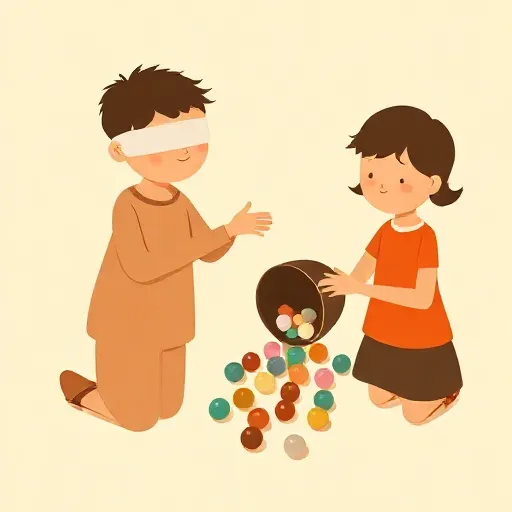
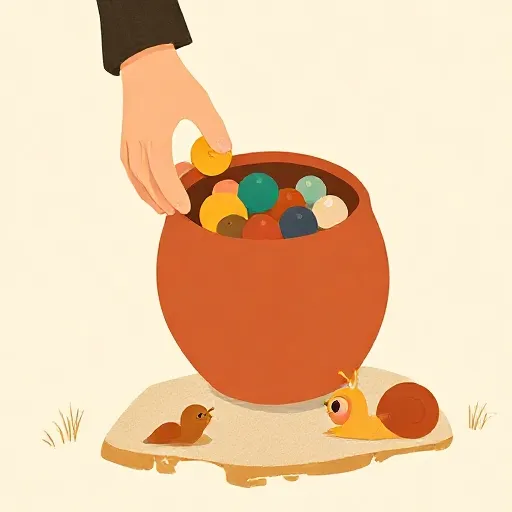
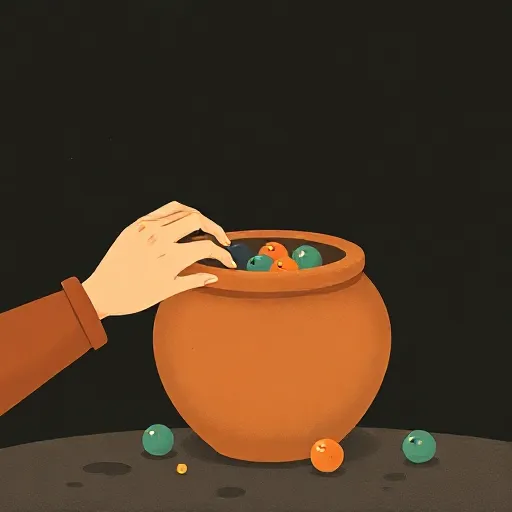
Picture an urn full of colored marbles — red, blue, green, yellow — in perfectly equal numbers. If you reach in blindfolded and grab a huge handful, the colors in your hand will almost match the colors in the urn. But if you only pull out four or five marbles, you might end up with mostly blue and no yellow at all, just by luck. Now imagine that each handful represents the parents of the next generation, and the colors are different versions of a gene. That is the core idea of genetic drift: random, undirected changes in how common a trait is from one generation to the next.
In the 1930s the population geneticist Sewall Wright (1889–1988) sharpened the picture. He described drift as the effect of random sampling in a breeding population of limited size. Every time parents produce gametes — egg and sperm cells — the particular gene versions that get passed on are a sample. If the sample is small, chance can nudge the frequencies up or down. Over many generations those tiny nudges can pile up, sometimes eliminating a variant completely or making it the only one left in the population.
This kind of sampling, where no physical difference between the variants makes any difference to which one is picked, is called indiscriminate sampling. You draw marbles without caring about color; nature “draws” genes without caring whether they make an organism stronger, faster, or more camouflaged. By contrast, natural selection is discriminate sampling: the environment favors some variants over others because of how they affect survival or reproduction. A bird picks off the snail whose shell is easiest to spot; a drought kills the plants with shallower roots. The difference that matters is that in drift, the physical traits are causally irrelevant to who succeeds; in selection, they are causally relevant.
The Philosophers’ Question: Is Drift Just a Mistake?
The bag‑of‑marbles picture seems clean, but in the 1980s the philosopher John Beatty pointed out a crack. Even in a population where some beetles are definitely fitter than others, the fitter ones don’t always out‑reproduce the weaker ones. A swift bird might still miss the showy beetle and snatch a well‑camouflaged neighbor; a lucky weakling might survive the drought by chance. So what do we call the generation when the less‑fit beetles end up having more babies? Beatty worried that if drift is defined merely as the departure from what fitness would predict, then the boundary between selection and drift blurs in a maddening way.
Another philosopher, Roberta Millstein, proposed a way to keep them apart. She said we must do three things. First, anchor the difference in cause, not just numbers: in drift, physical differences between individuals are causally irrelevant to who reproduces; in selection, those differences are causally relevant. Second, carefully separate the process of drift from its outcome (a gene becoming more or less common). Third, define drift and selection as processes, not as outcomes. On this view, even that unlikely generation where the weaker beetles win is still a selection process, because the birds were still hunting by color — the physical traits mattered, even if the result was improbable.
Not everyone agrees. Some biologists and philosophers define drift entirely by outcome: drift is whatever change is left over after you subtract the change predicted by fitness differences. On this outcome‑only view, drift isn’t a particular kind of physical happening; it’s more like the statistical noise in the system. The debate is real and alive: should we look to the living events — the concrete ways genes are sampled — or should we look to the mathematical models and call drift everything that deviates from the tidy expectation? Different answers lead to very different pictures of evolution.
The Great Snail Debate: Reading Clues in the Wild
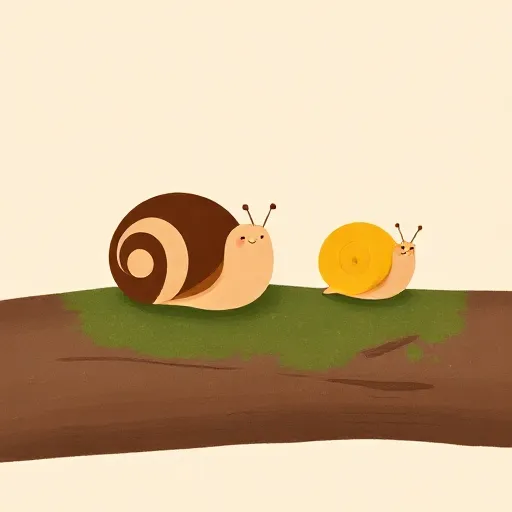
If drift and selection can produce such similar patterns, how could anyone ever tell them apart in nature? That question erupted in the 1950s and 1960s in what became known as “The Great Snail Debate.” The star was a tiny, colorful land snail called Cepaea nemoralis.
British biologists Arthur Cain and Philip Sheppard were convinced that snail shell colors and banding patterns were controlled by natural selection. Birds hunting by sight, they argued, would spot the snails that stood out against their background, so camouflage would drive the patterns. They spent years measuring backgrounds and counting snails to show that colors matched the landscape.
Then the French biologist Maxime Lamotte (1959) took a broader view. He surveyed over 900 populations and found something crucial. Among very large snail colonies, the mix of colors was fairly similar from place to place. But among the smallest, most isolated colonies, the color mixes bounced around wildly. That pattern — more random scatter in tiny groups — is a classic signature of drift. Lamotte didn’t deny camouflage; he said selection was important too. But he argued that the founding of new small populations, with their chance samples of colors, left a deep mark on the snails’ story.
The snail debate didn’t end with a knockout. Both sides had evidence. Both kinds of process — discriminate sampling by birds and indiscriminate sampling by foundings — were likely happening at once. This is exactly why philosophers got interested: if drift and selection can intertwine so tightly that even the sharpest field biologist struggles, then we need a very clear concept of what drift is in order to find it.
Why Rolling Dice Matters for All of Life
Today the puzzle of drift has spread from snail shells to the very core of your cells. In the 1960s the Japanese geneticist Motoo Kimura (1924–1994) proposed that the great majority of DNA changes are neither helpful nor harmful. They are neutral. If neutral, they are invisible to natural selection, so their fate is controlled by drift — the random sampling of gametes each generation. On Kimura’s view, the genetic differences you see between people, between species, even between you and a banana, are largely a record of accidents that slipped through the fingers of selection.
This doesn’t mean selection is unimportant. Harmful mutations are usually swept away, and the rare useful ones still get fixed by discriminate sampling. But the constant background hum of drift means evolution is not a master engineer optimizing everything. It’s more like a history book written partly by winners and partly by lucky survivors of a dice roll.
So the next time you notice that your friend has attached earlobes while yours hang free, or that some trait seems to run in your family for no obvious reason, you’re brushing up against the same mystery Darwin and Gulick saw. Philosophers will keep arguing about whether drift is a process of sampling or a numerical leftover, and biologists will keep designing clever ways to tell chance from purpose. The debate matters because it shapes how we understand our own story — and whether the living world is a neat plan or a magnificent, messy lottery.
Think about it
- If a trait spreads through a population purely by luck, would you still call it “evolution”? What would that mean for the idea that living things are perfectly adapted?
- Imagine you and your friends start a new village where, by accident, more people have curly hair than straight hair. Over many generations curly hair becomes the norm. Did curly hair “win” because it was fitter, or did something else happen? How would you try to find out?
- Can you think of a time in your own life when something seemed random but later you suspected there was a hidden cause? What would it take to figure out which parts were chance and which parts weren’t?