Where Did All the Variation Go? The Math That Keeps Life Surprising
The Riddle of the Blending Coat
In 1859, Charles Darwin (1809–1882) shook the world with On the Origin of Species. He argued that all living things are descended from common ancestors, and that the engine of change is natural selection—the survival of the fittest. Many scientists accepted the first part, but not the second. The problem was inheritance. If parents pass on their traits, and the fittest survive, then over many generations species should change. But Darwin didn’t know how inheritance worked. He could only say that offspring tend to resemble parents, “the strong principle of inheritance,” while admitting the mechanism was a mystery.
That mystery left Darwin open to a devastating attack. Fleeming Jenkin (1833–1885), a Scottish engineer, argued in 1867 that even if variation existed, it would be wiped out almost immediately. Imagine you mix blue and yellow paint. You get green, and you can never separate the original colors again. Jenkin thought inheritance worked the same way: a short parent and a tall parent would produce a medium child, and after a few generations everyone would be a uniform middle height. All the raw material for natural selection would vanish before it could shape anything complex. This was the “blending inheritance” problem.
Darwin had no good answer. The theory that would soon transform biology was in danger of being dismissed as impossible. But unbeknownst to most, a quiet monk had already discovered a crucial clue.
The Monk Who Counted Peas
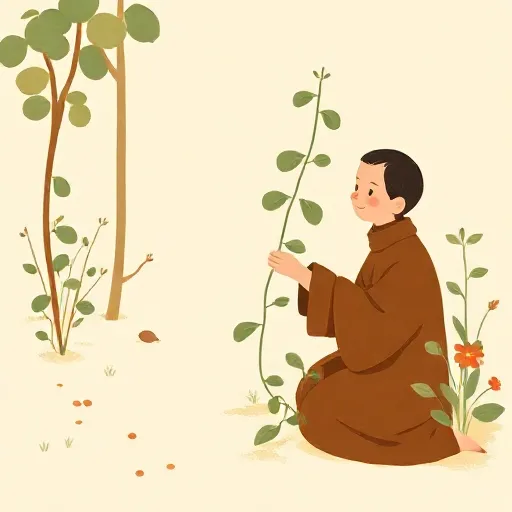
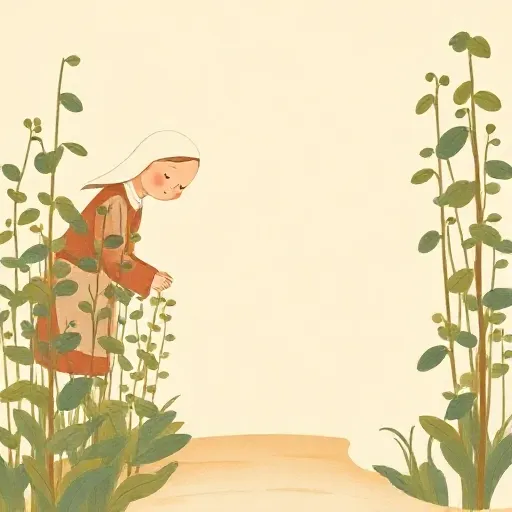
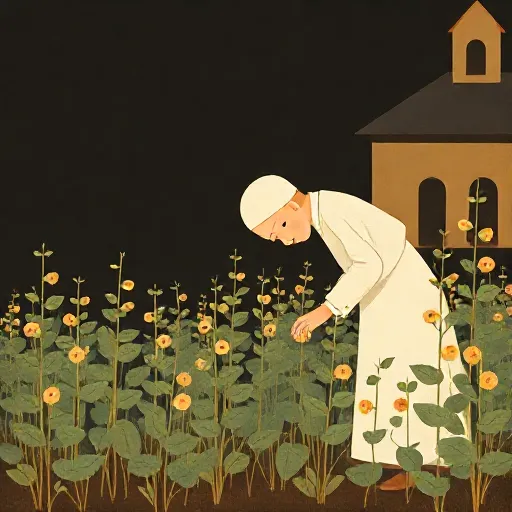
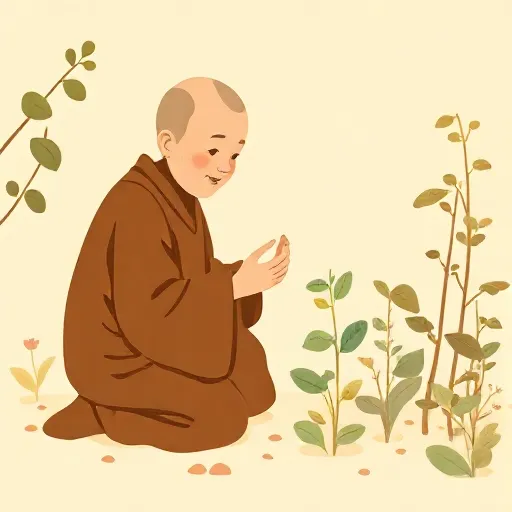
Gregor Mendel (1822–1884) wasn’t a mathematician, but he loved counting. In his monastery garden, he grew pea plants and tracked their traits: round seeds vs. wrinkled, yellow vs. green. He noticed something strange. When he crossed a pure round-seed plant with a pure wrinkled-seed plant, all the offspring had round seeds—the wrinkled trait seemed to disappear. But when he let those offspring self-fertilize, about one quarter of the grandchildren had wrinkled seeds again. The trait had skipped a generation.
Mendel’s insight was that organisms carry two “factors” for each trait (we call them genes), one from each parent. These factors come in different versions, or alleles. In his example, the allele for round seeds ((R)) was dominant over the allele for wrinkled seeds ((W)). A plant with two (R) alleles (a homozygote) had round seeds; one with two (W) alleles (also a homozygote) had wrinkled seeds; but a plant with one of each (a heterozygote) also had round seeds, because (R) masks (W). When heterozygotes made gametes (sex cells), each gamete got only one of the two alleles, chosen randomly. So the wrinkled trait could reappear when two (W) alleles came together by chance.
This was a game-changer. Inheritance was not like blending paint; it was particulate. Genes stayed intact as they passed through generations, like cards in a shuffled deck—they don’t melt together. Mendel had shown why sexual reproduction alone does not erode variation. But his work, published in 1866, was largely ignored until 1900.
The Magic Equation: Why Variety Doesn’t Vanish
Even after Mendel’s rediscovery, many scientists believed that Mendelian inheritance couldn’t work with Darwinian natural selection. It took a small mathematical miracle to prove them wrong.
In 1908, G.H. Hardy and W. Weinberg independently worked out what is now called the Hardy-Weinberg principle. Imagine a huge population of organisms, mating at random, with no natural selection, no mutation, and no migration. Focus on one gene with two alleles, say (A) and (a), whose frequencies are (p) and (q) (so (p+q=1)). The principle states that after one round of random mating, the three genotypes (AA), (Aa), and (aa) will appear in the proportions (p^2), (2pq), and (q^2). And if nothing disturbs them, those proportions will stay the same generation after generation. This is called Hardy-Weinberg equilibrium.
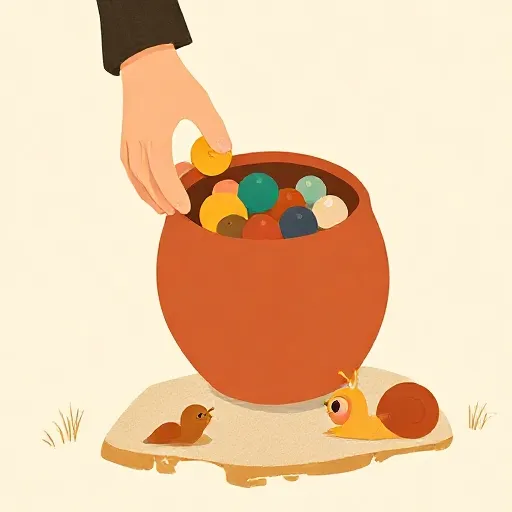
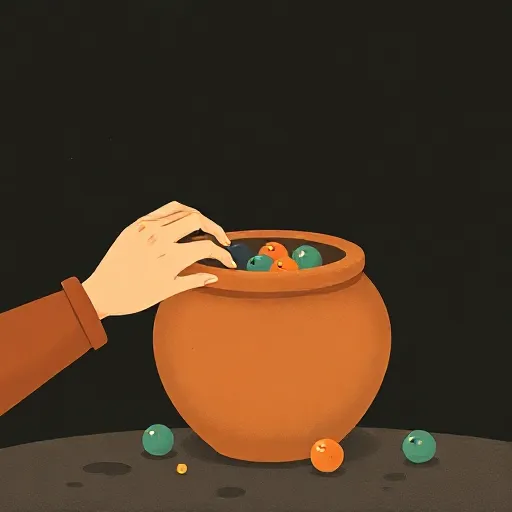
Why does this matter? Because it directly disproved Jenkin’s blending objection. Sexual reproduction, all by itself, does not destroy genetic variety. The shuffling of genes maintains variation; it doesn’t smooth it out. Think of a big bag of red and blue marbles (the alleles). If you blindly draw pairs to make new “offspring” marbles, the overall mix stays the same. Blending would be like crushing the marbles into purple dust—the original colors vanish. Mendel’s particulate inheritance is more like keeping the marbles whole, so red and blue can re-emerge.
The Hardy-Weinberg principle is a cornerstone. It tells us that if we see a population deviating from these proportions, something interesting is going on: perhaps selection is favoring some genotypes, or mating isn’t random, or the population is small. It gave biologists a null model, a baseline expectation, against which they could detect the forces of evolution.
The Tug-of-War Between Chance and Purpose
Once we know variation can persist, the next question is: what changes it? The two biggest players are natural selection and genetic drift.
Selection is the more familiar idea. If one allele helps an organism survive or reproduce better, its frequency will increase. A simple model shows that a beneficial allele can sweep through a population to fixation (100% frequency), while a harmful one can be eliminated. But not always. When heterozygote superiority exists—where the hybrid (Aa) has higher fitness than either homozygote—both alleles can be maintained in a balanced polymorphism. So selection doesn’t always smooth out variation; it can preserve it.
Genetic drift is stranger. In any real population, the number of individuals is finite. Each generation, the genes that make it into the next are a random sample of the parents’ genes. Imagine a village where ten families have a rare surname. Over generations, by sheer luck, some families have no sons, and the name might disappear entirely—or, less often, become the only name in the village. Drift works the same way on alleles. The smaller the population, the more powerful drift becomes.
In the 1960s and ’70s, a huge debate raged: how much of genetic change is due to selection, and how much to drift? Motoo Kimura (1924–1994) proposed the neutral theory of molecular evolution. He pointed out that many differences in DNA sequence don’t seem to affect an organism’s fitness at all; they are “neutral.” He argued that drift, not selection, is the main force shaping this molecular variation. Selectionists strongly disagreed, insisting that even tiny fitness differences could be decisive. The debate never ended with a clear winner. Today we know that both forces matter, and the balance depends on population size and the nature of the mutation. A key number is (4N_e s): if it’s much greater than 1, selection dominates; if much less, drift rules. The question of how much of evolution is driven by chance versus design remains one of the liveliest in biology.
What Is a Gene, Really?

The gene that Mendel described was a mysterious “factor” whose physical nature was unknown. For decades, population geneticists treated the gene as a unit of inheritance, something that stays whole as it passes from parent to child. When molecular biology later revealed that genes are stretches of DNA coding for proteins, a new concept of the gene emerged—as a functional unit, a recipe for a molecule.
These two concepts don’t perfectly align. A molecular gene might be split across several inherited segments, and not everything that behaves as a Mendelian unit is a protein-coding region. Some philosophers and geneticists have argued that classical and molecular genes are different things entirely, while others believe one can be reduced to the other. This is not just a word game; it affects how we think about evolution. If we define evolution as “change in gene frequencies,” are we reducing all the richness of life—butterfly wings, whale songs, human kindness—to shuffling alleles? Critics say this leaves out the role of development, the way an organism builds itself from genetic instructions. The field of evo-devo (evolutionary developmental biology) studies how small genetic tweaks can reshape bodies, and argues that evolution should be understood as changes in development, not just gene frequencies.
This may sound abstract, but it touches a question that matters to you: are you nothing but a temporary vehicle for your genes? The “gene’s eye view,” popularized by Richard Dawkins, suggests that organisms are merely survival machines built by genes to make more copies of themselves. It’s a powerful idea that has explained much about animal behavior. Yet it bristles with philosophical puzzles about what causes what, and whether you can be reduced to a sequence of letters.
Why It Still Matters: From Peas to Your Own Story
Today, high-speed sequencing lets us read the DNA of thousands of individuals and search for signatures of past selection. The mathematical toolkit that Fisher, Haldane, and Wright built a century ago still lies at the heart of this research, even as we tackle questions they could not imagine: tracing human ancestry, understanding genetic diseases, and even debating whether racial categories reflect deep biological divisions or social constructions.
And the old questions persist. Why don’t you look identical to your sister, even though you share the same parents? Because Mendel’s shuffling cards put a different hand of alleles into each of you. Why does some variation stick around? Because of heterozygote advantage, mutation, migration, and drift. Are the forces that shaped your genome mostly the result of careful selection, or did a lot of it happen by dumb luck? The jury is still out.
The math that saved Darwin’s theory started with a monk counting peas. It grew into a way of seeing life as a grand tug-of-war between chance and necessity. And it invites you, the next time you notice a family resemblance or a surprising difference, to wonder about the invisible cards you were dealt and the hidden equations that keep our world gloriously, stubbornly varied.
Think about it
- If you ran a simulation where small random changes (like genetic drift) sometimes win over big advantages (like selection), how would you decide when chance is more important than fitness?
- Some argue that defining evolution as “change in gene frequencies” misses the whole animal. Can you think of something about a living thing that cannot be captured by just listing its genes?
- Imagine you could edit a single gene in a child to make them taller. Would that be more like shuffling a deck of cards (just rearranging what nature already allows) or like painting a new picture? Why?