Why Scientists Can’t Agree What a Gene Really Is
The Monk Who Counted Peas
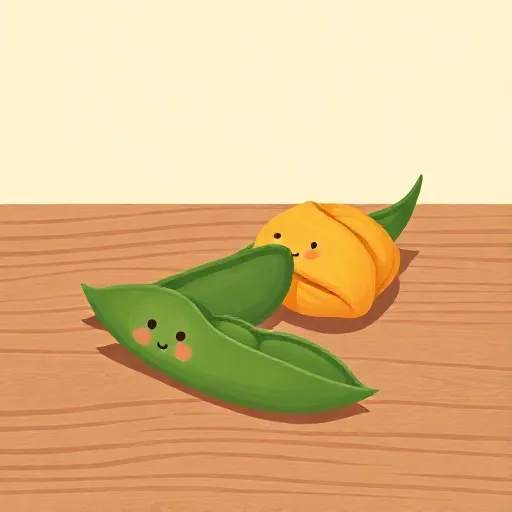
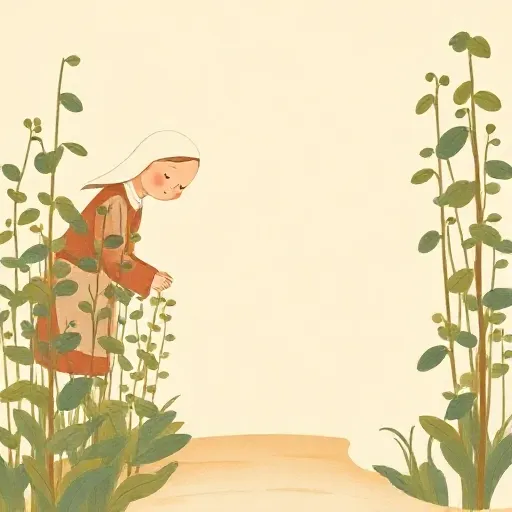
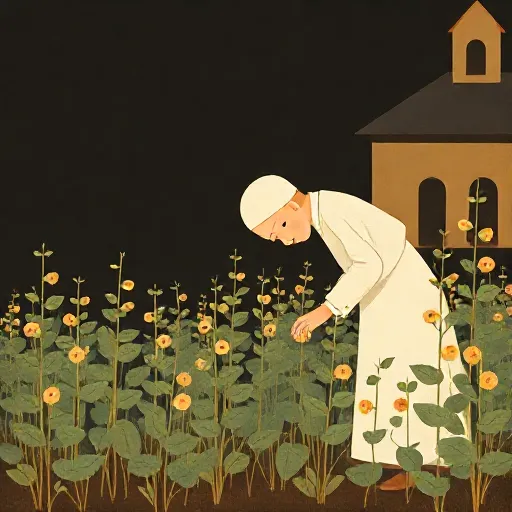
In the 1850s, inside an abbey garden in what is now the Czech Republic, Gregor Mendel (1822–1884) was trying to solve a puzzle. He crossed pea plants with round seeds and plants with wrinkled seeds, then did it again with other traits — tall stems versus short, purple flowers versus white. He wasn’t looking for a grand law of heredity. He wanted to know what happened when hybrids mated with each other.
To see clearly, he made a few clever moves. First, he studied only one clear trait at a time. Second, he grew hundreds of offspring — enough to trust his counts. Third, he invented a simple letter notation to keep track of what he called elements.
The results were striking. In the first generation, every seed came out smooth round — the wrinkled form had vanished. Mendel called that winning form the dominant character and the hidden one recessive. But when he crossed those first-generation plants, the recessive trait popped back up in about one quarter of the next batch. Over and over he saw the same 3-to-1 ratio in the second generation.
Mendel concluded that each plant carries two elements for each trait, one from each parent. When sex cells form, those elements separate, so an egg or pollen grain gets just one. He didn’t claim his patterns were laws for all life — he thought other species might behave differently. Still, he had hit on something big about how biological information gets passed down.
The Invisible Unit Gets a Name
Around 1900, three botanists independently rediscovered Mendel’s work. Soon after, William Bateson (1861–1926) gave the new science a name: genetics. Bateson and other early Mendelians talked about invisible “unit-characters” and called the actual thing passed on a factor. One popular idea was that a dominant trait appeared because a factor was present, while a recessive trait appeared because it was absent. But no one knew what the factor physically was.
That changed with Wilhelm Johannsen (1857–1927). In 1909 he coined the term gene — a deliberately neutral word that didn’t commit to any material substance. He also drew a line that still shapes biology: your genotype is the collection of genes you inherit; your phenotype is what you can observe (your height, eye color, or a disease). The gene was, for now, a handy counting tool.
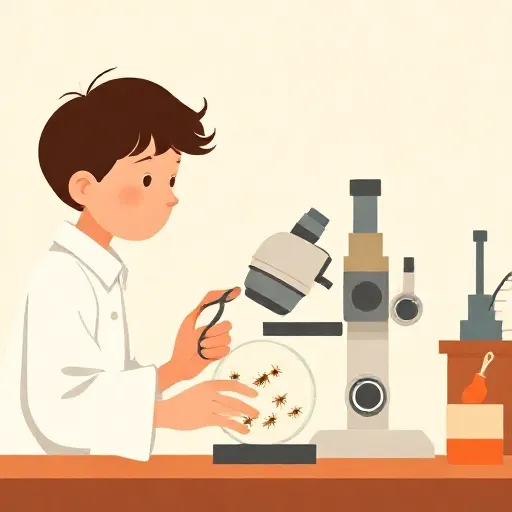
Thomas Hunt Morgan (1856–1945) and his students turned that tool into something you could map. They bred millions of fruit flies and watched how traits like eye color and wing shape got mixed up in offspring. Some traits were inherited together more often than expected. Morgan reasoned that genes are arranged in a line on chromosomes — the threadlike bodies seen in cell division — and that close neighbors tend to stay together. By counting how often two traits were split apart (“crossing over”) they built the first linear chromosome maps. A gene was now a position on a chromosome, a real physical place. Still, the connection was slippery: a single gene could influence many traits, and many genes often influenced one trait. The only safe claim was that a difference in a gene leads to a difference in a phenotype.
A Secret Code in a Twisted Ladder
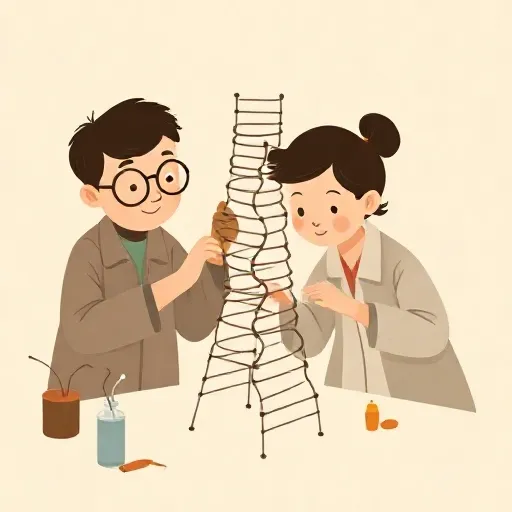
As microscope work pushed forward, a deeper question took hold: what is a gene made of? By the 1940s, experiments with bacteria and viruses pointed strongly at DNA, a long molecule found in chromosomes. In 1953, James Watson (born 1928) and Francis Crick (1916–2004), using X-ray data from Rosalind Franklin and Maurice Wilkins, built a model: the double helix. Two strands wind around each other, held together by pairs of four chemical bases — adenine (A) with thymine (T), cytosine (C) with guanine (G).
The shape itself suggested how a gene could copy itself: unwind the strands, and each acts as a template for a new partner. Around the same time, George Beadle (1903–1989) and Edward Tatum (1909–1975) used bread mold to show that one gene controlled the production of one enzyme (the one gene–one enzyme hypothesis). Proteins are chains of amino acids; enzymes are proteins that speed up chemical reactions. The next puzzle: how does a sequence of bases direct the sequence of amino acids?
Crick proposed the sequence hypothesis: a stretch of DNA is a code, with three bases spelling one amino acid. He also formulated the central dogma: information flows from DNA to RNA to protein, but never backward from protein to DNA. By the late 1960s, labs had cracked the full genetic code — 64 triplets (codons) for 20 amino acids. A gene looked like a neat package: a DNA segment with a start signal, a protein recipe written in codons, and a stop signal. Job done — or so it seemed.
When One Gene Isn’t One Recipe
Almost immediately, the tidy picture started to fray. In the 1970s, researchers discovered that in animals and plants the DNA for many proteins was interrupted by long non-coding stretches called introns. The coding parts, called exons, get spliced together after the gene is copied into RNA. Even more surprising, a single gene can be spliced in different ways to make different proteins — and the splicing pattern can change depending on the cell type or moment in development.
At the same time, scientists were uncovering that genes are not just passive recipes. François Jacob (1920–2013) and Jacques Monod (1910–1976) worked out that bacteria switch genes on and off with repressor proteins that bind to DNA near the gene. So besides structural genes that code for enzymes, there are regulatory genes that control when other genes are active. In complex organisms, some genes produce RNA molecules that never become proteins at all but still do crucial work.
Then came the surprises of the Human Genome Project. When the first complete human sequence was released in 2003, biologists found only about 23,000 protein-coding genes — far fewer than expected. A tiny worm has nearly as many. The real complexity comes from alternative splicing, layers of regulation, and a vast landscape of non-coding DNA that gets transcribed into RNA. The ENCODE project later confirmed that a huge portion of the genome is alive with overlapping transcripts and far-flung control switches. The once‑crisp definition — a stretch of DNA that codes for one protein — no longer holds.
Why the Gene Keeps Shape-Shifting

If a gene isn’t one fixed thing, what is it? Many philosophers of science argue that there simply isn’t a single answer — and that’s not a failure, it’s a sign of a healthy, evolving concept. In today’s biology you find at least three gene identities living side by side.
The instrumental gene (or gene-P) is the classic unit defined by its effect: a DNA difference that helps predict a trait, like a mutation linked to a disease. Breeders and medical geneticists use this version all the time because it’s practical. The nominal gene is the tidy protein‑coding unit still used in databases — it’s easy to annotate, even if it oversimplifies the mess inside cells. Then there is the post‑genomic gene: a union of genomic sequences that together give rise to a set of possibly overlapping products, including proteins and functional RNAs.
Why should this matter to you? Because almost every time you hear “scientists found the gene for…” you are hearing the instrumental gene, stripped of context. Real traits — height, personality, risk of diabetes — depend on many genes, countless non‑coding elements, and the environment. When the gene shape‑shifts, it reminds us that biology isn’t a simple instruction manual. That humility makes for better medicine, fairer talk about human differences, and a deeper respect for the living world that keeps surprising us.
Think about it
- If someone says “I have the gene for getting angry,” what does that statement miss about how genes really work?
- Suppose a test tells you that you have a DNA variant linked to a disease, but that disease never appears. What are some possible reasons?
- Is it helpful to keep using the word “gene” even though its meaning keeps changing, or would it be better to invent new words?