What Is a Gene, Really? The Mystery That Took Over Biology
The Puzzle That Baffled Geniuses
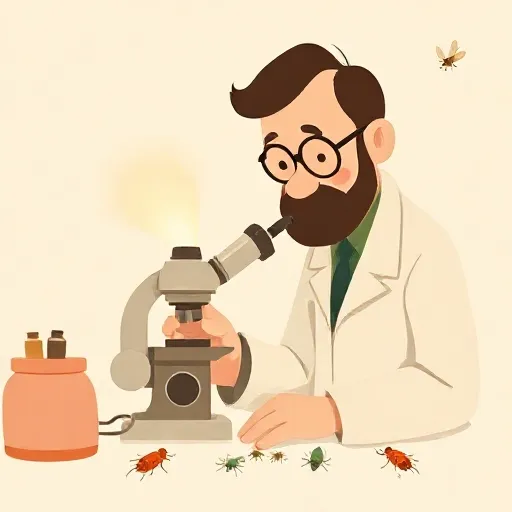
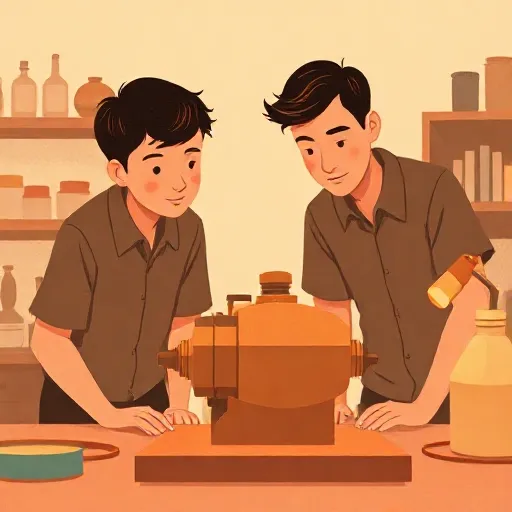
In the 1930s, a scientist named Hermann J. Muller (1890–1967) was stuck. He had spent years blasting fruit flies with x-rays to change their genes—the mysterious factors that pass traits from parent to offspring. He knew genes had to be made of real, physical stuff. But as a geneticist, he could not figure out what that stuff was or how it worked. So in 1936, he begged physicists and chemists to join the hunt. His plea sparked a revolution. Within decades, a new science called molecular biology had cracked the structure of DNA and uncovered the basic mechanisms of life—collections of tiny parts (like molecules) whose organized activities (like bonding) produce a phenomenon (like copying a gene). But even as they celebrated, deep philosophical questions surfaced: What exactly is a gene? Does DNA really mastermind the cell? And can we trust what we learn from studying worms and mice?
The physicists answered Muller’s call. Erwin Schrödinger (1887–1961), famous for his work in quantum mechanics, wrote a book called What Is Life? in 1944. He proposed that genes might be stable yet changeable, like a quantum code. Max Delbrück (1906–1981), another physicist, became fascinated by the physical basis of heredity. He started studying viruses that infect bacteria—tiny, fast-multiplying systems to probe how living things copy themselves. Delbrück and his colleague Salvador Luria formed the “Phage Group” in the early 1940s, training a generation of scientists in this new, mixed discipline. The term “molecular biology” itself was coined in 1938 by Warren Weaver, who saw these new physical and chemical approaches merging. But the big breakthrough was still to come.
The Twisting Ladder That Changed Everything
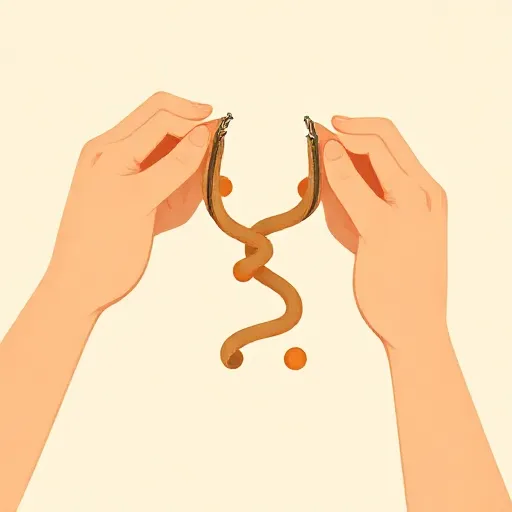
In 1953, James Watson (born 1928) and Francis Crick (1916–2004) built a model that looked like a twisted ladder. The sides were a sugar-phosphate backbone, and the rungs were pairs of four chemical bases—adenine with thymine, cytosine with guanine. This double helix was DNA, and the pairing meant that if you unzipped the ladder, each half could serve as a template to build a new copy. Watson and Crick had uncovered how genetic information could be passed on. The very next year, Crick proposed his central dogma: information flows from DNA to RNA to protein, but never backward. The cell reads a gene like a recipe, transcribing it into a messenger RNA and then translating that into a protein, the workhorse of your body. This was elegant—a molecular code that spelled out life.
But the gene’s story soon got messy. In the late 1970s, scientists discovered split genes: long stretches of DNA that are chopped up, with coding parts (exons) sitting between huge non-coding gaps (introns). Even more startling, they found alternative splicing—one gene could be cut and reassembled in different ways to make different proteins, like a sentence that changes meaning depending on where you start reading. And some genes overlapped, sharing the same stretch of DNA but read in different frames. The simple idea that one continuous DNA sequence equals one protein crumbled. So what exactly was a “gene” now?
When a Gene Isn’t Just a Gene
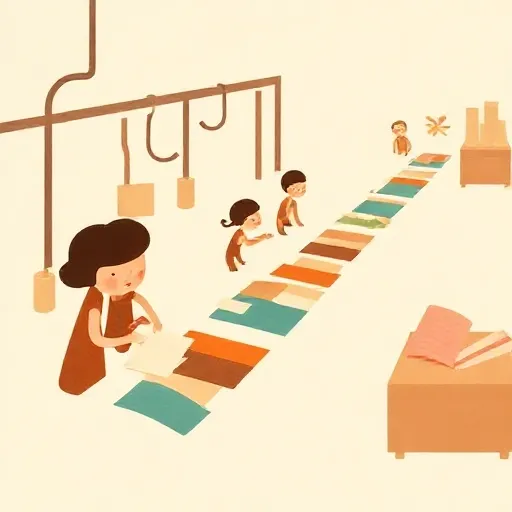
Philosophers jumped into the muddle. Evelyn Fox Keller (20th–21st century) argued we might need two gene concepts. A structural gene is simply the ordered sequence of DNA bases that gets transcribed. A functional gene is the broader set of DNA elements—including regulatory regions—that together produce a trait. So even non-coding DNA that helps turn a gene on or off counts as part of the functional gene. Others went further. Eva Neumann-Held proposed a process molecular gene concept: the gene is not a static object but the whole recurring process that leads to a specific protein in a specific time and place. It is like a recipe that only works when you also consider the oven, the ingredients, and the chef’s timing.
These philosophical moves weren’t just wordplay. They highlighted a deeper puzzle: if making a protein requires a swarm of molecules beyond the DNA—enzymes, RNA, energy carriers—then who is really in charge?
Is DNA Really the Boss? The Causal Showdown

For decades, textbooks called DNA the “master molecule,” the carrier of information that tells the cell what to do. But many philosophers pushed back with the causal parity thesis: if you remove any essential part—a ribosome, a splicing enzyme, a signal from outside the cell—the protein doesn’t get made, so no single part is more important than any other. Just as an orchestra needs every player, a cell needs every molecule.
W. Kenneth Waters defended DNA’s special status. He argued that DNA is an actual difference maker. If you swap a specific DNA sequence, you get a predictable change in the protein. You can’t achieve that precise, systematic control with most other molecules. DNA has causal specificity. Think of a light switch and a power plant: both are needed to light a bulb, but the switch gives you fine-grained, moment-by-moment control. Even so, the discovery of “junk DNA”—stretches that don’t code for proteins—complicated the picture. Some philosophers point out that junk DNA can still influence when genes are used, but its causal reach is limited, so it doesn’t get the same status. The debate isn’t settled, and it matters for how we think about genetic diseases, evolution, and even personal identity.
Meanwhile, the very word “information” was under fire. Some philosophers, like Ulrich Stegmann, argued that DNA genuinely carries instructional information because its base sequence specifies the exact order of steps for building a protein. Others, like Eva Jablonka, saw information everywhere: environmental cues, maternal chemicals in the egg, even behavioral traditions. A third camp, including Waters, claimed that talk of information is just a handy metaphor—what really matters is the causal work. So depending on your view, a gene is either a rich information store, a convenient label, or just one link in an endless chain.
Why This Isn’t Just for Scientists: The Mouse in Your Medicine Cabinet
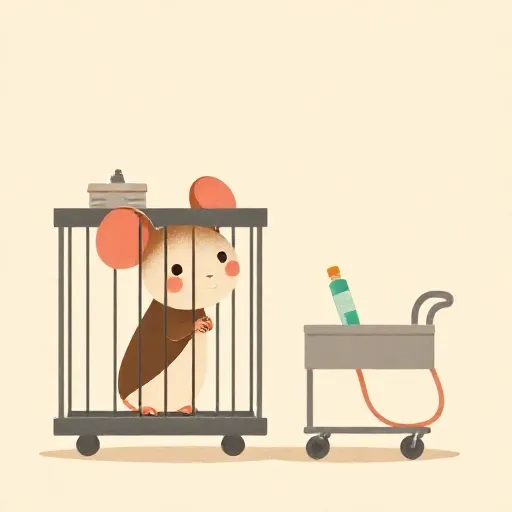
Molecular biology didn’t stay in the lab. Today, researchers routinely humanize mice by inserting human genes to test new medicines. This raises a thorny philosophical problem called extrapolation. How do we know that what happens in a mouse will happen in a human? Mice and humans share many genes, but they aren’t identical. Scientists must decide which parts of the molecular mechanism are similar enough. If they get it wrong, a drug that works in a mouse might fail in you—or even harm you.
Philosophers call the trap the extrapolator’s circle: to know if a mouse is a good stand-in, you already need to know how the human mechanism works, which is exactly what the mouse was supposed to reveal. Daniel Steel suggested a way out: we only need to check the downstream parts of the mechanism that sit after any likely difference. It’s like confirming that a water pipe after a bend is the same material in both houses—upstream connectors might differ, but the final stretch matters most. Yet critics worry that even this shortcut demands too much knowledge, or that alternative pathways can mask hidden differences. The question of how we extend knowledge from model organisms to you remains a live philosophical fight.
So next time you hear about a genetic breakthrough, remember: the questions behind the discoveries are as tangled as the molecules themselves. If you’ve ever wondered whether you’re just a bundle of chemical reactions running a code, you’re already doing philosophy—and you’re in good company.
Think about it
- If scientists could predict every choice you’ll ever make by reading your DNA, would it still be fair to punish people for bad actions?
- A recipe for a cake doesn’t bake itself—you need flour, eggs, and an oven. Does that mean the recipe isn’t really the “boss” of the cake? How is a gene like a recipe?
- Suppose we discover that a mouse’s heart works exactly like a human heart at the molecular level. Would it be okay to test all new heart medicines only on mice and skip human trials? Why or why not?