Are Genes Really the Instruction Manual for Your Body?
The Fly That Made Philosophers Think
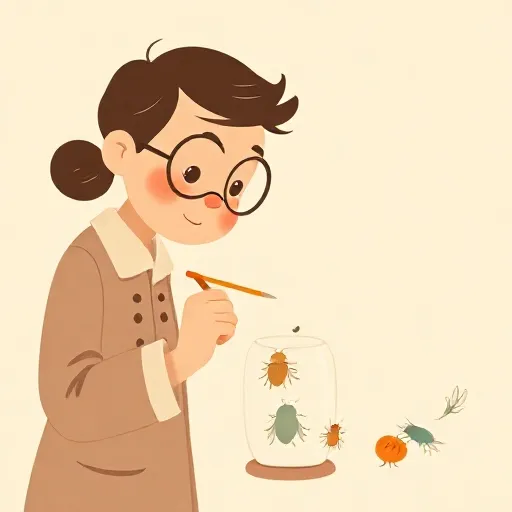
In 1910, in a cramped laboratory at Columbia University, a biologist named Thomas Hunt Morgan (1866–1945) stared at a tiny fruit fly. It had white eyes instead of the usual red. That single odd fly launched a century of questions — not just about biology, but about what counts as an explanation.
Morgan and his students discovered that traits like eye color are linked to tiny units they called genes, lined up on chromosomes. They didn’t know what genes were made of. They didn’t need to. Their theory explained how parents pass traits to offspring simply by tracking the movement of chromosomes. A difference in a gene (say, a mutant version) caused a difference in eye color, under certain conditions. This idea — the difference principle — was enough to build a whole science of heredity. You don’t need to know what a gene is to predict that two purple-eyed flies will have purple-eyed babies. You just need to know that the difference makes a difference.
But as molecular biology exploded in the 1950s, scientists uncovered the physical stuff: DNA. Now a gene was a stretch of DNA that coded for a protein. That opened a deeper puzzle. If we can describe everything in molecules, does that replace the old explanations? And what is a gene, really, when the DNA doesn’t have clean boundaries?
When Genes Turned Into Molecules
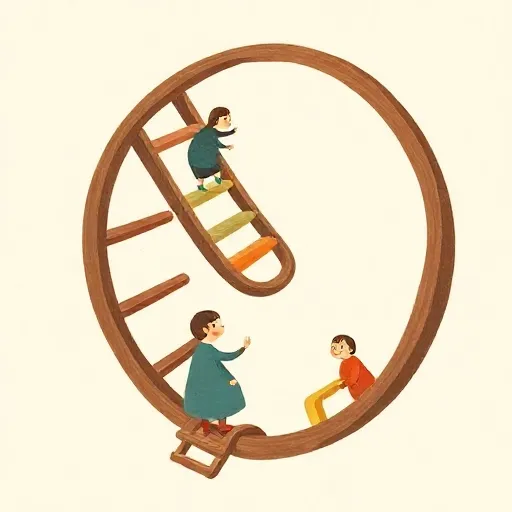
By 1953, James Watson and Francis Crick showed that DNA is a double helix — a twisted ladder with rungs made of four chemical bases (A, T, G, C). A gene became a string of these bases along one chain. The sequence of bases spells out a sequence of amino acids, which fold into a protein. That protein might be an enzyme that affects eye color, or a hormone, or a structural part of a cell.
This answered old questions. How do genes replicate? The double helix unzips, and each strand serves as a template for a new partner strand. How do gene differences cause trait differences? A change in the base sequence leads to a different amino acid chain, which might change the protein’s shape and action. So the purple-eye mutation in Morgan’s fly turned out to be a difference in a DNA sequence that eventually alters a pigment-making protein.
Many scientists then took a bolder step. They claimed that genes don’t just specify proteins — they direct the whole development of an organism. The genome contains the “program,” the “blueprint,” the “information” for building and running a body. Everything else is just raw materials. This sweeping idea is what philosophers call the fundamental theory of molecular genetics. And it’s where the trouble begins.
Can You Explain Heredity Without Talking About Molecules?
A fierce debate in philosophy of science asks: was classical genetics reduced to molecular genetics? Reduction here means that the old theory’s laws can be derived from the new theory’s laws — like how the gas laws can be derived from the motion of molecules. The philosopher Kenneth Schaffner (1970s) argued that a corrected version of classical genetics was being reduced. But most philosophers of biology pushed back.
One objection is that terms from classical genetics don’t match up neatly with molecular ones. A classical gene for eye color isn’t a single stretch of DNA; it’s any difference in DNA that makes a visible difference. A fruit fly’s red eye involves dozens of genes, and mutations in many of them can cause white eyes. So you can’t map “the gene for red eyes” onto one molecular segment. This is the unconnectability objection.
A deeper worry is the gory details objection. Classical genetics explains patterns of inheritance by following whole chromosomes during meiosis, the cell division that makes egg and sperm cells. At that level, the separation of chromosome pairs is simple. At the molecular level, the forces involved are chaotic and diverse. Yet the simple picture works perfectly. Does adding molecular details actually improve the explanation, or just bury it?
The debate taught philosophers something important: different levels of explanation can coexist without one being more real than the other. You don’t need molecular gory details to predict that the offspring of two purple-eyed flies will have purple eyes. The classical story is still powerful.
What Is a Gene, Anyway?
If you open a biology textbook, it will say a gene is a segment of DNA that codes for a protein. But that tidy definition falls apart under a microscope. In organisms like us, many DNA stretches produce RNA that never becomes a protein but does essential jobs. So the definition is too narrow. Worse, the “coding” region is often split into pieces called exons, separated by non-coding bits called introns. The cell snips out introns and splices exons together — sometimes in different combinations — to make different proteins from the same DNA stretch. So is the gene the whole region including introns, or only the exons? Biologists use the term both ways depending on context.
Some philosophers became gene skeptics. They argued that “gene” is a dummy word covering too many different molecular units, from coding sequences to regulatory switches. They suggested biologists should drop the term and only use precise labels like exon or promotor.
Others proposed precise molecular gene concepts. One idea is that a gene is whatever segment of DNA determines the linear sequence in a particular product — an RNA molecule or a protein — in a particular cellular context. So the same DNA stretch might be described as a gene for a raw RNA (including introns) or as a gene for the final protein (only exons). It’s consistent, but it means you can’t point to a fixed piece of DNA and say “that is the one gene.” Genes are partly defined by what they do and when.
Even more radically, some thinkers suggest thinking of a gene as a process — the whole event that involves DNA, splicing machines, and other molecules to produce a protein. That shifts the focus away from DNA as the star of the show.
The “Information” Metaphor Under the Microscope

Philosophers have long been suspicious of talk about genetic information. The idea that DNA carries a “program” or “blueprint” appeals to our love of crisp explanations. But when you examine it closely, the metaphor cracks.
Consider the claim that DNA contains causal information about the organism, just as smoke carries information about fire. The trouble is that if you swap the roles, the environment also carries information about the organism’s traits. A plant’s height reliably correlates with sunlight and soil, not just its genes. So information isn’t locked in DNA.
What about intentional information, like a sentence that means something? Some biologists argue that natural selection programs DNA with instructions, just as an engineer programs a computer. But natural selection has no mind. It can’t intend anything. Moreover, a random mutation that happens to be useful would still affect development in the same causal way, but it wouldn’t count as “programmed” by selection. So the metaphor doesn’t hold up under that reading either.
A growing number of philosophers suggest replacing information talk with straightforward causal language. Genes are actual difference makers: when two versions of a gene exist in a cell, their difference leads to different RNA molecules. Genes are special, however, because they are causally specific — many small changes in DNA sequence produce many specific changes in the RNA and protein sequences, like a dimmer switch with a thousand settings rather than just on/off. Other causal players, like enzymes, are more like on/off switches. This gives genes a distinctive, but not superior, role. They aren’t the master controller; they are one very precise dial in a vast network of causes.
Why This Matters for How You See Yourself
These philosophical puzzles aren’t just for academics. The language of genes as information shapes how we think about intelligence, illness, and identity. If genes are the “blueprint,” then we might imagine our future is written in our DNA. But if genes are just one kind of specific cause among many, that picture loses its power.
Biologists defend centering research on genes for a pragmatic reason: genes are incredibly useful handles for manipulating biological systems. By tweaking a specific gene, you can trace a whole chain of effects. That practical power doesn’t require believing genes are the ultimate directors of life. So the next time someone says you have a “gene for” a talent or a disease, you can ask: what exactly is that gene, and what is it doing? The answer might be more complicated — and more interesting — than any simple blueprint.
Think about it
- If every trait has many causes, including genes, environment, and chance, is it ever fair to say a person is “born that way”?
- Suppose scientists could perfectly predict your height from your DNA sequence alone. Would that mean your nutrition during childhood didn’t matter?
- When you describe a piece of music as a “code” for a feeling, are you using a metaphor? How is that similar to calling DNA a “code” for life?