What Galileo Saw Through His Telescope and Why It Almost Destroyed Him
A Tube Pointed at the Sky
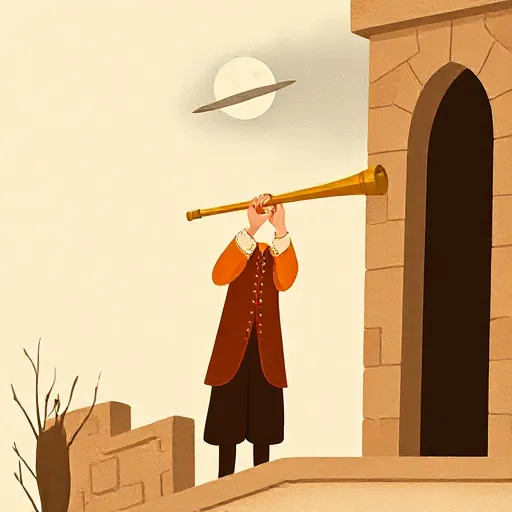
One night in 1609, a middle-aged Italian stuck a bent tube of glass and metal out his window and pointed it at the moon. His name was Galileo Galilei (1564–1642), and he did not expect to see rocks. For centuries, everyone had believed that the moon was a smooth, perfect heavenly sphere. Instead, his telescope — a spyglass he had improved himself — showed dark valleys and jagged mountains catching the sun.
Over the next few months, Galileo trained his new instrument on Jupiter and found four tiny stars that seemed to follow it. They were moons, just like our own, circling a planet that wasn’t the Earth. He saw that Venus had phases, like the Moon, which meant it had to revolve around the Sun. In 1610 he rushed a small book into print: The Starry Messenger. It made him famous across Europe.
But Galileo wanted more than fame. He asked the Grand Duke of Tuscany to give him the title of not just “Mathematician” but also “Philosopher.” At that time, natural philosophy was the name for the study of nature — what we now call science. The old natural philosophy, built by Aristotle and accepted in the universities, sorted everything into separate categories: the celestial realm was made of a perfect fifth element, while the messy Earth was made of earth, water, air, and fire. Each had its own kind of motion. Galileo was about to tear that whole picture apart and replace it with a single, mathematical science of matter.
Making Matter Obey Math
When Galileo was a young teacher in Pisa around 1590, he wrote a private book called On Motion. He attacked Aristotle’s claim that some things are naturally heavy (earth and water) and others are naturally light (air and fire), so they move up or down because of two different principles. Galileo argued there is only one principle: heaviness. A piece of wood floats on water not because it has lightness, but because heavier water pushes it up.
He pictured heaviness using a balance scale: a weight on one side is heavier in proportion to the weight on the other side. If he could describe all motion with that same mathematical pattern, he would have a single science of matter. But he quickly realized that a simple balance could not capture changing motion. A rock falls faster and faster — its speed grows. How do you weigh acceleration?
Galileo invented a new concept, momento, a sort of momentary push that depends on a body’s weight and speed. He played with inclined planes and pendulums, trying to find reliable measures. The pendulum gave him a crucial clue: the time it takes for a bob to swing depends only on the length of the cord, not on how heavy the bob is. Time, he began to see, might be as important as weight. Still, getting a clear mathematical law for falling bodies took years. He finally cracked it: a body starting from rest falls a distance that grows with the square of the time — what we now call the law of free fall. Yet he did not publish a word about time-centered motion until almost the end of his life.
One Matter, One Motion
After 1610, Galileo’s telescope kept smashing the old distinction between heaven and Earth. The moon had mountains like Bohemia. Jupiter had moons — so Earth wasn’t the only center of circling. Venus went through a complete set of phases, proving it orbited the Sun, not us. If the heavens contained the same kind of stuff as our own world, then all matter everywhere must be one thing. And if there is only one kind of matter, there can be only one kind of natural motion.
By 1632, Galileo was ready to defend Copernican heliocentrism — the idea that the Sun stands at the center and Earth moves around it — in a book called Dialogue Concerning the Two Chief World Systems. He proposed two principles that covered the whole universe. First, matter naturally moves in circles at a steady speed. Second, an observer cannot detect a uniform motion they share with what they are watching. If you are on a smoothly moving boat and drop a stone from the mast, it lands at the foot of the mast, not behind — because the stone, you, the boat, and the air all share the same horizontal glide. Likewise, we do not feel Earth spinning because we spin with it. So all the old complaints — “If Earth moved, birds would be left behind!” — fall apart.
Galileo even believed he had a physical proof of Earth’s motion: he said the tides were caused by the sloshing of the seas as parts of Earth’s surface sped up and slowed down during its combined daily spin and yearly orbit. It was clever and mechanical, but it was also wrong. Yet for him, all the pieces now fit: one matter, one motion, one mathematically describable world.
The Day He Took It All Back
The Church was not pleased. In 1616, officials had suspended Copernicus’s book and warned Galileo not to teach or defend the sun-centered view. Galileo countered with a careful argument: God had written two books — the Bible and the book of nature. Both were true, and they could not truly contradict each other. But both needed interpretation. The Bible was for ordinary people and sometimes spoke in everyday language (like saying the sun “rises”). Nature’s book was written in the language of mathematics, and its meaning had to be discovered through patient investigation.
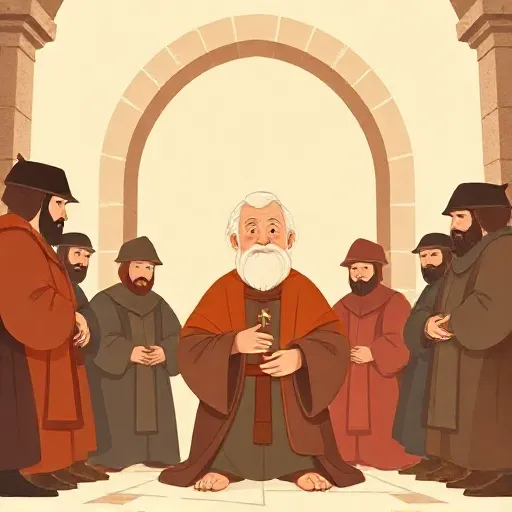
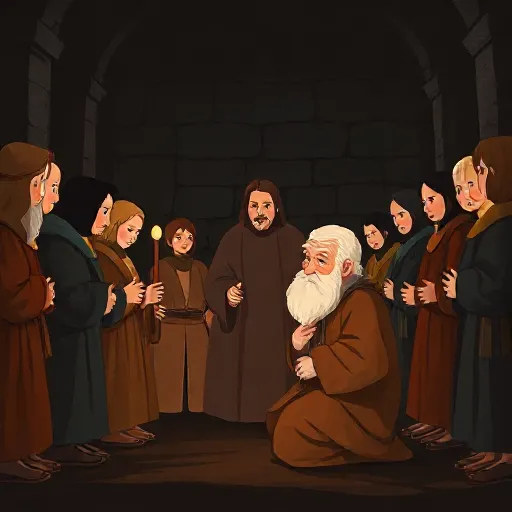
Cardinal Robert Bellarmine, the Church’s leading theologian, replied that if Galileo had absolute proof, he might take it seriously. But a planetary model, he said, was just a mathematical tool — not a physical claim. Galileo could not prove his tidal argument beyond doubt, and many of his telescopic claims were still debated. So in 1633, after publishing the Dialogue, Galileo was dragged to Rome and forced to kneel in the church of Santa Maria sopra Minerva. He was convicted of “vehement suspicion of heresy” and made to abjure — formally to swear that he did not hold the sun-centered belief and that he “curse and detest” those errors. His sentence was house arrest for the rest of his life.
While confined, he wrote his final masterpiece, Two New Sciences, which laid out his mechanics of matter and motion without mentioning Copernicus at all. It was smuggled out of Italy and published in Holland in 1638.
Why You Still Hear His Name
Galileo’s gamble changed what it means to do science. He gave us the idea that matter everywhere — in a falling apple, on the moon, inside a star — is the same stuff, described by the same mathematical laws. When you drop your phone and calculate how fast it falls, you are using the physics he helped invent. When you spin on a carnival ride and feel pushed outward, his early thoughts about motion are under the math that engineers still use.
And the trial never really ended. It opened a battle that echoes today: when science and authority disagree, whose voice should shape what we teach? Galileo’s reply — that nature has its own language, and we must read it with tools and honest doubt — still sits at the heart of how we learn about the world. The next time you look up at a bright half-moon, you are not seeing a perfect heavenly lamp. You are seeing a place. That shift, more than any telescope, is his real gift.
Think about it
- If you saw something through a telescope that your whole community said could not be true, what would you do?
- Galileo believed the book of nature is written in math. Do you think everything in the universe can be explained with numbers, or are there things math can’t capture?
- Should a scientist with a strong belief but imperfect proof be allowed to teach it, even if it upsets powerful people? Why or why not?