Galileo’s Trial: Did It Start a Science vs Religion War?
Galileo’s Telescope and the Bible: The Start of a War?

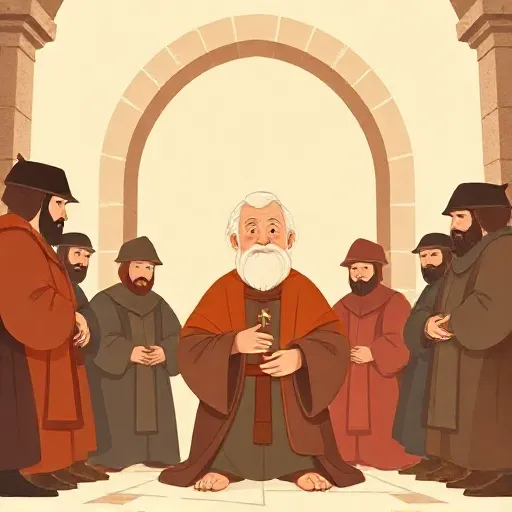
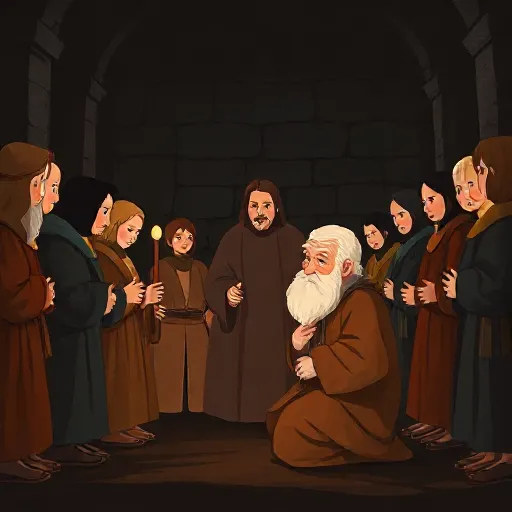
In 1633, an elderly Italian scientist knelt in a grand hall in Rome. His name was Galileo Galilei (1564–1642), and he was on trial. His crime? He had used a new invention—the telescope—to argue that the Earth travels around the Sun, not the other way around. Church leaders believed his idea contradicted the Bible. Under threat of punishment, Galileo was forced to publicly deny his own discovery.
Was this the beginning of a long war between science and religion? For many people, the answer is “yes.” The idea spread that science and religion are in constant, unavoidable conflict—a fight that started with Galileo and continued with every new discovery. In the 19th century, writers like John William Draper (1811–1882) and Andrew Dickson White (1832–1918) painted this picture in bestselling books, and their version stuck.
But historians today disagree. They point out that the story is more complicated. Draper and White were not neutral reporters; they had their own reasons for telling a dramatic tale of warfare. Most scholars in the field now say that the conflict model—the view that science and religion are locked in permanent battle—is a shallow reading of history. So if they aren’t simple enemies, what are they? The question has launched decades of careful thinking about how two powerful ways of understanding the world can live together.
Four Ways to Picture Science and Religion

One of the most influential thinkers in this debate was Ian Barbour (1923–2013). In the 1960s, he laid out four basic models of the science–religion relationship. His categories are still used today.
The first is the conflict model—the idea we’ve just met. Science and religion can’t both be right about the big questions, so one must eventually defeat the other. Some outspoken atheists today, like Richard Dawkins (born 1941), treat religious claims as testable hypotheses and argue that science leaves no room for a supernatural God.
The second is the independence model. According to this view, science and religion are completely separate domains that ask different questions. The biologist Stephen Jay Gould (1941–2002) called them Non-Overlapping Magisteria (NOMA). A magisterium is a domain of authority. Science’s magisterium covers facts about the natural world. Religion’s magisterium covers values, meaning, and purpose. If each stays in its lane, there is no conflict. But many philosophers have pointed out a problem: religions routinely make factual claims—like “Jesus rose from the dead” or “the early Hebrews crossed the Red Sea.” If religion is barred from saying anything about what happened in the world, it’s hard to see how it can justify its moral teachings.
The third is the dialogue model. Science and religion do overlap, but they talk rather than fight. They might share similar methods, like using metaphors and models to understand things we can’t directly see. A Christian might say that believing the universe is orderly and intelligible came from the idea of a creator, which encouraged scientific investigation in the first place. Dialogue doesn’t force a merger; it simply keeps the conversation going.
The fourth is the integration model. Here, the two fields actively reshape each other. Some thinkers try to build arguments for God’s existence using scientific facts, like the universe’s origin in the Big Bang. Others start with religious beliefs and reinterpret scientific findings through that lens—seeing evolution not as a blind process but as God’s way of creating. Integration sounds attractive, but it’s hard to do without stretching either the science or the religion in troubling ways. Still, many religious scientists and theologians find it the most satisfying path.
Not Just Christianity: Other Religions, Other Stories

For decades, the science-and-religion conversation focused heavily on Christianity and Western science. But the picture becomes richer and more complicated when we look at other traditions.
Buddhism, for example, does not teach that there is an unchanging soul. Some modern Buddhists have argued that this fits neatly with neuroscience, which explains thoughts as brain activity and finds no separate “self” inside the head. But historically, when Darwin’s theory of evolution reached East Asia, many Buddhist thinkers rejected one piece of it—the “struggle for existence.” They emphasized compassion and cooperation instead, pointing toward ideas biologists would only embrace later.
Islam has its own complex history. Between the 9th and 15th centuries, scientists in the Islamic world led the way in mathematics, astronomy, optics, and medicine. Later, more conservative theological views gained influence, and scientific activity slowed. In the 19th century, evolutionary ideas arrived together with European colonialism, and many Muslims came to associate science with foreign control. Today, some Muslim scientists argue that the Qurʾān and science are in harmony, while others reject human evolution because the Qurʾān describes Adam being specially created from clay.
Hinduism includes both polytheistic and monotheistic strands and does not always draw a sharp line between God and creation. When British colonialism brought Western science to India, thinkers like Swami Vivekananda (1863–1902) claimed that Hindu scriptures had long anticipated scientific truths, a “Vedic science” that made the tradition modern and compatible. Other Hindus rejected evolution entirely, much like some Christians did. The range of responses shows that a religion’s reaction to science depends as much on history, politics, and culture as on doctrine.
Can God Act in a Scientific World?

One of the sharpest debates sits inside a single idea: methodological naturalism. This is the rule that science, in its daily work, looks only for natural causes. A neuroscientist explains a thought by talking about brain states, not an immaterial soul. A geologist explains a rock layer through plate tectonics, not a miracle. Almost everyone agrees that doing science requires this rule, at least inside the lab. The question is: what does this say about whether anything supernatural exists at all?
Some go further and embrace ontological naturalism—the claim that the natural world is all there is. But plenty of religious thinkers accept methodological naturalism for scientific practice while also believing in God’s action. The challenge is explaining how God acts without breaking the laws of nature. One classic answer is interventionism: a miracle is God temporarily suspending a law, like a programmer reaching in to change a game. But as physics came to picture the universe as a vast deterministic machine, it seemed there was no room left for intervention.
More recent science opened new possibilities. Quantum mechanics shows that at the smallest scales, events are genuinely undetermined—not just unpredictable by us, but not fixed ahead of time. Some thinkers, like the physicist John Polkinghorne (1930–2021), have suggested that God might act through quantum events or the deep randomness of chaos theory. This would allow God to influence the world without ever breaking a law. Critics reply that it’s not even clear how free human choice works at that level, let alone divine action, and that God is not simply another cause competing with natural ones.
The topic of evolution sharpens the question. If random mutations and natural selection drive the history of life, where is divine guidance? Some religious believers, known as theistic evolutionists, say God creates indirectly through the lawful processes of nature. Randomness, they argue, is a design feature that gives creation true freedom and novelty—a universe like jazz improvisation, not a clockwork toy. Others insist that God quietly guided every mutation along the way. The argument is live, and no single answer commands agreement.
Where Did We Come From? The Puzzle of Human Origins
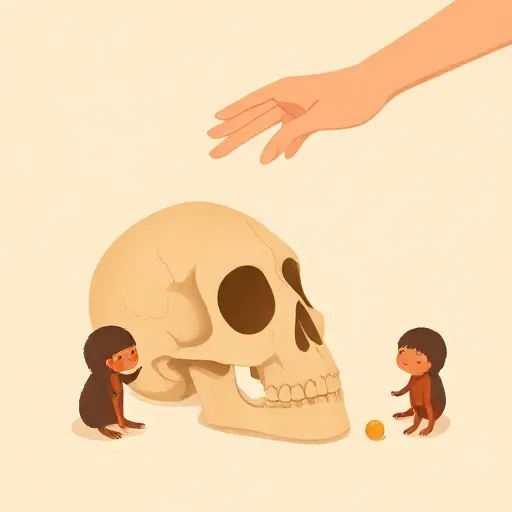
For Christians, Jews, and Muslims, scripture says humans were made in a special act of creation—Adam from clay, Eve from his side. But geology, genetics, and paleoanthropology tell a different story. Fossils of Australopithecus afarensis (like the famous “Lucy”), Homo neanderthalensis, and the tiny Homo floresiensis all show that humans did not appear suddenly. Our species, Homo sapiens, emerged in Africa around 300,000 years ago, branching off a family tree that includes many extinct relatives. Ancient DNA even reveals previously unknown populations like the Denisovans. There never was a single original couple who are the ancestors of all humans today.
These findings press hard on traditional teachings about the imago Dei, the idea that humans bear God’s image, and on the concept of original sin. If the first chapters of Genesis are not literal history, what do they mean? Many contemporary theologians now read the story of the Fall not as a report about two individuals but as a profound myth about the human condition: our sense of moral awareness, our capacity for both great good and deep wrong. Some even wonder whether extinct hominins like Neanderthals should be included in the “image of God.”
Others have tried to keep the idea of a historical Adam. The philosopher Peter van Inwagen (born 1942) suggested that God may have guided evolution until a small community of primates developed reason and free will, and then entered into a special relationship with them—and that at some point those beings misused their freedom. But scientists counter that no genetic or fossil evidence points to such a moment. The conversation is far from over; it shows how deeply science can shake up ancient beliefs, and how those beliefs can be rethought rather than simply discarded.
Why the Argument Still Matters Today

You can see the tension in your own world. In the United States, there have been legal battles—like the 2005 Kitzmiller v. Dover trial—over whether public schools can teach Intensive Design as an alternative to evolution. The question of what counts as science, and what role religious views should play, reaches right into the classroom.
That doesn’t mean you have to choose between being a curious science student and holding religious beliefs. Many working scientists are also religious believers who think deeply about these issues. The field of science and religion isn’t about declaring a winner; it’s about being thoughtful and honest about what different ways of knowing can offer. The same questions that began in Galileo’s courtroom are still alive: What do you do when a scientific explanation and a sacred story seem to point in different directions? Is it possible to hold both with integrity? Those are not questions only for experts—they’re questions you might carry with you too.
Think about it
- If a scientific explanation for something feels complete, do you still need a religious explanation? Why or why not?
- Imagine a religious teaching says the world is 6,000 years old, but scientists say it’s billions. What would you do if you believed both sources were trying to tell the truth?
- Can a person be a good scientist while also believing in miracles? What challenges might they face when talking with colleagues who see the world differently?