Why Was a Teacher on Trial for Teaching Evolution?
A Teacher on Trial: The Scopes “Monkey Trial”

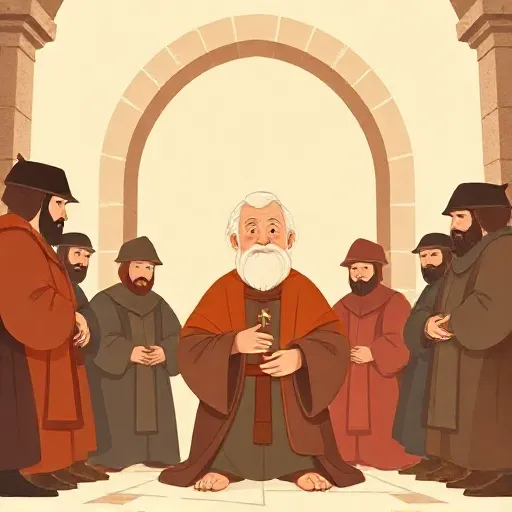
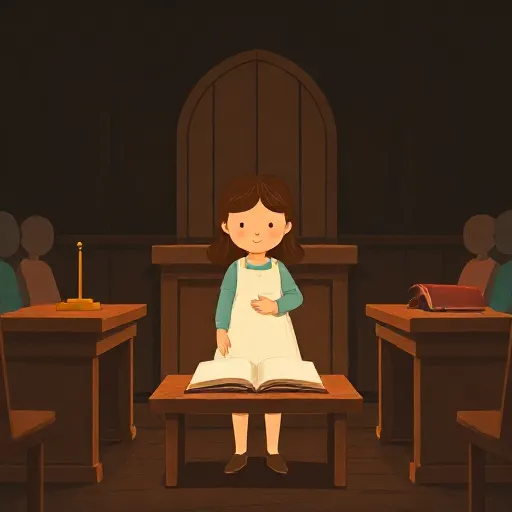
In July 1925, in a sweltering courtroom in Dayton, Tennessee, a high-school biology teacher named John Scopes faced a jury. He had done something against the law: he had taught his students that humans and apes share ancient ancestors. The case — soon called the “Monkey Trial” — became a national circus. The prosecutor was a famous politician who had nearly become president. The defense lawyer was the most feared agnostic attorney in America. Scopes was found guilty and fined $100, though the verdict was later thrown out on a technicality. Yet the deeper question was never settled: in a science classroom, does the Bible’s creation story belong on the same shelf as evolution? To understand why that question could land a teacher in court, you have to go back much further than 1925.
How the Bible Came to Be Read Literally
Today many people think real Christianity always insists on reading every word of the Bible exactly as it is written — a position called literalism (or inerrantism, because believers hold that the Bible contains no errors). But history tells a different story. From the earliest centuries, Christians frequently read Genesis as metaphor or poetry. St. Augustine, writing around 400 AD, warned that taking the six days of creation literally could make believers look foolish and drive away honest seekers. Neither did the great Protestant Reformers, Martin Luther and John Calvin, demand a wooden literalism. Luther famously referred to the gospel as ‘right strawy stuff’ because it seemed to clash with his core insight that salvation comes by faith, not by good works. For most Christian history, the authority of the church and the voice of reason were at least as important as a literal reading of scripture.
Things changed in the 1700s and 1800s. After a wave of religious revivals on both sides of the Atlantic, a stricter literalism took hold — especially among evangelical Protestants in the American South. For many Southern communities, the Bible became a cultural banner, not only a religious one. After the Civil War, literalism hardened into a powerful populist movement. It fought against ideas that seemed to come from Northern elites, industrial cities, and new European immigrants. By the early twentieth century, several forces combined: the success of the temperance movement (which banned alcohol), the growth of public schools that taught evolution, and a series of popular booklets called The Fundamentals, which gave the movement its name: Fundamentalism. And then came the First World War. Many fundamentalists saw the violence of that war as proof that Darwin’s idea of a “struggle for existence” was morally poisonous. Evolution, they believed, was not just wrong — it was dangerous.
Creation Science: Six Arguments Against Evolution

After the Scopes trial, the creationist movement seemed to fade. Yet textbooks quietly removed evolution, so students learned little about it. When the Soviet Union launched Sputnik in 1957, the United States panicked over its science education. Congress poured money into new textbooks that gave evolution full treatment. The creationist reaction was fierce. Help came in 1961 with a book that became the movement’s new Bible: The Genesis Flood, by biblical scholar John Whitcomb and hydraulic engineer Henry Morris. They claimed that every detail of the early chapters of Genesis — six literal 24-hour days, creatures appearing by miracle, humans created last, and soon after a worldwide flood that buried their bodies in mud — was supported by real science. They also launched a series of arguments against evolution. Here are some of the most famous, along with the replies from scientists.
Argument 1: “Evolution is just a theory, not a fact.” Creationists point out that scientists themselves call evolution a “theory,” which in everyday language means a hunch. The reply: the word theory has two meanings. In science, a theory is a well-supported body of laws — like the theory of gravity or the heliocentric theory. That is entirely different from a guess. Evolution is a theory in that strong sense.
Argument 2: “Natural selection is a tautology.” Survival of the fittest, creationists say, boils down to “those that survive are those that survive.” That is not a real claim, just a trick of words. Scientists answer that natural selection makes a genuine prediction: some organisms really do leave more offspring than others because they have particular helpful traits (called adaptations). It could have been otherwise. An earthquake could wipe out the fittest, too. So it is not an empty truth.
Argument 3: “Random mutation could never build anything as complex as an eye.” If a monkey typed at random, it would never produce Shakespeare. Evolution faces the same odds, creationists claim, because the raw material — genetic mutations — is random. But scientists say that evolution does not start from scratch each time. When a useful mutation appears, natural selection keeps it, and the next improvement builds on it. The odds shrink dramatically — like keeping the letter “F” and then trying for an “r” instead of starting over every time.
Argument 4: “The fossil record is full of gaps.” Creationists say those gaps — missing links between major animal groups — prove that organisms were created separately and sorted by Noah’s flood. The reply: fossilization is rare; gaps are expected. Moreover, many beautifully complete sequences exist, such as the evolution of the horse, and fossils never appear out of order. Humans are never found buried with dinosaurs.
Argument 5: “The second law of thermodynamics says everything runs down, but evolution requires things to become more complex.” That law, which states that entropy always increases, rules out blind evolution, creationists argue. The answer: the second law applies to a closed system; Earth receives a constant stream of energy from the sun. That energy can drive local increases in complexity — at least until the sun burns out.
The Arkansas Showdown: When Creation Science Went to Court
By the late 1970s, creationists had a new strategy. Since the Supreme Court forbids the government to establish a religion, they could not simply ban evolution. Instead, they pushed for “balanced treatment” laws: if evolution was taught, then “creation science” had to be taught alongside it. The idea was to present creationism as a scientific alternative, not a religious belief. In 1981, Arkansas passed such a law, requiring biology teachers to give equal time to a “creation-science model.”
The American Civil Liberties Union immediately sued. The trial brought together an unusual cast: a theologian, a geneticist, a paleontologist, and a philosopher. The judge, William Overton, had to decide what makes something science. His ruling listed five essential features of a scientific claim: it must be guided by natural law; it must explain by natural law; it must be testable against the real world; its conclusions must be tentative (never the final word); and it must be falsifiable — that is, open to being proved wrong. Creation science, he wrote, failed every one of those tests. It was religion, not science, and had no place in a public-school biology class.
The trial also turned on the idea of falsifiability, taken from the philosopher Karl Popper (1902–1994). Popper had once expressed doubt about whether evolution was truly falsifiable, and creationists seized on that. The philosopher testifying for evolution, Michael Ruse (b. 1940), showed that evolution makes plenty of risky predictions: if dinosaur and human fossils were ever found in the same rock layer, the theory would be in serious trouble. That never happens. Creation science, by contrast, dodged every test by inventing new explanations on the spot. So the judge concluded that it was not falsifiable.
Some philosophers later objected. They argued that there is no clean, hard rule — no single “criterion of demarcation” — that can divide science from non-science in all cases. Still, the courts cared about a practical, legally workable distinction. The Arkansas decision stood, and in 1987 the U.S. Supreme Court struck down a similar law from Louisiana. Yet the philosophical argument had only just begun.
Intelligent Design: A New Kind of Argument

In the 1990s, a Berkeley law professor named Phillip Johnson launched a fresh attack. He claimed the debate was not just about science versus religion, but about two rival world pictures. Johnson distinguished between methodological naturalism — the scientist’s rule of looking only for natural explanations — and metaphysical naturalism — the belief that nature is all there is, with no God. He argued that the first always slides into the second, so teaching evolution is really promoting a godless philosophy. Therefore, he said, schools should teach “theistic realism” as an alternative.
The most prominent scientific arm of this movement came from biochemist Michael Behe (b. 1952). Behe introduced the concept of irreducible complexity. Take the bacterial flagellum, a whip-like motor that some bacteria use to swim. It is made of several matched parts — a filament, a hook, a rotary motor embedded in the cell membrane — that all must be present for the system to work. Remove one part, and the whole machine fails. Behe argued that such a system could not be built gradually by natural selection, because any half-built stage would be useless. It must have arisen all at once, and that points to a designing intelligence.
Philosopher-mathematician William Dembski (b. 1960) tried to give a logical tool — an explanatory filter — for spotting design. Imagine you receive a radio signal from space. If the signal is just a random string of beeps, you chalk it up to chance. If it follows the laws of physics, you attribute it to necessity. But if the beeps spell out the prime numbers — a recognizable pattern you could have specified in advance — you infer design. Dembski said that living cells contain complex, specified patterns that natural law and chance cannot produce, so we are justified in detecting design.
Critics pounced. They noted that natural selection can indeed build irreducibly complex systems by co-opting parts that once had other jobs — the way stonemasons first build a wooden support to hold the stones of an arch, then remove it. A famous example is the Krebs cycle, an intricate chemical pathway in our cells that was cobbled together from existing pieces. Moreover, if a designer is powerful enough to craft bacterial motors, why does the same designer allow the tiny genetic copying errors that cause heartbreaking diseases? That, Behe replied, is part of the problem of evil — but critics said it was a devastating dodge. If the designer takes credit for the good, why is it not responsible for the bad?
Why the Battle Over Origins Still Rages

The fight is far from over. In 2004, a school board in Dover, Pennsylvania, voted to read a statement about Intelligent Design in biology class. A federal judge — appointed by a Republican president — struck it down, ruling that Intelligent Design is a form of creationism and thus unconstitutional. But the same tensions keep popping up. Today, some prominent philosophers, like Alvin Plantinga (b. 1932) and Thomas Nagel (b. 1937), express sympathy for the idea that natural selection cannot explain everything that fascinates us about life, especially human consciousness. They stop short of endorsing a supernatural designer, but their doubts give creationists hope.
For many believers, the origins debate is only partly about fossils and DNA. It is also about moral order. Many creationists are premillennialists: they believe Jesus will return soon and that the world cannot be fixed by human effort. That fuels their focus on personal conversion and traditional family values. Evolution, some of them fear, teaches that life is a relentless struggle without purpose, undermining the idea that every human being is made in God’s image. Even if these concerns fall outside science, they are powerful reasons why the controversy will not disappear. If you walk into a classroom today, the question that landed John Scopes in a Tennessee courtroom almost a hundred years ago — “Where did we come from, and how?” — still has two very different sets of answers, and society has not finished arguing about which one children should hear.
Think about it
- If a judge declared that a religious idea cannot be taught in science class, does that mean it is not true, or just that it belongs in a different subject?
- Suppose a biologist proves that a particular molecular machine evolved step by step. Would that disprove a designer, or could the designer have worked through evolution?
- Do you think a scientist who is also a devout Christian has to keep those two identities separate, or can they fit together honestly?