
Where Is Your Mind? A Roman Doctor Put It to the Test
A Squealing Pig and a Stunning Claim

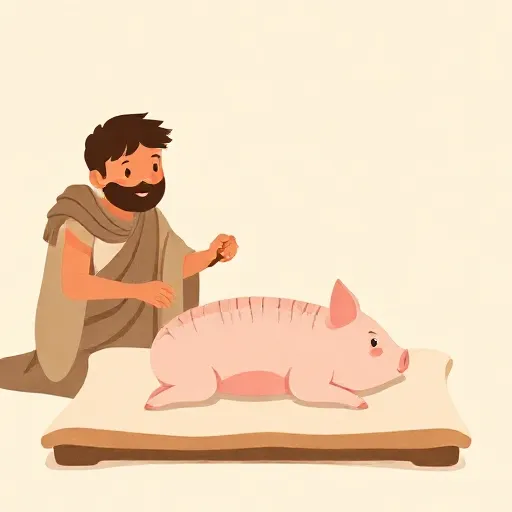
Imagine a crowded lecture hall in ancient Rome. A doctor in a simple tunic stands beside a wooden table where a pig lies, still able to squeal. He asks his students to watch closely. Then he carefully presses a small rod against a precise spot on the exposed spinal cord at the back of the pig’s neck. Instantly, the animal falls silent and stops moving — yet its heart keeps beating. The doctor explains that he has just cut off the brain’s connection to the rest of the body, proving that the brain, not the heart, controls voluntary movement and speech. This was no magic trick. It was one of the most famous demonstrations in the history of medicine, performed by the Greek-born Roman physician Galen (129 – after 200 CE).
Galen was trying to settle a fierce debate. Many philosophers, especially the Stoics, argued that the hēgemonikon — the “leading part” of the soul that makes decisions, perceives the world, and gives commands — lived in the heart. Galen was convinced it lived in the brain. To prove it, he didn’t just argue with words. He reached for a scalpel.
The Three-Part Soul: Brain, Heart, Liver

To Galen, discovering where the mind was meant understanding how the soul was built. He adopted a powerful idea from Plato: the soul is not one single thing, but has three distinct parts. Each part, Galen argued, sits in a specific organ and is connected to the rest of the body by its own system of channels.
The rational part (the logistikon, which Galen also called the hēgemonikon) lives in the brain and communicates through the nerves. It is responsible for thinking, remembering, and making choices, as well as for sensation and voluntary motion. The spirited part (the thumoeides), the home of anger, courage, and indignation, sits in the heart and pulses through the arteries. The desiderative part (the epithumētikon), which handles hunger, desire, and nutrition, is rooted in the liver and spreads through the veins.
This was a whole-body map of mental life. When you feel your face flush with anger, Galen would say that’s your spirited part stirring in the heart. When you solve a maths puzzle, your rational part is at work in the brain. His opponents, particularly the Stoics, rejected this. They believed the hēgemonikon was a single, unified command centre in the heart — period. Galen’s pig experiment was his direct challenge to them: if the heart were really the command centre, cutting off the brain should not instantly silence the animal.
What Counts as Proof? Galen’s Love of Demonstration

Galen didn’t just want to be right. He wanted to be scientific, in a way that matched the certainty of mathematics. He believed that the very best kind of knowledge — what he called epistēmē — comes from demonstration (apodeixis). A demonstration starts with propositions that are clearly true, either because they are obvious to the senses or because they are built into the very definition of the thing you are studying. Then, by a chain of rigorous logic, you reach an unshakeable conclusion.
He laid out his case about the brain in the form of a simple syllogism: (1) Where the nerves begin, there is the hēgemonikon. (2) The nerves begin in the brain. (3) Therefore, the hēgemonikon is in the brain. The first statement, Galen claimed, followed from the universally agreed definition of the hēgemonikon as “the source of perception and voluntary motion.” The second was a plain anatomical fact he could point to with his own hands.
Yet even Galen admitted that not every part of his theory reached this gold standard. He could give a demonstrative proof for the location of the rational part. But his claims that the spirited part lives in the heart and the desiderative part in the liver relied on a lower grade of reasoning — what he called dialectical or plausible arguments. These drew on everyday observations (your heart pounds when you are angry) and analogies (just as the trunk of a tree feeds its branches, the liver feeds the body through the veins). Galen was honest about the difference. He thought perfect knowledge was possible in some areas, but in others we must be content with strong, carefully checked experience.
Is the Soul Just a Mixture? The Mind–Body Puzzle

Galen’s maps of the soul did not answer an even deeper question: what is the soul made of? He was a doctor who treated flesh and blood every day, and he believed that all physical things are built from a blend of four fundamental qualities: hot, cold, wet, and dry. The exact mixture (krasis) of these qualities determined what a body was like — whether a person’s brain was quick or sluggish, whether their temperament was fiery or calm. He pointed to obvious examples: too much wine (hot and wet) makes people act irrationally. Fevers can cause hallucinations. Different weather can shift your mood. How could a soul that is completely separate from the body be changed so easily?
In one especially bold work, The Capacities of the Soul Depend on the Mixtures of the Body, Galen came very close to saying that the soul is a particular mixture. He argued that if even Aristotle called the soul the “form” of the body, then that form might simply be the body’s mixture. The mortal parts of the soul — the non-rational ones like anger and desire — might literally be mixtures in the heart and liver. But then Galen pulled back. When it came to the rational soul, he repeatedly confessed that he did not know whether it was a bodily mixture or a separate, non-material substance. He left the question open, believing that both the practical needs of medicine and the limits of human knowledge prevented a final answer.
This had striking consequences. If your character depends on your bodily mixture, can you really be praised or blamed for being courageous or greedy? Galen raised the worry plainly in his writings, though he never settled it. It was a problem that would haunt thinkers for centuries.
Taming Your Inner Passions: Galen’s Therapy for the Soul

Galen was not only interested in where the soul sits — he wanted to help people live better. Drawing on Plato and the Stoics, he developed a kind of mental self-discipline that feels remarkably modern. He called the destructive emotions pathē — affections or passions — and he saw them as the main obstacle to a good life. When your non-rational drives (greed, rage, jealousy) run wild, they drag the whole soul into misery. The most dangerous of all the passions, he thought, was distress (lupē), a heavy blanket that could smother you in grief, envy, or anxiety.
His solution was a daily training programme for the rational part of the soul. You should put your habitual desires under the control of reason, not try to stamp them out entirely. The spirited part could even become an ally: its natural hatred of injustice could help you fight shameful urges. Galen recommended practical tools: keep a watchful eye on your own behaviour, adjust your expectations so you want only what is truly within your control, and sometimes ask a trusted, neutral person to point out your faults — a kind of ancient “cognitive therapy.” He himself claimed to have lost a huge library in a fire and felt no distress, though he admitted that some situations, like exile or harm to a friend, might still shake his calm.
Why This Still Matters: Your Brain, Your Feelings, and You

Nobody today would place the mind in the heart — we know the brain is the organ of thought. Yet Galen’s central puzzles are far from solved. How does a squishy lump of brain tissue produce the feeling of a sunrise, the taste of honey, or a twinge of guilt? Modern neuroscience and medicine still grapple with what Galen called the “substance of the soul”: is your mind entirely explained by physical stuff, or is something else going on? And the question he dared to raise — if your moods and choices are shaped by bodily mixtures, brain chemistry, or genes, what happens to responsibility? — is debated by judges, doctors, and philosophers every day.
Galen’s therapy for distress, too, left a lasting mark. The idea that you can, with practice, reshape your emotional habits by observing your own thoughts and adjusting your expectations, is at the heart of many contemporary approaches to mental health. He was a physician of the body who never forgot that a human being also needs care for the invisible part — the part that squealing pigs could never fully explain.
Think about it
- If a scientist could predict your every decision based on your brain chemistry, would you still be truly responsible for your actions?
- Galen thought anger lives in the heart and thinking lives in the brain. Why do we still say “I love you with all my heart” or “my heart is broken”?
- Galen believed you could train yourself to be less distressed by changing your thoughts. Do you think that works for all kinds of sadness — or are some sorrows too deep for that?