
If God Already Knows What You’ll Do, Are You Really Free?
A Ring at Nine O’Clock Tomorrow

Imagine it’s late evening, and you know the telephone will ring tomorrow at exactly nine in the morning. You will either pick it up or you won’t. One of those two things will happen — that’s just logic, what philosophers call the Law of Excluded Middle: either “I will answer” is true, or “I will not answer” is true. No third option.
Now add a being who knows the future perfectly. Call that being God, with infallible foreknowledge — God’s beliefs about what’s going to happen cannot be wrong. If God already believed yesterday that you will answer the phone at nine, then it seems that fact is locked into the past. And if the past can’t be changed, how could you be free to choose otherwise?
That’s the riddle that has kept philosophers busy for over fifteen hundred years. It’s called theological fatalism. The puzzle doesn’t depend on any particular religion; it arises for anyone who thinks a being might have infallible knowledge of the future. The real question is: if someone already knows what you’ll do, is your choice still truly yours?
The Trap: Pike’s Chain of Necessity
In 1965, the philosopher Nelson Pike laid out the argument in a way so clear it sparked a flood of responses. Let’s walk through the chain step by step, without any fancy notation.
Suppose, as before, that it’s true you will answer the phone tomorrow at nine. Call that statement T. Suppose God believed T yesterday — and God’s belief is infallible, which means: necessarily, if God believed T, then T is true.
Step 1: Yesterday God infallibly believed T. (That’s the starting assumption.) Step 2: The past has a special fixity. Philosophers call this temporal necessity, or now-necessary: if something already happened, no one can do anything now to make it un-happen. Yesterday is over and done with. Step 3: So it’s now-necessary that God believed T yesterday. You can’t go back and scrub out God’s belief. Step 4: Because God is infallible, there’s a necessary link: if God believed T, then T must be true. Step 5: A transfer of necessity principle says: if a past fact is now-necessary, and that past fact necessarily leads to something else, then that something else becomes now-necessary too. Step 6: Therefore, it’s now-necessary that T — that you will answer the phone tomorrow at nine. The future event is just as fixed as yesterday’s spilled milk. Step 7: If it’s now-necessary that T, then you cannot do otherwise than answer the phone at nine. Step 8: If you cannot do otherwise, then (so a famous principle goes) you don’t act freely. This is the Principle of Alternate Possibilities (PAP): free action requires genuine alternative paths.
Conclusion: you do not answer the phone freely.
Pike’s argument is logically valid — if all the premises are true, the conclusion follows. Philosophers who want to keep both God’s infallible foreknowledge and human free will must find a premise that is false. The four main targets are (1) that God had such a belief yesterday, (2) that the necessity of the past covers all past facts, (5) the transfer principle itself, and (9) the Principle of Alternate Possibilities. Each has inspired a different escape route.
Getting God Out of Time
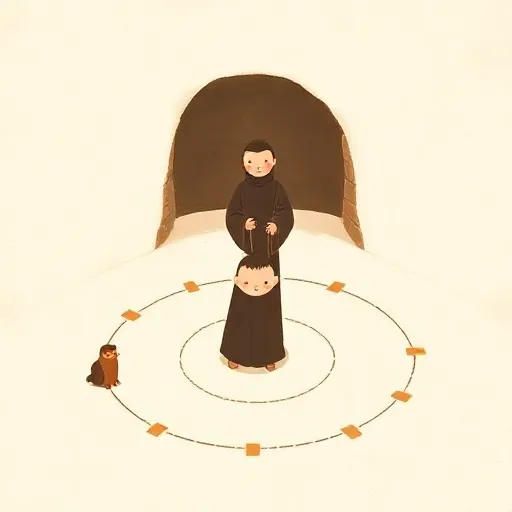
The first major attempt to break the chain is to deny that God had the belief yesterday at all. In the sixth century, the philosopher Boethius (c. 477–524) argued that God isn’t inside time. For a timeless being, there is no yesterday, no today, and no tomorrow. God does not have beliefs at a particular moment; instead, all moments of history are “at once” before God’s mind — like the center of a circle being equally close to every point on its rim.
If Boethius is right, premise (1) is just mis-stated. God doesn’t believe T yesterday in the way we think about past events, so the argument can’t get started. Later thinkers, including Thomas Aquinas (1225–1274) and contemporary philosophers such as Eleonore Stump and Norman Kretzmann, have revived and defended this “eternity solution.”
Critics point out that timelessness itself is hard to think clearly about. And even if God is outside time, the worry can return in a new form: maybe the timeless realm has its own kind of fixity, and God’s timeless knowing would still force the future. Defenders reply that our intuition about the necessity of the past doesn’t automatically transfer to a mysterious timeless realm. The debate remains open.
The Problem with “Soft” Facts: Ockham’s Gamble
What if God is in time, but not all past facts are equally necessary? In the fourteenth century, William of Ockham (c. 1287–1347) challenged premise (2) — the idea that everything past has that special now-necessity. He distinguished between “hard” facts about the past, which are completely closed and unchangeable, and “soft” facts, which are in part about the future.
A hard fact might be that a vase shattered yesterday. A soft fact might be that it was true yesterday that you will eat breakfast tomorrow — because the fact points forward to an event that hasn’t happened yet. Ockham argued that God’s past beliefs about the future are soft facts, not hard ones. So premise (3) — “it’s now-necessary that God believed T yesterday” — doesn’t apply in the fateful way the fatalist needs.
This “Ockhamist” strategy was revived in the twentieth century by Marilyn Adams and developed by many others. The difficulty is drawing the line between hard and soft in a principled way. God’s belief about the future seems as firmly lodged in yesterday as any other mental act. Unless there’s something special about divine beliefs that makes them intrinsically “soft,” the move looks like it was invented just to dodge the problem. Yet Ockhamists reply that the fixity of the past really does come in degrees, and that facts depending on what hasn’t yet happened are not fully frozen.
When the Future Isn’t True Yet
A more radical escape rejects premise (1) from the opposite side — not by changing when God believes, but by denying there is a settled truth for God to believe. In his famous “Sea Battle” argument, Aristotle (384–322 BCE) suggested that statements about a contingent future — like “there will be a sea battle tomorrow” — are not already true or false. They become true only when the event happens (or doesn’t). If that’s right, there was never a true proposition T for God to infallibly believe yesterday. The fatalist’s chain never has a first link.
This idea has been taken up by philosophers who defend open theism, the view that God’s knowledge of the future is limited to what can genuinely be known — and if the future is open, even God doesn’t yet know which free choices you’ll make. Thinkers like A. N. Prior, Richard Purtill, and more recently Alan Rhoda and Patrick Todd have developed sophisticated versions of this approach.
Objections come thick and fast. Many ordinary people talk as if “It will rain tomorrow” is already true or false, and the logic of such talk is hard to dismiss. Even if future statements lack truth values now, God might still have “quasi-true” beliefs that create a similar problem. And for many religious traditions, denying that God knows the future outright is a steep price to pay. The debate about whether the future is settled — and what that even means — cuts to the heart of how we think about time itself.
Freedom Without Alternative Paths

All the solutions so far try to derail the argument before it reaches step (8). But what if the argument does reach (8) — the claim that you cannot do otherwise — and that’s not the disaster it seems? The Principle of Alternate Possibilities (PAP) says you act freely only if you could have done otherwise. Many philosophers, however, have come to doubt PAP.
In the twentieth century, Harry Frankfurt invented thought experiments featuring a hidden neuroscientist who is ready to interfere with your brain if you show any sign of not doing a certain action — but in the actual case he never interferes. The person acts on their own desires. Most people judge the person acts freely, even though, because of the backup device, they couldn’t have done otherwise. If such cases are convincing, PAP is false: what matters for freedom is whether your action comes from you, not whether there were alternative possibilities.
Applied to theological fatalism, this means that even if God’s infallible foreknowledge implies you can’t do otherwise, you might still be free — because God’s knowing plays no causal role in what you choose. Augustine (354–430) had a similar insight: “God’s foreknowledge does not force the future to happen.” If your will is the source of your action, the fact that the outcome could not have been different may not strip away your freedom.
This compatibilist strategy has attracted source incompatibilists — those who hold that freedom is about being the genuine source of your action, not about alternate possibilities. The approach allows you to accept premises (1) through (8) and still deny the fatalist’s conclusion. But many libertarians remain uneasy: giving up alternate possibilities feels too much like giving up what makes a choice a choice.
Why This Matters Long After the Phone Rings

Strip away the religious language, and the problem survives. Suppose there is no God, but it was already true yesterday that you will eat cereal for breakfast tomorrow. The past truth of that statement would be just as fixed as any divine belief, and a similar chain of necessity threatens to make your breakfast choice inevitable. Philosophers call that logical fatalism, and it follows the same pattern.
The deeper issue is about time and necessity itself. Most of us think the past is settled and the future is open. But if some facts about the past necessarily carry forward into the future — and a simple transfer principle seems to push necessity along — we may have to give up one of those ideas: the fixity of the past, the openness of the future, or the transfer principle. The argument for theological fatalism is the most vivid version of a puzzle that lurks in the very structure of time, causality, and choice.
The next time you’re about to make what feels like a free decision — whether to pick up the phone, what to say, which path to take — ask yourself: is the future already settled, even in some small way? And if it were, would that change what it means to be the person who chooses?
Think about it
- If a scientist could predict every choice you’ll ever make with perfect accuracy, would it still be fair to praise or blame people for those choices?
- Imagine a video game where every level has been recorded in advance and you’re just watching yourself play. Could you still enjoy the game if you knew the outcome was fixed?
- When you feel you’re making a free choice, is that feeling itself evidence that the future is not already determined — or just an illusion you can’t shake?