Can God Know Everything — and Still Let You Choose?
What does it mean to know everything?
You’re playing a video game against a friend who knows every trick. Before you even decide your next move, she says it out loud. She’s predicted you perfectly. That feels spooky — almost as if you never really had a choice. This is the tiniest taste of a much bigger question: what would it mean for a mind to know absolutely everything, including every choice you will ever make?
Philosophers call that kind of complete knowledge omniscience. The simplest definition says that to be omniscient is to know every proposition — every statement that is either true or false — that happens to be true. If “there are seven clouds in the sky” is true, an omniscient being knows it. If “you will become a marine biologist” is true, that being knows that too.
Some thinkers have added extra requirements: that an omniscient being also knows which propositions are false, or that it believes no falsehoods at all. But these additions don’t really change the job description. If you already know every true proposition, you automatically know that any false one is false, and you can’t believe a falsehood because you know the contradicting truth.
The real arguments begin when we ask what counts as “all truths.” Do truths about the future exist? Are there truths about what it feels like to be you, right now, from the inside? The main debates in philosophy of religion center on exactly that — the scope of omniscience. And the most famous of those debates is whether perfect knowledge of the future would destroy human freedom.
The ancient worry: if God knows the future, can you choose freely?
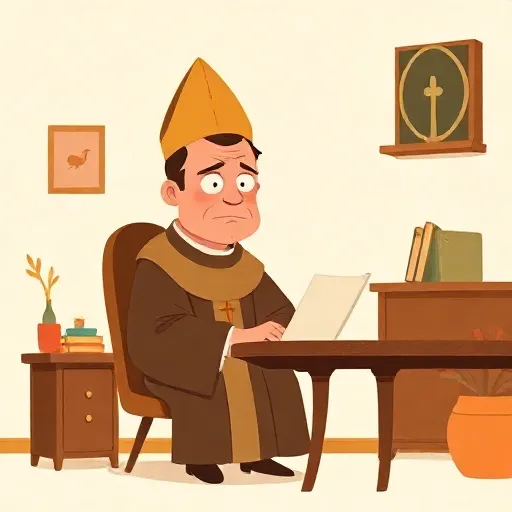
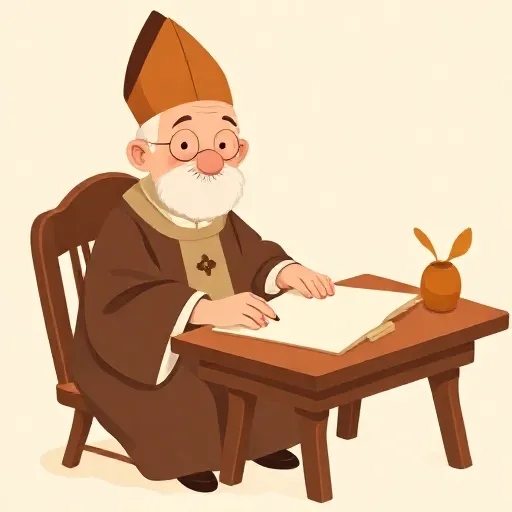
Augustine of Hippo (354–430) sat in his study in North Africa, thinking hard about a student who might commit a sin the next day. If God already knew the student would sin, did the student really have a choice? The worry takes a simple shape:
- If God has foreknowledge that you will do something, then it is necessary that you will do it.
- If it is necessary that you will do it, then you are not free with respect to that action.
- Therefore, if God has foreknowledge, you are not free.
Augustine never fully settled the matter. A few decades later, the Roman senator Boethius (c. 477–524), writing in prison while awaiting execution, proposed a dramatic escape. He said God doesn’t have foreknowledge at all — because God doesn’t live inside time the way we do. From God’s eternal perspective, everything that ever happens is seen all at once, the way you see an entire painting in a single glance. So God’s knowledge isn’t “before” our actions; it’s just that God sees them timelessly. On this view, the whole argument doesn’t get off the ground.
But many philosophers later saw a simpler problem with the argument, even if God does know the future inside time. Thomas Aquinas (1225–1274) pointed out an ambiguity. The first premise could mean:
- “Necessarily, if God knows you will do X, then you will do X.”
Or it could mean: - “If God knows you will do X, then it is a necessary truth that you will do X.”
The first reading is true but harmless. The second would make the argument valid, but it’s false — knowing a contingent truth doesn’t make it a necessary truth. So the simple argument collapses. However, a more troubling version lay ahead.
The haunting puzzle of the past belief
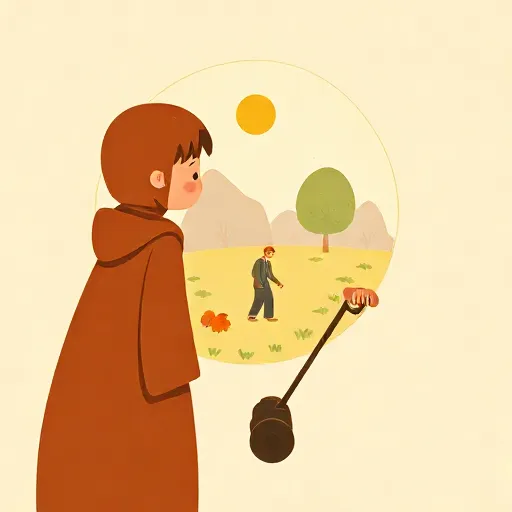
In 1965, the philosopher Nelson Pike (1930–2010) crafted a stronger argument that doesn’t rely on confusion about necessity. It begins with a mundane example: imagine God believed eighty years ago that a man named Jones would mow his lawn tomorrow. That past belief is now fixed. In philosophy, past events are often said to be accidentally necessary — you can’t now change what happened yesterday. So this old belief of God’s seems locked in place.
Now add another idea: if God is infallible (he could not possibly be mistaken), then God’s believing that Jones will mow is enough to guarantee that Jones really will mow. The past belief, which is fixed, chains itself to the future action. And if the fixed past forces a certain future, then no one — not even Jones — can make that future false. Jones’s mowing tomorrow becomes unavoidable, so he doesn’t act freely.
This argument turns on two claims: (1) past facts about God’s beliefs are accidentally necessary, and (2) that necessity leaks from the past belief to the future event (technically, accidental necessity is closed under entailment). If both claims hold, then divine foreknowledge really does threaten free will.
Ways to escape: soft facts, middle knowledge, and open futures

Philosophers have tried many routes to avoid Pike’s conclusion, and the debate is far from settled. Three of the most colorful escape attempts come from very different centuries.
First, the Ockhamists, named after the medieval thinker William of Ockham (c. 1287–1347). They deny that the past belief is entirely about the past. Some facts, even though they happened earlier, are “soft facts” — their truth depends in part on what happens later. If God’s belief that Jones will mow is one of these soft facts, it isn’t really fixed just because time has passed. Jones’s later choice still matters.
Second, the followers of Luis de Molina (1535–1600), a Spanish Jesuit. Molina agreed that God knows what every creature will freely do, but he claimed God knows this through middle knowledge — knowledge of what you would freely choose in any possible situation. Molina denied that accidental necessity transfers to free actions in the way the argument assumes. God’s knowledge doesn’t push you; it tracks your free choices without making them unfree.
Third, in recent decades, a movement called Open Theism (championed by William Hasker, born 1935) has taken a bolder step: it says God doesn’t know future free choices at all. The future is genuinely open, not yet settled, so no one — not even God — can know it with certainty. On this view, omniscience stops at the edge of what can be known, and free choices are simply not knowable ahead of time.
None of these replies convinces everyone. The puzzle remains one of the liveliest in philosophy of religion.
Knowing what it’s like to be you: a different challenge

There is another, quieter challenge to omniscience that doesn’t involve time at all. It’s about a special kind of knowledge philosophers call de se knowledge — Latin for “of oneself.” Imagine Jones wakes up in a hospital with amnesia. He reads a newspaper story about a man named Jones who is in the hospital, but he doesn’t yet realize, “I am in the hospital.” When he finally grasps that truth, he knows something that no one else — not the doctors, not his family, not a friend reading the same newspaper — can know in the same immediate way.
In 1966, Norman Kretzmann (1928–1998) argued that if omniscience means knowing everything anyone knows, it would have to include your first-person knowledge. But then God would have to be you, which seems impossible if God is a distinct being. So either omniscience is impossible, or we’ve misunderstood what such knowledge is.
A modern reply turns to the idea that some propositions are perspectival — true only at a certain perspective or index. The statement “I am in the hospital” is true at the perspective ⟨Jones, now⟩ but false at ⟨Smith, now⟩. God can know the eternal truth that this perspectival proposition is true for Jones-at-this-moment, without having to be Jones. He simply doesn’t believe it from that perspective because he isn’t located there. This tweak to the definition of omniscience — adding perspectives — seems to keep first-person knowledge safe while leaving God’s completeness intact.
Why this still matters — for you and me

When a friend says, “I knew you’d pick the chocolate cake,” you might feel a flicker of annoyance — as if your choice was already sealed. That tiny feeling is the same one philosophers have been analyzing for centuries, blown up to cosmic scale. The question isn’t just about God. It’s about whether perfect knowledge and genuine freedom can ever fit together.
Today, scientists debate whether brain scans or ultra-smart algorithms could predict your decisions before you even feel you’ve made them. The ancient debate about omniscience gives us the sharpest version of that worry. It forces us to ask what it means to know something, what it means to be free, and whether there might be some kinds of knowledge — like what it feels like to be you, or what you’ll freely do tomorrow — that can’t be had without destroying the very thing they try to know.
Philosophers are still arguing. The future of this question, like some futures themselves, remains open.
Think about it
- Imagine a machine that could predict with 100% accuracy every decision you will ever make. Would that machine’s existence make you any less free, even if you deliberately tried to prove it wrong?
- If a friend knows you so well that they can always guess what you’ll order at a restaurant, does that mean your choice wasn’t free? How is that similar to — or different from — God’s foreknowledge?
- Could a perfect being know exactly what it feels like to be you right now without actually being you? What would it take to know someone else’s feelings from the inside?