Can You Ever Really Know Something? The Doctor Who Said No
A Book That Said Nothing Is Known

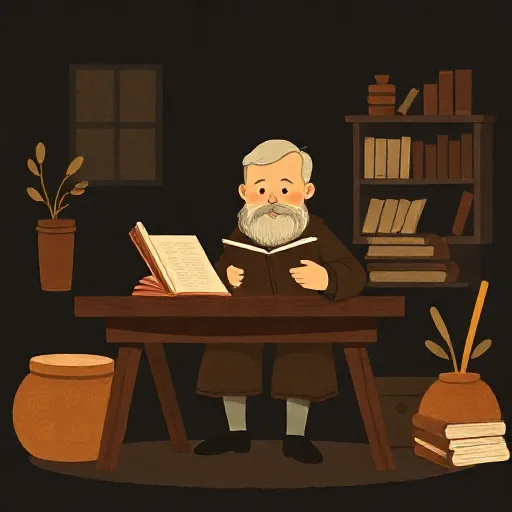
In 1581, a doctor and professor named Francisco Sanches (1551–1623) published a book with a title that was either outrageous or brave: That Nothing Is Known. He lived in Toulouse, France, where he taught medicine and philosophy. But after years of studying the great thinkers of the past, he had reached a startling conclusion. Almost everything people called “knowledge” was nothing more than words built on shaky foundations.
Sanches was not trying to be destructive for fun. He was a skeptic — someone who questions whether we can have certain knowledge — but he was also an empiricist, someone who believed that real learning must come from what we can see, touch, and test. He had trained as a physician, treating real patients, and that experience made him impatient with theories that sounded impressive but couldn’t be checked against anything solid. His book opens with a personal confession: as a young man he devoured every book he could find, but the more he read, the more he doubted. Eventually, he decided to start over, examining each thing for himself, as if nobody had ever said a word about it. That method led him to one big, uncomfortable question: can we ever know anything perfectly?
Why Words Can’t Capture the World
Sanches looked closely at how the philosophers of his day used words. The dominant system was Aristotelianism, based on the works of Aristotle (384–322 BCE). In the universities, scholars would argue by setting up careful definitions and moving step by step through syllogisms — logical arguments where a conclusion follows from two given statements. For example: “All humans are mortal. Socrates is a human. Therefore, Socrates is mortal.” That looks airtight. But Sanches saw a problem hiding in plain sight.
Definitions like “human,” “being,” or “substance” are supposed to tell you the real nature of a thing. Yet when you ask what “being” actually means, Sanches said, the answer is always another definition that itself needs defining. You end up chasing words in a circle. “You do not know what Being is; much less do I,” he wrote. He pointed out that a long chain of words is still just words. If you can’t connect a definition to something you’ve actually experienced through your senses, you’re just moving air around.
He was equally tough on the idea that logic alone could deliver science — by which he meant a body of perfect, certain knowledge. If your first premises are never proven but simply believed, then whatever you build on them is only as strong as that blind faith. Sanches said this kind of “knowledge” was not knowledge at all, only belief dressed in formal language. His own writing style was deliberately plain and direct, avoiding rhetorical flourishes, because he believed fancy speech simply hid the lack of real evidence.
The Problem with Our Senses
If words can’t give us absolute certainty, what about our eyes and ears? Sanches thought sensory experience was the only honest starting point, but he was far from thinking it solved everything. As a physician, he knew that our senses often mislead us. More importantly, he argued that even when they work perfectly, they only show us the accidents of a thing — its outward qualities like color, shape, and texture — never its inner substance or true essence.
Imagine you see an apple. You can describe its redness, its roundness, its smooth skin. But can you see what makes it an apple “on the inside,” its deepest nature? Sanches said no. The mind receives images from the senses and turns them around, asking “What is this?” and “Why?” Yet it never gets an answer that goes beyond those surface appearances. The thing itself — what later philosophers would call the thing-in-itself — stays hidden behind the curtain of our perception.
This did not make Sanches give up on learning altogether. It made him insist that knowledge, in any strict sense, must be perfect understanding of a thing. Since we cannot reach the thing itself, perfect understanding is impossible. The best we can do is collect observations, notice patterns, and make probable guesses — exactly what a good doctor does when diagnosing a patient. He sees symptoms, not the disease itself, yet he acts on the best evidence he has. Sanches thought all human knowledge was like that: useful, but never final.
Sanches and Descartes: Two Doubts, Different Paths
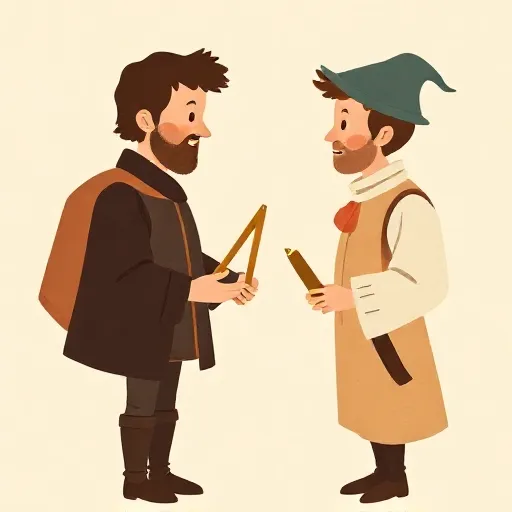
If you have heard of a famous doubter in philosophy, it is probably René Descartes (1596–1650). In his Discourse on the Method, Descartes described locking himself in a room and deciding to doubt everything until he found something he could be absolutely certain about. His answer was his own thinking mind: “I think, therefore I am.” Historians have noticed that Sanches’ autobiographical opening, where he describes his own crisis of doubt, reads very much like Descartes’ story. It is possible Descartes read That Nothing Is Known and borrowed its dramatic starting point, though we cannot be sure.
But the two thinkers ended up in completely different places. For Descartes, the one thing that survived all doubt was the inner light of reason. From that certainty he built a system in which mathematics — with its clear, indubitable truths — became the model for all knowledge. Sanches, by contrast, had already attacked the idea that mathematics gives us access to a higher, perfect realm. In a letter to the famous mathematician Christopher Clavius, he argued that geometry was simply the practical measurement of land and objects. A triangle drawn on paper was not a glimpse of some eternal, perfect triangle existing in the mind of God; it was just a useful tool for building houses and sewing jackets.
Sanches was an empiricist skeptic: he trusted the messy data of the senses over the clean proofs of reason, even though he acknowledged the senses could never deliver absolute certainty. Descartes, by contrast, trusted the deductive power of the mind and treated the senses as notoriously deceiving. They both rejected blind obedience to ancient authorities. They both started from radical doubt. But one looked outward to the world of things, the other inward to the world of ideas.
Why It Still Matters: Keep Asking ‘Quid?’

Sanches ended his book — and many of his other writings — not with a grand conclusion, but with a single word in Latin: Quid? It means “What?” That small question holds the heart of his philosophy. He was not content to say “nothing is known” and then go silent. He told his reader to get to work, to keep examining things, to keep questioning everything that should be questioned. His skepticism was not a dead end; it was an energetic invitation.
Today, we often talk about “facts” as if they were little blocks of certainty you can stack up. But science itself, at its best, operates a lot like Sanches’ ideal doctor: it observes, tests, revises, and never claims to have the final, perfect explanation of reality. Every new discovery opens up new queries. What a cell really is, what gravity really is, what consciousness really is — these questions resist easy definitions. Sanches would recognize that struggle.
His life reminds us that good thinking often starts with admitting what we don’t know. It is not about giving up on truth. It is about being honest about the limits of words and senses, and then, precisely because of those limits, staying curious. The next time you feel absolutely certain about something, you might try Sanches’ trick: ask yourself what exactly you know, and whether you could explain it without relying on words that you cannot perfectly define. Chances are you will find a mystery waiting. That is not a failure. That is where philosophy begins.
Think about it
- If you can never be 100% sure of anything, is it still worth trying to learn? Why or why not?
- Think of something you really, really believe you know for sure. Can you prove it to someone who disagrees without using words or senses?
- Why do you think Sanches, a doctor, kept working to heal people even though he believed perfect knowledge is impossible?