Can Anything Be Known for Sure? A Philosopher Who Changed His Mind
A Philosopher on the Run
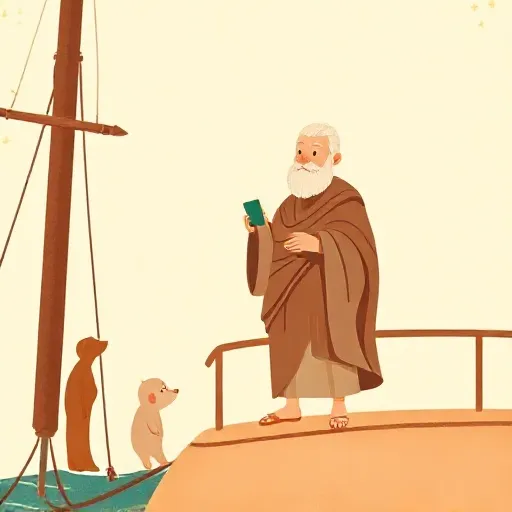
In 88 BCE, an old philosopher named Philo of Larissa (c. 159–84 BCE) climbed aboard a ship in Athens, clutching scrolls filled with a shocking new idea. For years he had led the famous Academy, where students debated whether anyone could really know anything. Now, fleeing war, Philo was heading to Rome to publish a book that would stun his own students. He was about to argue that knowledge does not require absolute certainty — a view that broke the rules of ancient thinking.
To understand why Philo’s scrolls caused a scandal, we need to step back to a long-running fight between two philosophical teams: the Stoics and the Academics.
The Stoics’ Dream of Perfect Certainty

The Stoics were a school of thinkers who wanted to show how a person could become perfectly wise. They believed that to act well you first had to know — really know — how the world is. So they built a theory about what it means to be certain.
Imagine you’re looking at a friend across the room. Light hits her face and enters your eyes, leaving an impression. The Stoics said that in some lucky cases that impression is so clear, so detailed, and so perfectly matched to reality that it couldn’t possibly be false. They called this a cognitive impression. A cognitive impression was like a stamp making an exact seal in wax: the object reaches out and plants itself in your mind, guaranteeing its own truth. If a wise person accepted only cognitive impressions and never anything less, she would never make a mistake. That state — a mind built entirely from error‑proof pieces — was catalepsis, or a firm “grasp” of the truth.
For the Stoics, this was the path to happiness. If you could avoid all false beliefs, you would always act correctly, and nothing could shake you.
The Academic Attack: Why Nothing Can Be Known

The Academics — the tradition Philo belonged to — had spent over a hundred years attacking the Stoic dream. Their hero was Carneades (c. 214–129 BCE), one of the sharpest critics in ancient thought. Carneades argued that you can never tell whether an impression is genuinely a cognitive one.
His reasoning was simple but powerful. From time to time, we all have vivid false impressions: dreams feel completely real while we’re in them, a fever can make you see a friend who isn’t there, and in a crowd you might mistake a stranger for your brother. Even two ordinary twins look exactly alike, yet one could be the person you think you see and the other a stranger you’re sure is her. In every case, the false impression feels just as rich and trustworthy as the true one. If that’s so, then you can never be absolutely certain that any impression is a cognitive impression. The Stoic “seal” could always be counterfeit.
Carneades and his student Clitomachus (187–110/9 BCE) drew a drastic conclusion. Since no impression ever comes with a built‑in guarantee, there is simply no certain knowledge at all. The wisest thing a person can do, they said, is to suspend assent — to refuse to commit to any belief. Everything is up for doubt.
Philo was elected head of the Academy in 110/9 BCE as a follower of this radical skepticism. He agreed with Clitomachus that nothing could be known.
Philo’s First Change: Reasonable Opinions Are Okay
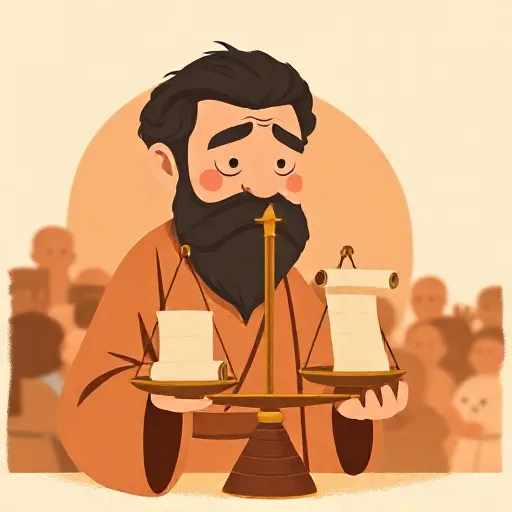
Within a few years, Philo began to think that radical skepticism had gone too far. It was one thing to say you can’t be absolutely infallible; it was another to say you should never trust your evidence at all. Along with other Academics like Metrodorus of Stratonicea, Philo shifted to a view historians now call mitigated skepticism.
Mitigated skeptics still believed that cognitive impressions in the strict Stoic sense don’t exist and that nothing can be “grasped” with total certainty. But they argued it was still rational to form beliefs — as long as you treated those beliefs as measured opinions, provisional and open to revision. They used what Carneades had earlier called persuasive impressions: impressions that, after you checked them under good conditions (good lighting, the right distance, coherence with other things you already accept), struck you as probably true. A persuasive impression isn’t a guarantee, but it’s evidence. And when the evidence is strong enough, a reasonable person may — and should — assent.
Picture a detective investigating a theft. She finds a footprint, a witness report, and a missing key. None of this gives her absolute proof, but taken together the clues persuade her that a certain suspect is the thief. A mitigated skeptic would say the detective forms a rational opinion, not knowledge. She’s wise to act on it, but she knows she could be wrong.
Philo himself lived by this rule. He argued on both sides of a question, weighed the evidence, and then accepted the conclusion that seemed better supported — always with the understanding that he might have to change his mind.
The Roman Books: Knowledge Without a Safety Net

When Philo fled Athens for Rome, he took with him a manuscript that broke even with mitigated skepticism. The text, known as his Roman Books, argued that knowledge is possible after all — but not the kind of knowledge the Stoics had described.
Philo’s first step was to repeat the old Academic arguments: if you insist that a cognition must be an impression that couldn’t possibly be false, then nothing can be known. But his second step was the bombshell: that Stoic definition must be wrong. There are plenty of things we do know, so the definition needs to change.
He proposed a new, simpler picture. An impression counts as knowledge, Philo claimed, if it is (1) true and (2) caused in the right way by the object it represents. Crucially, he dropped the Stoics’ third requirement — that the impression must be so detailed and unique that it couldn’t be false. Under Philo’s definition, you can know something even if it’s possible you’re mistaken. He called this a new kind of cognition, and it made him a fallibilist: someone who holds that knowledge doesn’t need to be absolutely safe from error.
This flew in the face of everything both the Stoics and the skeptical Academics had assumed. For centuries, nearly everyone in the debate had agreed that if you can’t eliminate every possibility of error, you don’t really know. Philo said that demand was a mistake. When you look out the window and see rain falling, you know it’s raining — even if, somewhere, a movie set could have fooled you with a fake storm. The bare possibility of being wrong doesn’t destroy knowledge when your evidence is good enough in practice.
Philo still drew limits. He seemed to think that this ordinary, fallible knowledge mainly covered what you can see, hear, and experience in daily life. Deep philosophical questions about the nature of the soul or the best kind of government might never reach that level of certainty. But you can know your own name, what you ate for breakfast, and what your friends look like.
His critics were horrified. His former student Antiochus of Ascalon (c. 130–68 BCE) accused him of giving up on philosophy. But Philo responded that he was returning the Academy to its original mission: not to insist on a particular dogmatic position, but to teach people how to think critically by arguing both sides of every question.
Why Philo’s Change Matters Today

Philo’s story isn’t just about ancient arguments. It’s about something you deal with every day: how sure you need to be before you say, “I know.”
You already live like a fallibilist. When you check the weather forecast and decide to take a jacket, you act on knowledge that could be wrong. When you study for a test and write an answer you believe is correct, you’re trusting evidence that’s almost — but not absolutely — certain. Philo’s Roman Books defended exactly that attitude. They argued that we shouldn’t wait for an impossible guarantee before we call something knowledge.
His journey also shows that changing your mind can be a sign of strength rather than weakness. Philo moved from “nothing can be known” to “some things can be known” over decades of honest thinking. He kept what was good in skeptical practice — checking arguments, doubting grand claims, demanding reasons — and built a new picture of knowledge that fit how we actually live.
The Academy didn’t survive long after Philo, but his idea that rational inquiry is more important than clinging to a single doctrine has echoed through centuries. It lives on whenever you ask, “What reasons do I have?” instead of just accepting an answer because someone said so.
Think about it
- If you can never be 100% sure of anything, is it still fair to say you “know” something? What would make a belief count as knowledge?
- Philo changed his mind several times about what it means to know. Is it better to stick to your beliefs, or to change them when you find new arguments? Why?
- Imagine you’re a doctor who has to decide on a treatment using the best evidence available, knowing it might turn out to be wrong. How is that like Philo’s fallibilism? How would you decide whom to trust in an uncertain situation?