Can You Know Anything for Sure? Carneades Didn’t Think So.
The Ambassador Who Argued Both Sides
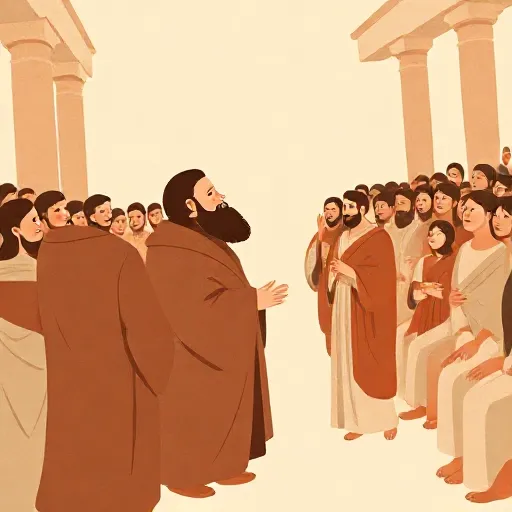
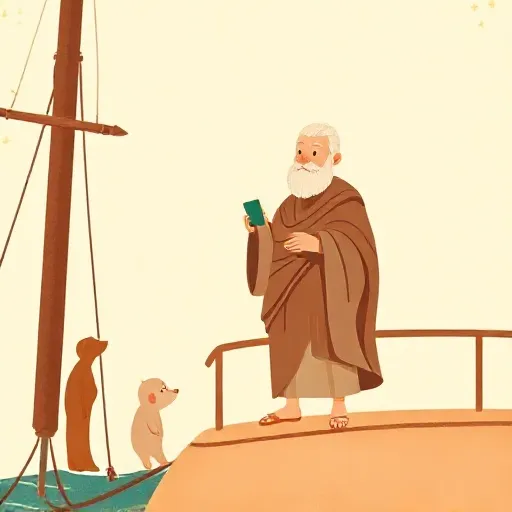
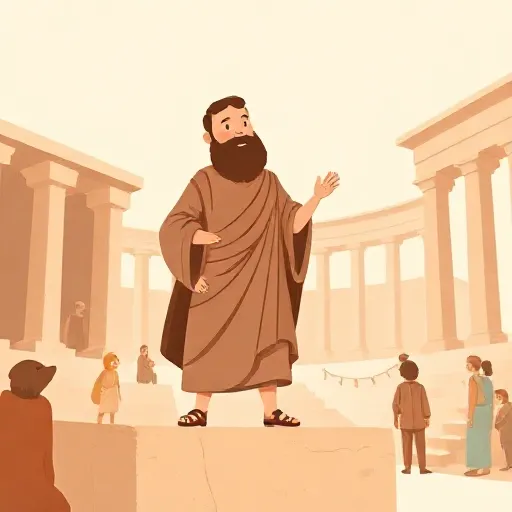
In 155 BCE, a Greek philosopher named Carneades (c. 214–129 BCE) arrived in Rome on a diplomatic mission. He had come with two other thinkers to ask the senate to reduce a fine against Athens. While there, Carneades did something extraordinary: he delivered two public lectures on justice. On the first day, he argued passionately that justice was the foundation of society. The next day, he returned and, using his own arguments against himself, demolished everything he had said, showing that justice was a fragile convention at best. The spectacle shocked and fascinated the Romans. It also captured exactly how Carneades worked. He was the head of Plato’s Academy, but he had turned it into a school of endless questioning. His signature move was arguing in utramque partem — on both sides of every question — never resting in a final answer, always testing.
The Stoic Dream: Absolute Certainty
To see why Carneades pushed so hard, you have to understand his target. The main rival of the Academy was the Stoic school, founded by Zeno of Citium and sharpened into a powerful system by Chrysippus (c. 280–207 BCE). The Stoics claimed that a wise person could live entirely free of false beliefs — a life of knowledge, not guesswork. They believed this because they thought some perceptions are absolutely reliable. They called these cognitive impressions (from the Greek katalēptikē phantasia). A cognitive impression is like a mental stamp that captures reality with perfect accuracy. It is “an impression from what is, stamped and impressed in exact accordance with what is, and such as could not be from what is not.” In plain terms: if you see an apple in broad daylight, close up, with clear eyes, the Stoics said that impression is so vivid and precise that no false impression could ever feel the same way. By only accepting these, you could build all your knowledge on an unshakable foundation, never making a mistake. This perfect foundation was the criterion of truth.
Carneades’ Attack: Why Certainty Slips Away
Carneades refused to accept that. He had studied under the Stoic Diogenes of Babylon (c. 240–152 BCE), and he turned Stoic logic against itself. The Academy under Carneades’ predecessor Arcesilaus (c. 316–241 BCE) had already made skepticism its weapon, but Carneades sharpened the attack. His arguments came in two waves.
First, he pointed to dreams, madness, optical illusions, and visions. A person in a fever may see a monster as vividly as you see your own hand. A dream can feel completely real while it lasts. If a false impression can have all the clarity and strikingness that the Stoics reserved for true ones, then the special feeling they rely on does not actually guarantee truth. An impression can feel unmistakable and still be wrong.
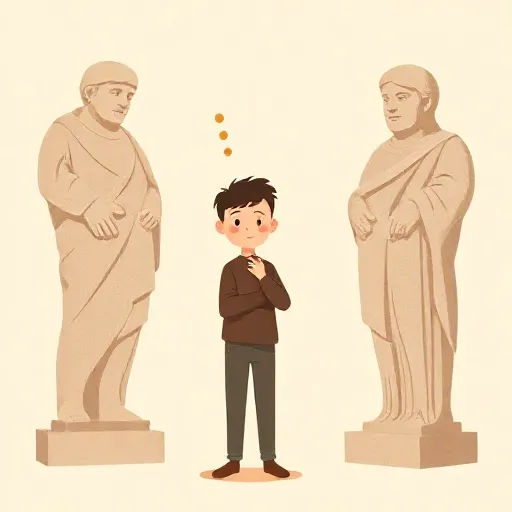
Second, Carneades attacked the idea that every object is perfectly unique. The Stoics denied that two things could be exactly alike. Carneades disagreed. Suppose you meet someone who has an identical twin. You see one of them in perfect light. Your impression is clear — but is it of the right person? Without a way to check which twin it is, even a crystal‑clear perception could lead you to a mistake. If indistinguishable things exist, then no feeling of clarity can protect you from error. The conclusion was devastating: there are no cognitive impressions. And without them, on Stoic assumptions, nothing can be known for sure. The wise person must suspend judgment about everything.
Living Without Certainty: The Power of Probability
The Stoics fired back: if you can’t know anything, how can you even get out of bed? Without a criterion of truth, they argued, rational action becomes impossible. Carneades’ most original move was to answer this challenge with his theory of probable impressions (from the Greek pithanon, meaning “persuasive”). A probable impression is one that strikes you as true, but you don’t treat it as infallible. You check it. You compare it with other impressions around it. If a shape in the mist looks like a person, you watch for movement, listen for footsteps, see if the shape fits with what you know about the place. The more checks an impression survives, the more confident you become — though you never reach absolute certainty.
This gave rise to two ways of living without the Stoic ideal. On one view, which Carneades sometimes defended, a wise person would never really assent to any impression; instead they would “follow” the probable one while holding back final judgment. On another view, a person could assent to what is probable, forming opinions, but always with the awareness “I might be wrong.” Both pictures showed that you can act, inquire, and live a full human life without ever touching certainty. Carneades thus built an early version of fallibilism — the idea that all our knowledge remains open to revision.
Free Will, the Gods, and the Good Life

Carneades did not stop at epistemology. He turned his two-sided method onto ethics, fate, and the nature of the gods. In ethics, he built a map of every possible view of the end or goal of life. He started from things humans naturally want: pleasure, freedom from pain, and natural advantages like health and strength. Virtue, he argued, is always about pursuing one of these — either just aiming at it, or actually obtaining it, or combining the two. This gave nine possible life goals. On different days, Carneades would defend different ones, not because he believed them, but to show that the Stoic claim (“virtue alone is the good”) was not forced on us by the facts. Other theories could also explain what matters in life.
When it came to fate, Carneades entered a fierce debate. The Stoics were determinists: every event, including your choices, is the inevitable result of a chain of prior causes, like a row of dominoes. The Epicureans rejected this but had to invent random “swerves” of atoms to break the chain, which seemed to make our minds playthings of chance. Carneades proposed a third way. He separated the logical principle of bivalence (every statement is either true or false — even about the future) from physical determinism. Knowing that “You will eat lunch tomorrow” is already true does not mean a hidden cause forces you. He then argued that voluntary actions are caused by the mind’s own nature, much as heavy atoms move downward not because something pushes them but because that is simply what they are. Your character and choices are genuine causes, not just effects of fate. This is an early attempt at an idea of free will that is neither locked chains nor pure randomness.
On the gods, Carneades wielded a sorites argument — a puzzle built from tiny steps. He started with Zeus: most Greeks accept him as a god. If Zeus is a god, he said, then Poseidon is a god. If Poseidon, then a river god like Achelous is a god. If Achelous, then the Nile is divine. If the Nile, then every river. If every river, then every little stream — an absurd conclusion. So maybe our starting point, that Zeus is a god, was already shaky. The argument pushes you toward suspension of judgment about the divine. Some ancient sources say Carneades only wanted to embarrass the Stoics; others think he was inching toward a careful agnosticism. Either way, his chain of questions forces people to see how small steps can carry you somewhere you never meant to go.
Why Carneades Still Matters

Carneades wrote nothing down. Everything we know comes from his students and later writers like Cicero. Yet his fingerprints are all over the way we think now. When a scientist says, “The evidence strongly supports this theory, but it might still be wrong,” that is fallibilism — Carneades’ gift. When a doctor lists possible diagnoses ranked by probability, or a weather forecast says “80 percent chance of rain,” you are seeing versions of his probable impression in action. Even in everyday life, you constantly act on less-than-certain information: you cross the street because you judge it is probably safe, not because you have a flawless guarantee.
His free‑will proposal — separating the logic of true‑or‑false statements from the physics of forcing causes — still shapes how philosophers debate freedom and responsibility. And his sorites puzzles pop up wherever people argue about drawing lines: When exactly does a few pounds become “heavy”? When does a patch of color become “red”? Carneades didn’t give us final answers. He gave us a method: turn the idea over, argue the other side, notice what cracks appear. That habit of honest, restless questioning is exactly what philosophy for kids — and for everyone — is all about.
Think about it
- If a supercomputer could predict every choice you’ll ever make, would you still feel that your choices are free? Why or why not?
- Carneades used a chain of tiny steps to turn a god into a stream. Can you think of a situation today where a series of small, apparently harmless decisions leads to a result nobody wanted?
- Imagine you are absolutely certain that a memory is correct, but a video recording shows it is wrong. What does that tell you about trusting your own feelings of certainty?