Can We Ever Know the Truth? A 15th-Century Thinker's Surprising Answer
A Revelation at Sea
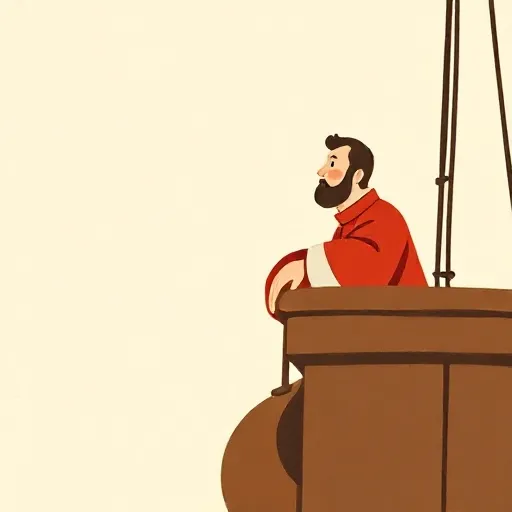
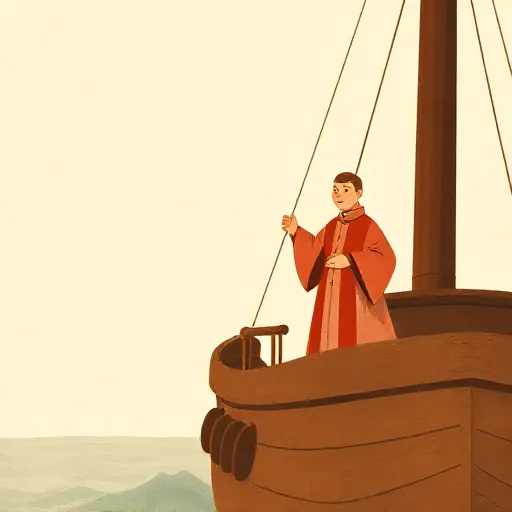
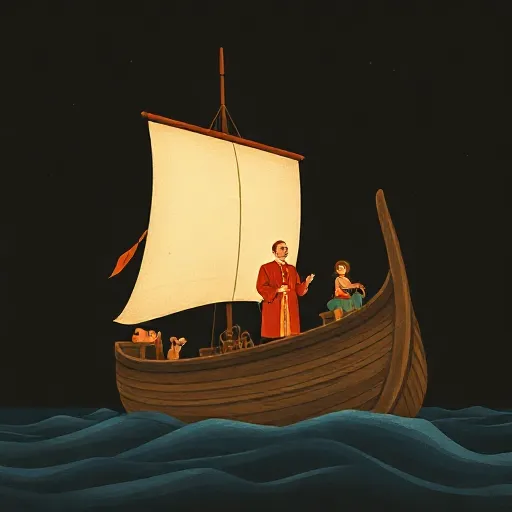
In 1437, a church official named Nicholas of Cusa (1401–1464) was sailing home across the Mediterranean Sea. He had just visited Constantinople on a diplomatic mission, trying to unite the eastern and western Christian churches. On the voyage back to Italy, something shifted inside him — a flash of insight so powerful that he later described it as a gift from above. What came to him during those weeks at sea became the foundation of a book that would shake up how people thought about knowledge, God, and the universe. He called it De docta ignorantia — On Learned Ignorance.
Nicholas was a canon lawyer, a cardinal, and a self-taught philosopher. He did not write like the schoolmen of his day, who filled huge textbooks with logical arguments. Instead, he thought in pictures and metaphors, moving back and forth between big ideas about God, the physical world, and the human mind. His central question was shocking: what if the wisest thing you can do is admit that you do not really know much at all — and that you cannot know? That kind of ignorance, he said, could actually be learned, and it could lead you closer to truth than any confident claim.
God Is So Big You Cannot Measure Him

Nicholas began with a bold claim: God is infinite — absolutely unlimited. But here is the problem. As human beings, everything we understand we understand by comparing one thing with another, by measuring “more” and “less.” A tree is taller than a bush; a day is hotter than the night before. But the infinite does not fit on any scale. As Nicholas put it, there is no proportion between the finite and the infinite. Our minds, which work by making comparisons, simply cannot reach something that has no limits.
To make this vivid, he invented the idea of the maximum. God, he said, is the absolute Maximum — so great that nothing greater can even be thought. But the twist is that in the infinite, the “biggest” and the “smallest” turn out to be the same thing. Why? Because once you leave the world of more and less, both “maximum” and “minimum” point to something that escapes all measurement. This led him to a startling metaphor: God is the coincidence of opposites — a reality where extremes meet and exceed ordinary logic.
You might think this stops us from saying anything about God. But Nicholas disagreed. He argued we can “incomprehensibly comprehend” the incomprehensible — not by grasping God directly, but by using images that train our minds to stretch toward what lies beyond our conceptual reach. Learned ignorance does not mean being silent; it means knowing exactly why your words and thoughts will always fall short.
When Opposites Collide: A Mind-Bending Exercise
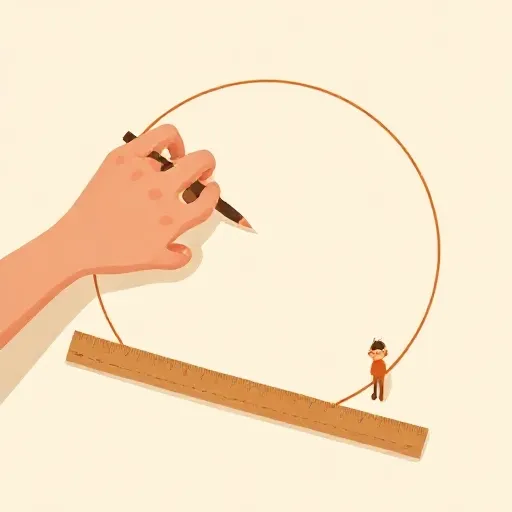
Nicholas loved using geometry to nudge the mind beyond its usual limits. He asked his readers to imagine a circle and a straight line that touches it, like a tangent. Now, imagine the circle’s circumference getting bigger and bigger. The curved line of the circle appears less and less curved. If you could keep enlarging it forever — reaching an infinite circle — the curved circumference and the straight tangent would seem to coincide. Mathematically this is impossible, but as a mental exercise it is powerful. It shows how opposites can merge when we push our thinking toward the infinite.
This “coincidence of opposites” became Nicholas’s signature way of talking about God. In God, maximum and minimum are one; straight and curved are one; being and nothingness are one. But he was careful: creatures do not merge into God. The world of finite things remains real and distinct. The coincidence happens in God, not in us. Our job is to use such exercises to loosen our attachment to tidy either/or thinking and glimpse a reality that holds both sides together.
This way of thinking may sound mystical, but it had concrete consequences. It meant that no limited human concept — not even a religious one — could fully capture the divine. All our names for God, all our doctrines, were at best helpful signs pointing toward something we could never wrap our minds around. Learned ignorance meant holding strong beliefs while knowing they could never be the whole story.
A Universe Without a Center — or an Edge
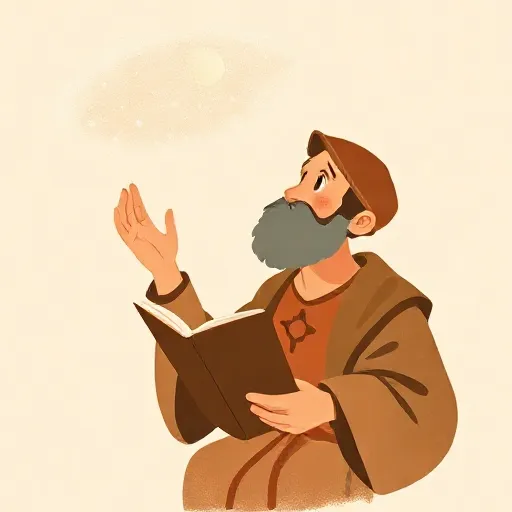
The second book of On Learned Ignorance turned from God to the natural universe. Nicholas described creation as a contracted maximum — an image of the infinite God, but limited, spread out in space and time. He used another striking metaphor: all things are enfolded in God, and God unfolds them into the world like an original unfolding into many images. The world is not God, but it is alive with God’s presence.
From this, Nicholas drew a remarkable conclusion: the physical universe has no exact center and no outer boundary. In his words, the universe is “infinite” in the sense of being unbounded — not because it is God, but because its center is everywhere and its circumference is nowhere. The earth, he argued, is not fixed at the center of everything. It moves, and other planets might be inhabited. What looks like the center to us depends entirely on where we stand. If you stood on another planet, our earth would be part of the distant sky.
He came to this not by peering through a telescope — Galileo would not turn one to the heavens for more than a century — but by thinking through the logic of a created image of an infinite God. If God has no boundaries, the created image of God cannot have a fixed edge or center either. This made Nicholas one of the first thinkers in the West to break away from the old picture of a tidy, Earth-centered cosmos. His reasoning was philosophical, yet it pointed toward the kind of universe science would later explore.
Every Thought Is a Guess

If the universe has no fixed center and God is beyond all concepts, what can we really know? Nicholas’s answer in his second major work, On Conjectures, was blunt: every positive assertion you make is a conjecture. But he did not mean conjecture as a wild guess. A conjecture, for him, is a statement that partly shares in the truth — but only partly, because our minds are limited and our perspective is always partial.
To explain, he pointed to everyday seeing. Imagine you look across a room and say, “There is my friend.” That judgment involves your eyes, your bodily position, and your mind interpreting what you see. You see only one side of your friend, from one angle, in one moment. Your knowledge is real, but it captures the other person from a standpoint, never from all standpoints at once. Nicholas called this otherness — the inescapable gap between the full truth of things (which God alone knows) and the partial likenesses we form.
He also described the mind as a “measuring” tool. Human knowing, he said, is assimilative measuring: we take in the world by creating concepts that liken themselves to things, while at the same time our minds actively shape those concepts. Our minds are like a living compass that adjusts itself to measure many different shapes. Still, all our measurements remain approximate. Only concepts we construct entirely ourselves — such as mathematics — can be perfectly exact, because we build them from scratch. For everything else, we see “in a mirror dimly,” as the biblical phrase has it. The full truth always lies enfolded in God’s mind, beyond our reach.
Nicholas was not saying we should stop trying to know things. Far from it: he thought using our reason and imagination was part of being made in God’s image. But he insisted that wisdom begins when we see the limits of every claim we make — scientific, historical, even personal — and keep learning, keep adjusting, keep stretching our minds.
Why It Still Matters (and Why You Should Care)

You might never sit in a cardinal’s robes on a medieval ship, but Nicholas of Cusa’s insight reaches right into your everyday life. Every time you are completely sure about something — a friend’s motives, a science fact, a moral rule — his challenge hums in the background: What is your standpoint? What might you be missing? Learned ignorance is not about being wishy-washy; it is about holding your beliefs with enough humility to keep your mind open to what you have not yet seen.
Scientists today accept that even well-tested theories might be overturned by new evidence. Historians argue about the very same events because every account is told from a particular angle. Even in arguments with your brother or your best friend, what looks obvious to you may look entirely different from where they sit. Nicholas was one of the first thinkers to make this perspectival nature of knowledge a central philosophical point. He saw that embracing uncertainty could be deeply productive — not a dead end, but a starting place for deeper wonder.
So the next time you feel absolutely right about something, try a little learned ignorance. Ask yourself what a person standing on another “planet” — another family, another culture, another time — might see. You will not lose your convictions. But you might discover that the truth is bigger than any one angle on it, and that the wisest people are often the ones who know how much they do not know.
Think about it
- If we can never be totally certain about anything, does that make some beliefs better than others, or are all opinions equally good? How would you tell the difference?
- Think of something you once believed strongly that you later changed your mind about. What caused you to shift? In that moment, were you closer to the truth, or just seeing from a new standpoint?
- Nicholas imagined seeing Earth from another planet. Try that now: pick an everyday thing — a school rule, a food you dislike, a sport you love — and describe how it might look from the viewpoint of someone very different from you. What does that shift reveal?