Could a Medieval Monk Predict Your Every Move?
A Ball, a Lecture Hall, and a Problem
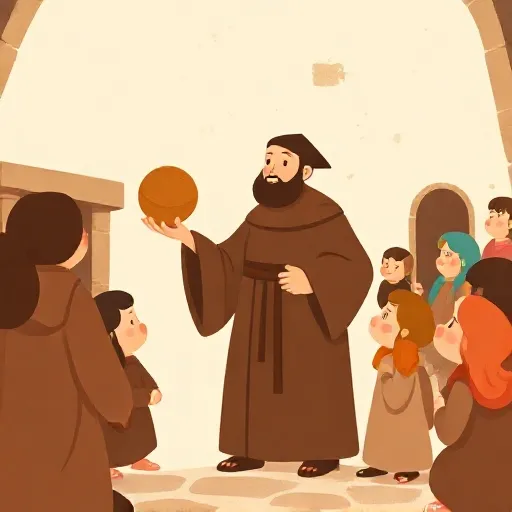
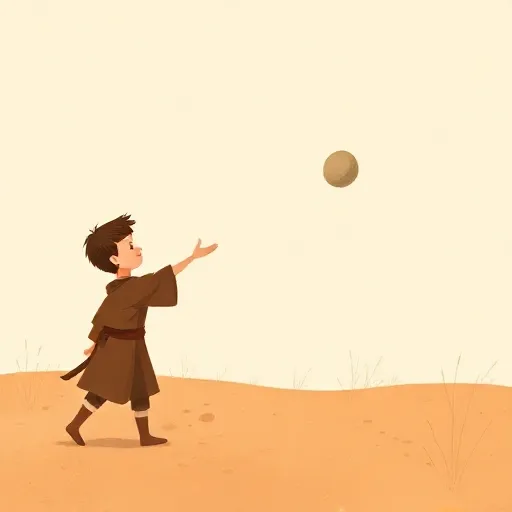
In the early 1320s, in a crowded room at the University of Paris, a Franciscan friar named Francis of Marchia (born around 1285) asked his students a question that would keep thinkers busy for centuries. When you throw a ball, why does it keep sailing through the air after it leaves your hand?
The ancient Greek philosopher Aristotle (384–322 BCE) had an answer, but it was awkward. He said the air pushed out of the way rushes around behind the ball and shoves it along. That idea never felt satisfying. Marchia decided to break with Aristotle. He proposed a cleaner, simpler explanation.
According to Marchia, when you launch a ball, you leave behind a force inside it. He called this a virtus derelicta — Latin for “a force left behind.” This force isn’t a permanent engine; it’s more like a flicker that gradually spends itself. Once the force runs out, the ball falls to the ground. Marchia didn’t invent inertia the way Isaac Newton later would, but he spotted something crucial: an object can carry its own power for a while, without anything else pushing it.
He applied the same idea to many other things — spoken words, light, even the motion of stars. He thought God might have left a virtus derelicta in the heavens that keeps them spinning, at least for a time. That was a radical step. No one before him had spelled out so clearly that a thrown object has a temporary, self-spending force. Later, the philosopher John Buridan (c. 1300–c. 1358) would develop a similar concept, impetus, which moved physics closer to modern ideas. And if you watch a toy top slow down and wobble, you’re seeing something like Marchia’s vision: an inner force that finally gives out.
Nature’s Domino Chain
But Marchia didn’t stop at physics. He thought deeply about what makes things happen. He drew a sharp line between two kinds of causes.
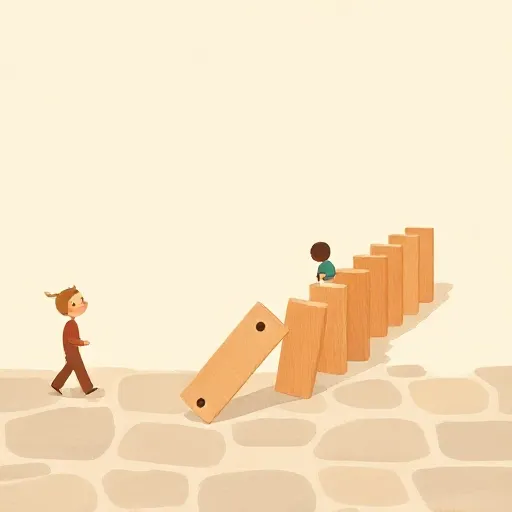
When we talk about nature — falling rocks, flowing rivers, the changing weather — we might think many events are chancy or unpredictable. Marchia disagreed. He argued that natural causality is really a chain of necessary connections. A rock falls because of gravity, the wind blows because of pressure differences, and each effect follows from a chain of causes. But to us, these events can look per accidens contingent — meaning they seem uncertain only because we don’t see all the hidden links. He called this per accidens contingency (contingency “according to accident”). In reality, if you could know every natural cause at once, the outcome couldn’t be otherwise. The chain would fall like dominoes, and a perfect intellect could predict exactly how.
Where does this leave human choice? Marchia made a crucial distinction. True freedom, he said, appears only in the will. This is per se contingency — contingency “through itself.” When you choose between two desserts, you aren’t just another falling domino. You hold a real power to turn one way or the other, even if all the natural causes around you stay the same. That kind of freedom can’t be found in rocks or stars — only in minds.
Marchia even claimed that a created intellect (like a super-smart angel) could, in principle, foresee every natural event perfectly, because natural causes are finite. Why can’t we humans do it? Only because our intellect is “imperfect” and human life is “short.” If we lived long enough and grew smart enough, predicting the path of a tossed ball — or the weather — would be like solving a jigsaw puzzle where you finally see all the pieces.
God, Foreknowledge, and Your Next Ice Cream

Now Marchia faced a puzzle that worried many medieval thinkers. If God knows everything that will ever happen, including what you’ll choose tomorrow, does that mean your choices are already fixed and you can’t do otherwise? Some philosophers, like Peter Auriol (c. 1280–1322), argued that if a future choice is already true or false, it stops being genuinely contingent. A determined truth, he thought, kills freedom.
Marchia refused to give up either side. He wanted to keep both divine foreknowledge and real human free will. To pull this off, he invented a clever set of distinctions.
First, he insisted that statements about the future are already determinately true or false. For instance, “You will eat chocolate ice cream tomorrow at noon” is true right now, or it’s false. That’s the principle of bivalence, and Marchia defended it strongly. But, he said, that truth doesn’t force you. It’s not like a heavy puppet string. Instead, he introduced the ideas of de possibili (about what is possible) and de inesse (about what will actually come to be).
Before you choose, you are undetermined de possibili: you have the genuine ability to pick chocolate or vanilla. At the same time, you already have a determination de inesse — there is a fact about which one you will actually pick. That determination, however, is not an actual push; it’s more like a lean, a disposition. He called it an aptitudinal or dispositional determination. It makes the future definite without taking away your power to do the opposite until the moment you act. So God can know your choice perfectly without taking away your freedom, and you remain fully in charge.
Think of it like this: you can stand by two doors, fully capable of opening either one. But your own habits and inclinations make you disposed to open the left door. The disposition doesn’t lock the right door — you just happen to go left. In the same way, Marchia thought God’s knowledge rests on that gentle disposition, not on a forced outcome.
One Universe, One Recipe?
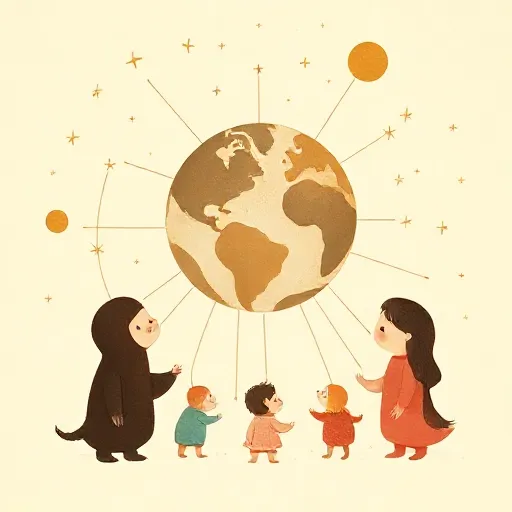
Marchia liked to push boundaries. In his question commentary on the Sentences, he asked whether the heavens and the Earth might share the same basic material. For Aristotle, the cosmos was split in two: the region below the moon was made of corruptible matter that changes and decays, while the celestial realm was filled with a perfect, unchanging fifth element. Marchia wondered: what if the same prime matter — the deepest, barest stuff that underlies everything — exists both up there and down here?
He didn’t go all the way to saying that the same laws apply everywhere. The way he saw it, water and air are wildly different even though they exist on the same planet, because their natural potencies differ. In the same way, celestial objects might be made of the same foundational stuff but behave according to their own special potentials. Even so, suggesting a unity of matter was daring. Some modern scholars compare him to Galileo, who centuries later insisted that the heavens and Earth are made of the same basic substance. Whether Marchia was truly a forerunner of Galileo remains a live debate among experts, but the question he raised — is the cosmos all one piece? — has never stopped being important.
Why This Monk Still Matters
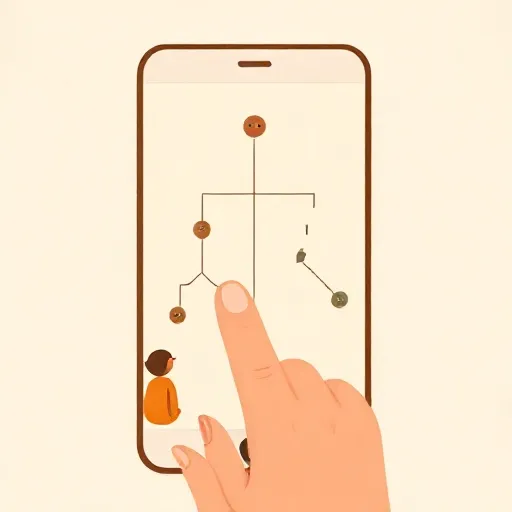
Marchia’s ideas crisscross puzzles we still worry about. Today, scientists build computer models that forecast storms, stock markets, even what you’ll want to watch next. If a supercomputer can predict your behavior, does that mean your choices are just another set of falling dominoes?
Marchia would say no. He built a careful space for human freedom even inside a mostly predictable world. For him, nature runs on necessary tracks, but a person’s will is a different kind of cause — one that can really, truly tilt either way, even if its future tilt is already known by an all-knowing mind.
Yet his solution raises its own awkward questions. If you have a disposition to choose chocolate, and that disposition makes the future definite, could you have ever broken that disposition? And if a friend knows you so well that she always guesses your choices, does that start to look like foreknowledge? Marchia would likely reply that human guessing is just statistical, while God’s knowledge sees your whole self — including your power to still surprise.
The debate over freedom and foreknowledge rolls on, just like the ball he studied. By refusing to accept one simple answer, Marchia showed that the best philosophy doesn’t just solve problems — it makes new ones worth thinking about. And maybe the next time you toss a ball into the sky, you’ll remember the friar who first said there’s a little force asleep inside it, waiting to run out.
Think about it
- If a scientist knew every fact about your brain and the laws of nature, could she predict your next choice? Would that prediction remove your freedom, or only describe it?
- Marchia believed that your choices are already true or false before you make them. Does the idea that your future is already “settled” feel different from being forced? Why or why not?
- We now know that some tiny events in nature (like radioactive decay) are pure chance, not fully determined. Would Marchia’s distinction between natural causes and free will still work in a partly chancy universe? Explain.