Why Does a Thrown Stone Fly? And the Fight Over Free Will
The Puzzle of the Flying Stone
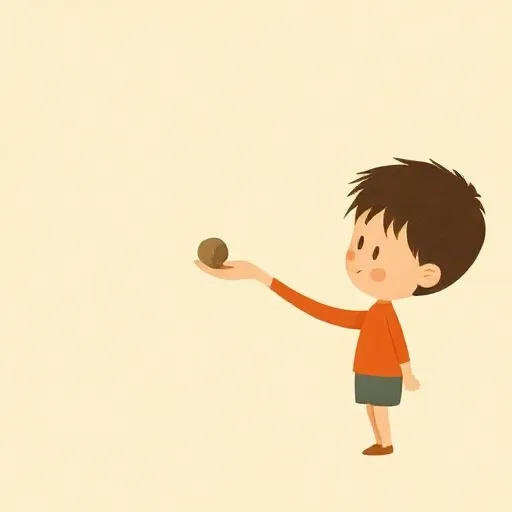
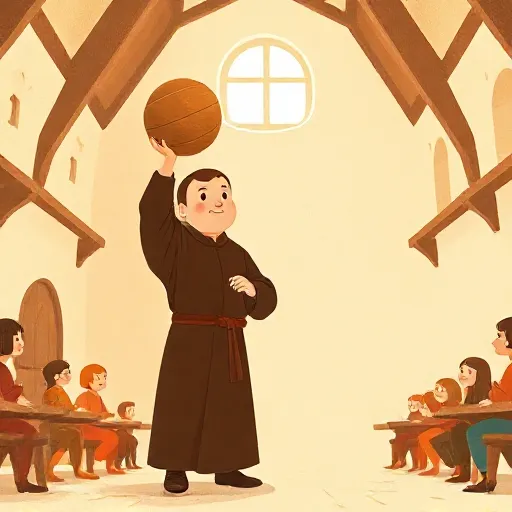
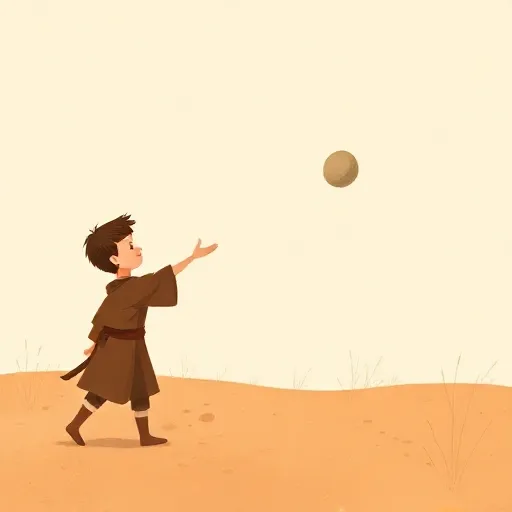
It is a sunny afternoon in 14th-century Paris. A boy picks up a smooth stone, winds up, and sends it arcing across the field. The stone flies, drops, clatters to a stop. But as he watches it sail, one question nags at him: what keeps it moving once it leaves my hand? That simple question launched a long fight about what causes things to happen, and about who—or what—is really in control.
The starting point for almost all medieval thinkers was Aristotle (384–322 BCE). In his Physics, Aristotle claimed that every motion needs a mover that is right next to it. He divided motions into two kinds. Natural motion happens when a thing goes toward its natural place. A heavy body, like a stone, has a natural tendency to move downward. As the 13th-century philosopher Peter of Auvergne put it, “being below is the principal end of a heavy body.” Fire, in contrast, naturally shoots upward. Violent motion, on the other hand, is pushed from outside—a cart pulled by a horse, or a stone thrown by a hand. The hard problem is violent motion that continues after the pusher stops touching.
Aristotle’s answer for a flying stone went like this: as the stone moves, it leaves a temporary vacuum behind it. Air rushes around from the front to fill that empty space, and that rush of air pushes the stone from behind, keeping it going. Medieval thinkers spotted big holes in this story. It is much easier to throw a heavy stone than a light bean, even though a light object should be more easily moved by puffs of air. And if you throw two stones in opposite directions so they cross paths, the air currents would need to push both ways at once at the crossing point—that makes no sense. Such objections were raised by many, and most famously by John Buridan (c. 1300–c. 1358) and Nicole Oresme (c. 1323–1382).
Impetus: A Force Inside Things

Buridan and Oresme offered a different picture. They said a violent motion isn’t driven by outside air; it happens because a new form—impetus—gets impressed into the moving body. When you throw a stone, your arm plants impetus in it, and that impetus carries it forward. Over time, the impetus naturally decays—like a fire slowly going out—and the stone slows down and drops. This made sense of things: a heavy stone can hold more impetus than a lightweight bean, and the meeting of two flying stones doesn’t create a nonsense tangle of air.
There was even careful quantitative work in the 14th century trying to work out the mathematical law according to which impetus fades. And the idea stretched far: Buridan and Oresme both said it would be perfectly consistent with everything we observe if the earth itself were rotating while the heavens stood still—making them, in a limited sense, “precursors of Galileo.”
Yet their causal world was still thoroughly medieval. Impetus was a form inhering in a substance, much like heaviness. The stone still had two forms—weight pulling it down and impetus pushing it forward—and those two forms conflicted. Motion still needed an internal mover, and the basic picture of agents and patients remained. Later, Galileo and Newton would treat uniform straight-line motion and rest as equally natural, no force needed to keep going. That was a break the impetus thinkers never quite made.
Who Pushes Your Will?

Motion in medieval philosophy didn’t just mean changing place. Any change of state—like a thought forming, or a decision being made—was a kind of motion. So the same questions about what causes motion spilled over into questions about the will.
Aristotle held that nothing can cause a change in itself. Your actions come from a combination of beliefs and desires; those belief‑desire states are not themselves actions, so the will never moves itself—it is always pushed by something else. But that picture didn’t satisfy everyone. From the 12th century onward, a rival tradition, rooted in Anselm, said the will is a self‑mover.
The most influential defender of self‑motion was Duns Scotus (c. 1266–1308). Scotus said the will has two inclinations: one toward what fulfills the self, and one toward justice. Because it has both, the will is not determined the way a falling stone is. A natural cause, unless blocked, must do its one thing; but a will with two inclinations can tip either way. It is self‑determining.
William of Ockham (c. 1287–1347) pushed this even further. He argued that ends and reasons influence the will, but never force it. Under exactly the same circumstances, a free agent can choose otherwise. In Ockham’s striking example, a human will could even turn away from the Beatific Vision—the ultimate happy sight of God—and freely choose something else entirely. For Scotus and Ockham, the mind contains a genuine self‑mover, just as some thinkers held a thrown stone contains impetus.
Could God Make Fire Not Burn?
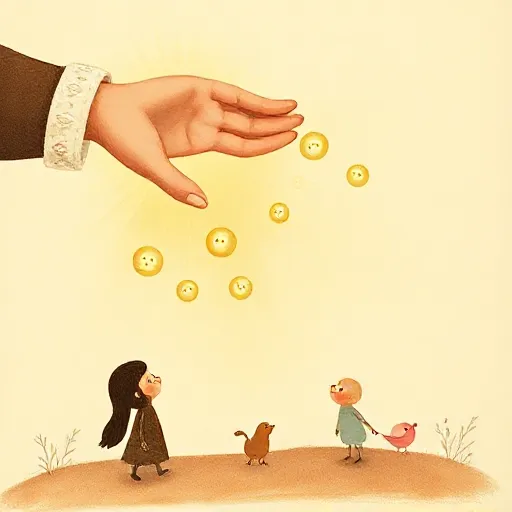
This line of thought raises a scary question: if even a falling stone has its own natural drive, and the will moves itself, are the laws of nature as solid as we think? Medieval philosophers framed this in terms of God’s power. They drew a key distinction between God’s absolute power and God’s ordained (or ordered) power.
Absolute power is unrestricted might. By it, God could create a vast array of possible worlds. A widely used principle said: given any two distinct things, God could make a world where one exists and the other does not, or could destroy one while leaving the other intact. So, by absolute power, God could make a world where fire feels cold, or stones fall up.
But that is not the world God chose to make. As Aquinas put it, what God can do by his ordered power is what a just will commands. Inside the wide space of all possible worlds, there is a smaller space of worlds that a just God would actually create. In that actual world, causes behave in reliable, necessary patterns. With respect to God’s ordained power, many causal connections were considered genuinely necessary.
This distinction gave medieval thinkers a flexible toolkit. Buridan used it to untangle tricky passages in Aristotle. Scotus used related arguments to study whether the present moment could be contingent. And it meant that, in practice, you could still do science: Ockham gave the example of a person who sees that a particular herb cures a fever in one patient, eliminates other possible causes, and then reasons that all individuals of the same herb kind will have the same effect—a tidy case of learning a causal rule from experience, grounded in a natural kind. God’s absolute power didn’t cancel reliable causes; it just said the world didn’t have to be arranged that way.
Why It Still Moves You
The medieval story didn’t settle everything, but it shaped what came next. The language of impetus eventually gave way to inertia, but the shift was built on centuries of digging into exactly why things keep going. The idea of the will as a self‑mover fed directly into later debates about freedom and determinism, debates you can still see in philosophy classrooms today. And the absolute‑ordained power distinction helped carve out a space where you could investigate nature without having to worry that God might change the rules at any moment.
So the next time you toss a paper ball across the room, or find yourself torn between two choices, you are standing at the edge of the very same puzzle that bothered that Parisian boy. What keeps things going? What makes you choose? And could the whole story, in some other world, be completely different? The medievals didn’t give the final answer, but they sharpened the tools we still use to think about it.
Think about it
- If you could rewind time to just before you chose your lunch today, do you think you could have picked something else? What would make that possible—or impossible?
- A soccer ball rolls to a stop. Is there something inside it that runs out, like medieval impetus, or is there another explanation? How would you test your idea?
- If God could make a world where dropped oranges float upward, would that change what “natural” means to you?