

Do You See What I See? Why Your Identity Matters for Knowing
Who Gets Believed in the Classroom?
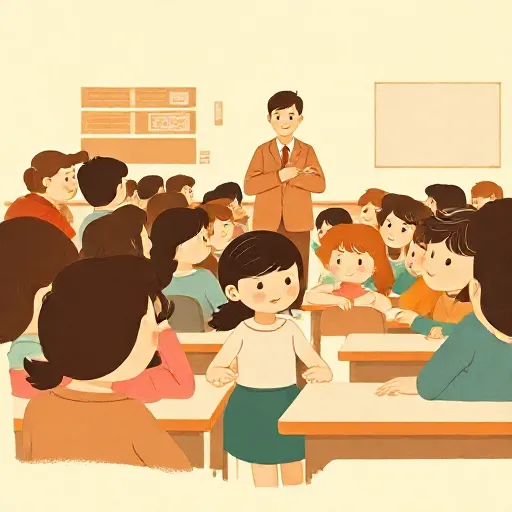
You’re in science class. Your friend Mia raises her hand and suggests an explanation for why leaves change color. The teacher pauses, frowns, and says, “Hmm, not quite.” A moment later, Jake, who sits across the room, says almost the same thing. The teacher nods: “Great answer, Jake.” What just happened? Is it possible that who speaks can matter as much as what they say? For most of Western philosophy, the answer was “no.” Knowers were seen as interchangeable, blank minds. But beginning in the late 1970s, a group of feminist philosophers argued that that picture is wrong. They asked: is the identity of the knower — their gender, race, class, life story — part of knowing itself? And if it is, what does that mean for what we call “knowledge”?
The “Generic Knower” Myth
Traditional epistemology — the branch of philosophy that studies knowledge — grew out of the idea that knowledge is a product of each mind, alone. From René Descartes in the 1600s onward, thinkers aimed to build knowledge from a single, first-person perspective: I see, I reason, I know. The “knower” in this story is solitary, self-sufficient, and generic — a stand-in for any human being anywhere. This is often called the atomistic model: each knower is like a separate atom, their social identity irrelevant to what they can know.
Feminist philosophers Lorraine Code (writing in 1981) and Sandra Harding (in 1982) challenged this model head-on. They argued that if all knowers are imagined to be interchangeable, then differences rooted in social position — like gender — are automatically dismissed as unimportant. But in the real world, a girl’s experience in a math classroom, or a doctor’s appointment, or a street at night can be profoundly different from a boy’s. Those different experiences give people different perspectives. It’s not just about having one more fact; it’s about how your entire angle on the world is shaped by where you stand.
Think of it like this: imagine a giant elephant in a dark room, and several people are feeling different parts of it. The person touching the leg says, “It’s a tree.” The person touching the trunk says, “No, it’s a snake.” If we only listened to the one touching the leg, we’d never get a complete picture. In the same way, if a society’s institutions — science, law, medicine — are mostly shaped by one group’s perspective, the whole picture can be skewed.
Standpoint: The View from the Margins
Some feminist philosophers pushed this further. Maybe the perspective of people on the margins isn’t just different — maybe it’s better for understanding certain things. This idea became known as standpoint theory.
The roots of it come from Karl Marx. He argued that factory workers, who are exploited by the people who own the factories, can develop a sharper understanding of how economic power works. The reason? They have a dual vision: they know the boss’s rules because they have to follow them, but they also know firsthand what it feels like to be ground down by those rules. The boss, from his comfortable position, can afford to ignore that reality.
In the 1970s and ’80s, thinkers like Nancy Hartsock and Dorothy Smith applied this logic to gender. In a society structured by male dominance, women often find themselves catching the view from both sides. They live their own experience, yet they must learn to navigate a world built for men. This dual position, theory says, gives them access to knowledge about how society really works that men may miss. Patricia Hill Collins (writing in 1990) extended the idea to Black women, arguing that their location at the intersection of racism and sexism creates a distinctive standpoint — not merely a perspective, but an achieved critical understanding that comes from shared resistance and political struggle.
Sandra Harding took this further with her concept of strong objectivity. She argued that if a researcher starts asking questions from the lives of the oppressed — the poor, women, people of color — they can actually see more of the social machinery, including the blind spots of the powerful. Instead of pretending to be a “view from nowhere,” strong objectivity acknowledges its starting point and uses it to produce less partial knowledge.
Standpoint theory has met fierce debate. Not all oppressed people experience oppression the same way, and oppression can sometimes confuse rather than enlighten (imagine a girl who has been taught that her harassment is her own fault). Still, the central insight stuck: some social locations can give you a lens that is uniquely powerful for exposing hidden forms of power.
Objectivity Is a Team Sport

If every perspective is partial, how can we ever get to something we can call “objective”? Helen Longino (born 1944) offered an answer that turns the old picture inside out. Objectivity, she argued, is not a special state of mind where you strip away all values and biases. It’s a social process.
Longino pointed out that in science (and in everyday knowledge), we can never let just the facts decide — data must always be interpreted through some set of background assumptions. The question is how to keep those assumptions from sneaking in unchecked. Her answer: a community that makes its reasoning public and subjects it to serious, critical questioning from people with different viewpoints. For this to work, the community needs four things: public spaces for criticism, a willingness to actually take up that criticism, shared standards of evidence, and a rough equality of intellectual authority so that no one’s voice is silenced ahead of time.
This is why diversity isn’t just a nice idea — it’s an epistemic requirement. If everyone in the room shares the same life experiences, they’ll share the same blind spots. The lone dissenter, the one whose body has moved through the world differently, can spot what others overlook. Think of a group project where everyone checks each other’s work. If the whole group makes the same mistake, they’ll never catch it unless someone with a different way of thinking notices. Longino’s picture transformed objectivity from a lonely achievement into a team sport.
Not Believed: The Injustice of Being Silenced

So far we’ve talked about how identity shapes what you can see. But feminist epistemologists also uncovered a related problem: sometimes, others refuse to hear you at all.
Philosopher Miranda Fricker (born 1966) names this a testimonial injustice. It happens when a speaker is given less credibility than they deserve because of a prejudice about their identity. A girl reports bullying and is dismissed as “dramatic.” A young person of color tries to describe a neighborhood detail to an adult and is met with condescension. The harm here isn’t just feelings — it’s a wound to the person’s status as a knower.
Fricker also identified a subtler wrong: hermeneutical injustice. This occurs when a whole group lacks the collective words to make sense of a shared experience, because the dominant culture has never given that experience a name. Before the term “sexual harassment” was coined, for example, women had a gut-level understanding of a workplace ordeal, but no socially recognized concept to express it. They were left, in Fricker’s phrase, with a crucial gap in the “collective hermeneutical resource” — the toolbox of shared meanings.
Later thinkers noted that sometimes the resources do exist within a marginalized community, but the dominant group refuses to use them — a form of contributory injustice or willful ignorance. All of these ideas share a common thread: systems of power don’t just shape what we investigate; they shape who can speak and who gets a fair hearing.
Why This Matters in Your Life

You may never become a philosopher, but you live inside these dynamics every day. In your group chat, who gets listened to and who gets ignored? When your class debates a historical event, whose story is treated as the “real” one? Even in choosing what topics to research for a paper, you’re making calls about whose questions matter.
Feminist epistemologists don’t ask you to abandon truth. They ask you to notice that truth has a location. A better knowledge system doesn’t eliminate perspectives; it brings more of them into the open, checks them against one another, and works to correct the injustices that leave some voices permanently on mute. That means building classrooms, clubs, and communities where criticism is welcome, where no one’s authority is assumed just because of their title, and where you actively seek out the people who see what you don’t.
The next time you see someone’s perfectly good point brushed aside, or you catch yourself dismissing a person before they’ve finished speaking, you’re facing the kind of puzzle that launched a revolution in philosophy. Is knowledge fair? Not yet. But philosophy gives us tools to make it fairer.
Think about it
- If you’ve ever been in a situation where someone didn’t believe you because of who you are, how did it feel? Could their doubt ever have been reasonable?
- Can a person who has never experienced a particular kind of unfair treatment ever fully know what it’s like, or do you need that lived experience to truly understand?
- In your friend group, do you instinctively trust some people’s opinions more than others based on who they are? Is that always a mistake, or could it sometimes be sensible?