
How Do You Know That Everyone Knows You Know?
The Spilled Gravy and the Missing “I Know”

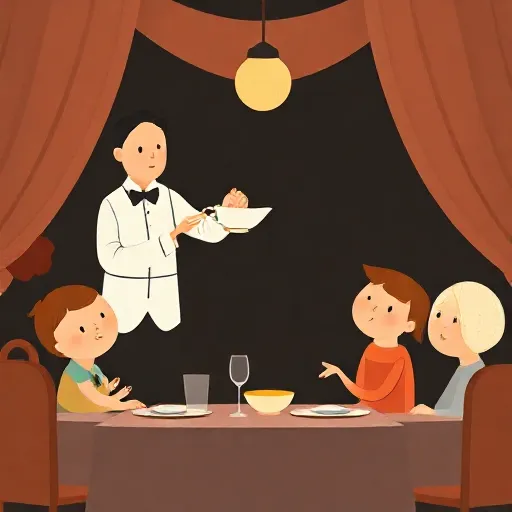
A waiter trips, and gravy splashes across a guest’s white silk dress. The guest glares with fury. The waiter blurts out, “I’m sorry. It was my fault.” Why does he say that? The guest already knows the waiter is at fault, and the waiter already knows the guest knows. Yet the waiter still speaks. He wants the guest to know that he knows he is at fault—and he wants the guest to know he wants her to know. That little extra makes all the difference.
In everyday life, we often need more than just everyone knowing a fact. We need mutual knowledge: each person knows the fact. But mutual knowledge alone doesn’t let us be sure about what others think we think. For that, we need common knowledge: I know it; you know it; I know you know it; you know I know it; and so on, forever. The waiter’s public apology instantly builds a tower of “I know that she knows that he knows…”—and the tension dissolves. Without that announcement, the guest might wonder: Did he realize how clumsy he was? Does he know I’m angry? The spoken words cut through the fog.
Philosophers call this kind of public event a basis for common knowledge. When everybody can see and hear the same thing, and each knows the others can draw the same conclusion, the fact becomes common knowledge. This sounds simple, but pick it apart and you find a puzzle: How many layers of “knowing” do you need before you can truly act together?
The Barbecue Mess and the Dinner Bell
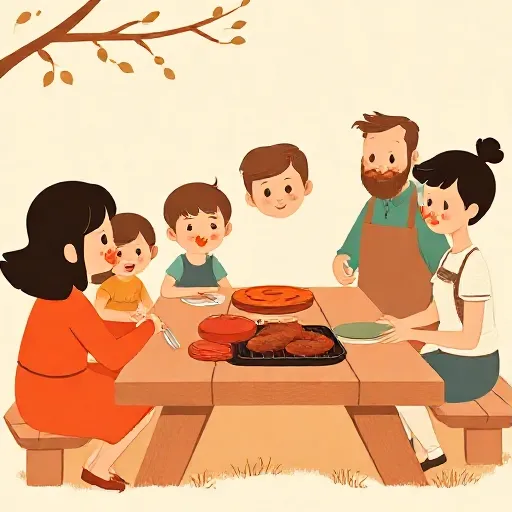
Consider a group of friends at a barbecue. After the meal, some have sauce on their faces, but no one can see their own face. Each person can see everyone else. So everyone knows whether others are messy, but not about themselves. The cook notices the mess and rings a bell. He announces: “At least one of you has barbecue sauce on her face. I will ring the dinner bell over and over, until anyone who is messy has wiped her face. Then I will serve dessert.”
If there is just one messy person, that person immediately sees everyone else clean, so he knows he must be the one and wipes his face at once. If there are two messy people, each sees one other messy person. At the first bell, neither moves, because each thinks maybe the other guy is the only one. But when the second bell rings and the other still hasn’t wiped, each realizes: if he were the only messy one, the other would have wiped after the first bell. So at the second bell, both wipe. If there are three messy people, the same logic takes three rings, and so on.
The cook’s announcement didn’t tell anyone a brand-new fact—everyone already could spot at least one messy face. But by saying it out loud, he turned mere mutual knowledge into common knowledge, and that let everyone reason through the arithmetic of who else knows what. The diners needed the infinite ladder of “he knows that she knows that he knows…” to finally deduce their own condition.
This barbecue puzzle (from mathematician J. E. Littlewood in 1953) reveals something surprising: a public statement can give people crucial information even when it only repeats what they already know. The power is in the publicness—in making sure everybody knows that everybody knows.
Meeting at the Mall and the Birth of a Convention

The economist Thomas Schelling (1921–2016) told a story about a husband who loses his wife in a department store. They hadn’t agreed on a meeting place. Yet they often find each other—each heads to some spot so obvious that both think it’s obvious to the other. But how? It’s not enough to think “I’d go to the shoe department.” You must think about what the other person thinks you’ll think, and she must think about what you think she’ll think, and so on.
Schelling called this a pure coordination problem—a situation where the two people’s interests match perfectly, but they still must pick the same action from many possibilities. In the department store, going to the same floor means success; being on different floors means staying lost.
The philosopher David Lewis (1941–2001) took this idea further. He argued that for people to successfully coordinate again and again, they need a convention: a pattern of behavior that everyone follows because everyone expects everyone else to follow it, and they all know this. In the store, if it is common knowledge that “meet at the fountain on the ground floor” is our way, then each can confidently go there. But if you merely believe the other will go there, without knowing she knows you know, you might hesitate—and your hesitation might make her hesitate too.
Lewis showed that common knowledge is the glue that holds a convention together. No matter how many layers of “I think she thinks I think…” you add, if the chain ever stops, the convention wobbles. This is why a loud, public, unmistakable event—a posted sign in the store saying “Meeting Point,” for example—makes coordination snap into place: it creates common knowledge in a flash.
When Two People Can’t Disagree (Even If They Want To)
Robert Aumann (1930–) proved a startling result in 1976. If two people start with the same set of basic beliefs (the same prior probability distribution), and then it becomes common knowledge what each now believes about some question, then they cannot possibly have different answers. In other words, real disagreement is impossible under full common knowledge and a shared starting point.
Picture two friends on a game show. They both know the prize is hidden behind one of three doors, and they both agree the odds are equal at the start. Then each receives a private hint. Alice’s hint leads her to think Door A is more likely; Bob’s leads him to Door B. If they then talk openly and it becomes common knowledge that Alice thinks “60% chance Door A” and Bob thinks “70% chance Door B,” Aumann’s theorem says they must adjust their beliefs until they match—provided they started with the same initial odds.
Why? Because once each knows what the other knows, and each knows the other knows that, the only remaining disagreements would have to come from treating the same information differently. But if they both reason from the same base, they must land in the same place. The result shook social science: it implies that many everyday disagreements must trace back either to a failure of common knowledge or to people not sharing the same basic assumptions. We can “agree to disagree” only if at some level the knowledge chain breaks.
The Email That Never Quite Arrives

Can real people ever truly achieve common knowledge? The philosopher and economist Ariel Rubinstein (1951–) set up a thought experiment: the email game. Two friends, Lizzi and Joanna, want to meet at a restaurant that has two branches. Only Lizzi knows which branch is open. She must email Joanna to tell her, but messages sometimes get lost. They agree that Joanna will send a confirmation when she gets the email, and Lizzi will confirm the confirmation, and so on. Each reply has a small chance of vanishing.
If the emails flew back and forth infinitely, the restaurant location would become common knowledge and they’d both go to the right place. But with any tiny risk of failure, the chain of replies always ends somewhere. So no matter how many confirmations they actually exchange, full common knowledge is never reached. Rubinstein showed something unsettling: even with a hundred messages back and forth, the mathematically best decision for each is to play it safe and stay home, as if they had no information at all. Only with infinite messages would they both dare to go.
This paradox isn’t just logic games. It means that in any noisy channel—texting, mail, even spoken words in a loud room—full common knowledge is fragile. A single missed “got it” can unravel the entire fabric of coordination. We muddle through every day by relying on approximations and conventions, but the logic of common knowledge remains unforgiving.
Why It’s Still Tricky to Really Know Everyone Knows
So did the clumsy waiter really need to speak? Yes—his public words, heard by both sides, created a public event that stamped “I know I’m at fault” as common knowledge. A grumble or a nod might not have done it. The guest might still wonder, “Does he realize how angry I am?” But the explicit “It was my fault” left no room for those gaps.
Every convention you rely on—taking turns at a four-way stop, using words with the same meanings, agreeing that a handshake means a deal—depends on something like common knowledge. If you merely believe the other driver knows the rule, you might still hesitate. You need the shared certainty that she knows you know the rule too.
And yet, as the email game shows, such certainty can be delicate. In everyday life, we often leap to trust the chain of knowing after just a few words, and mostly it works because we live in a world with many public signals. The barbecue cook ringing the bell, the mall’s “Meeting Point” sign, a teacher pointing to the homework board—these cut through the infinite regress in one stroke.
Philosophy’s lesson: common knowledge is easy to want and often hard to have, but once you see its structure you also see why so much of our social world depends on those rare moments when everybody really does know that everyone knows.
Think about it
- If you and a friend get separated in a park with no plan, what makes a meeting spot “obvious” to both of you? Can you ever be sure it’s obvious to the other person?
- Imagine you’re texting a plan, and you’re not sure your last message was delivered. How many “got it” replies would you need to feel safe acting—and might that number change depending on how important the plan is?
- If every shared understanding requires some level of common knowledge, is it possible for a whole society to ever fully agree on a fact or a rule, or will there always be a hidden crack in the chain?