

The Law Says Everyone’s Equal. So Why Doesn’t It Feel That Way?
A Call the Police Would Not Answer

In the 1960s, a woman could dial 911 because her husband was hitting her. An officer might arrive, stand in the doorway, and do nothing. The attack was happening at home, and the home was considered a private sphere—a zone where the law should not meddle. Feminist legal thinkers saw a terrible pattern. By keeping the door shut and the law out, the state let the strong control the weak inside what was supposed to be a refuge.
That single problem—what happens when the law draws a line between public life and private life—is just one place where feminist legal philosophy digs in. The bigger question is this: if the law is designed to be fair to everyone, why do its rules so often work out worse for women and girls? Feminist legal thinkers examine how law can look neutral while quietly protecting old patterns of power.
Why Fair Rules Can Still Carry Old Burdens
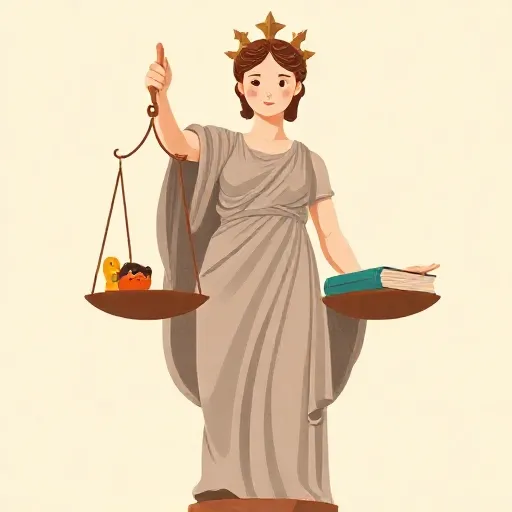
The rule of law is the idea that society should be governed by clear, public, stable rules that apply to everyone. That sounds great—no king deciding your fate on a whim. But feminists warn that sticking rigidly to how things have always been done can freeze injustice in place. The legal scholar Martha Minow (b. 1954) pointed out that law’s habit of treating like cases alike can make systemic bias invisible. If the “like cases” are defined by men’s experiences, women’s needs never count as similar.
A powerful form of this freeze is originalism, the view that courts should interpret laws exactly as they were understood when they were written. Originalists say this stops judges from reading their own values into law. Feminist critic Reva Siegel counters that originalism pulls authority from an imagined past—and those past communities often treated women as second-class. When the U.S. Supreme Court ended the constitutional right to abortion in 2022 (Dobbs), the originalist opinion dismissed equality arguments, saying a lack of abortion affects everyone who can get pregnant just the same. Feminist lawyers called it a jurisprudence of masculinity, where male-modeled rights are protected while rights linked to women’s bodies are brushed aside.
The ‘Reasonable Person’ Who Looks a Lot Like a Man

Suppose a law asks, “Would a reasonable person have felt threatened enough to use force in self-defense?” That test appears in criminal law, in job harassment cases, even in everyday contracts. For centuries, the test was literally the “reasonable man.” Today it’s the “reasonable person,” but feminist scholars argue the ghost of the man remains. Rules about what counts as sensible fear or fair bargaining grow out of male norms. A woman cornered in an elevator who freezes instead of fighting back might not seem “reasonable” to a jury that expects a fistfight—even though freezing is a common human fear response. These reasonableness standards can quietly punish those whose experience doesn’t match the assumed model, often women and gender minorities.
The Dilemma of Difference

Equality seems simple: treat everyone alike. But the real world isn’t flat. Martha Minow described a dilemma of difference. Take maternity leave. If a company gives time off for pregnancy but not for new fathers, some say that’s unfair to men. If it gives nothing, women who give birth shoulder a burden men never face. Minow argued the real problem is an unstated starting point: a workplace designed for someone who never gets pregnant. The appearance of unfairness comes from treating a male-shaped default as normal. For feminists, equality requires asking whose life the law already takes as the standard.
This dilemma explodes around gender identity and sports. Some sports rules classify athletes by sex assigned at birth, others by gender identity. Recognizing one kind of biological difference can entrench stereotypes; ignoring another can feel like erasing someone’s identity. There is no simple formula, and feminist legal thinkers disagree sharply.
Different Feminists, Different Roads to Change
The disagreements are deep. Liberal feminists aim for formal equality: get the law to stop saying “man” and “woman” where it doesn’t matter, and open all doors. That strategy removed openly discriminatory laws—for example, letting women administer estates or serve on juries. But critics of patriarchy, known as radical or dominance feminists, argue that tapping a “neutral” button won’t work when the whole machine is built on men’s power. For them, laws about sexual harassment, pornography, and domestic violence are not just individual wrongs but symptoms of how society organizes male dominance.
Scholars of intersectionality push both sides to see another layer. A Black woman facing job discrimination experiences not sex plus race but a specific form of harm that neither “women’s issues” nor “race issues” fully catch. This lens also challenges criminal law. Well-intentioned policies like mandatory arrest for domestic violence can backfire when they increase police surveillance of communities of color and punish victims alongside abusers. Leigh Goodmark and other feminist criminal justice thinkers insist that domestic violence is also an economic and public health crisis—not only a problem for cops and courts.
Feminists also split over commercial sex. Some liberals defend the freedom to do sex work; others argue that commodifying the body is always exploitative. The same debate rages over surrogacy and the buying and selling of gametes. What unites feminist legal philosophy is the shared conviction that the law is not a neutral backdrop. It builds the stage, decides who gets the spotlight, and often hides the scaffolding from view.
What This Means for You—Right Now

You don’t need a courtroom to bump into these fault lines. Think about a school dress code that measures girls’ skirt length but shrugs at boys’ gym shorts. Think about who gets called “bossy” and who gets called “a leader.” The public–private line still matters when a hurtful group chat targets someone after school—are those posts just private drama, or are they something the school should handle? How about the expectation that your mom, not your dad, will leave work early to pick you up? That’s the legacy of workplace norms built around a breadwinner husband and a wife at home—an echo that the legal thinker Claudia Goldin calls “greedy work.”
Feminist legal philosophy cannot wave a magic wand and fix bias with one statute. But by naming what is hidden, it gives people the language to ask: what does this rule take for granted? The woman behind the closed door, the bleeding colleague who froze, the student who hates being told her shoulders distract the class—all their stories raise that same question. And once you see the scaffolding, you can start to wonder whether the law could be built differently.
Think about it
- A company gives new mothers paid leave but not new fathers. Is this rule fair, unfair to men, or unfair to everyone because it assumes only women raise babies?
- If a rule is the same for everyone, but it consistently hurts one group more than another, does that make the rule unjust? What might a just rule look like instead?
- Can you think of a school or community rule that seems neutral but might secretly favor one gender? How could you test whether it’s truly fair?