Can Grammar Tell Us How the World Really Is?
The Teacher Who Wanted Grammar to Be a Science
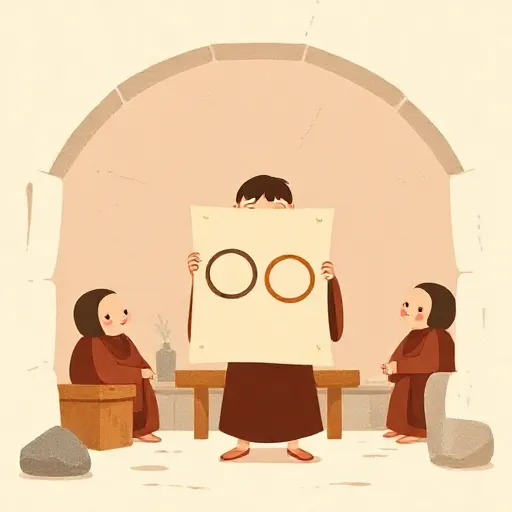
Imagine a chilly morning in 1310 at the University of Paris. Students huddle on wooden benches as a young teacher named Thomas of Erfurt (active early 1300s) strides to the front. He picks up a piece of chalk and writes the Latin word canis on a slate. “Most people,” he says, “think grammar is just a set of rules borrowed from old books. But I’m going to show you it’s a real science—one that can teach us how the world itself is put together.”
Thomas belonged to a group of thinkers called the Modistae, or speculative grammarians. The name comes from modi significandi, Latin for “modes of signifying.” The Modistae believed that behind every word is an invisible code, a “mode” that determines whether it acts as a noun, a verb, or something else. And these modes weren’t just human inventions—they came from the way our minds work, and ultimately from the way things really are.
To grasp their bold idea, think of a video game. When you give a character a command, the game knows what to do because the programmers built in rules that reflect the virtual world—a door opens when you push it, a sword swings. The Modistae thought language worked like that. The rules of grammar weren’t arbitrary; they matched the deep structure of reality. So if you could figure out the “modes” of signifying, you’d be reading the blueprint of existence.
At the time, most people taught grammar by memorizing the writings of ancient masters like Priscian. But Thomas and his fellow Modistae said those authorities only described what people happened to say. They never explained why a noun was a noun and a verb a verb. The Modistae wanted to turn grammar into an Aristotelian speculative science—a discipline with universal, necessary principles, like geometry. And they were sure the key lay in the theory of the modes of signifying.
Three Modes: Words, Thoughts, and Things
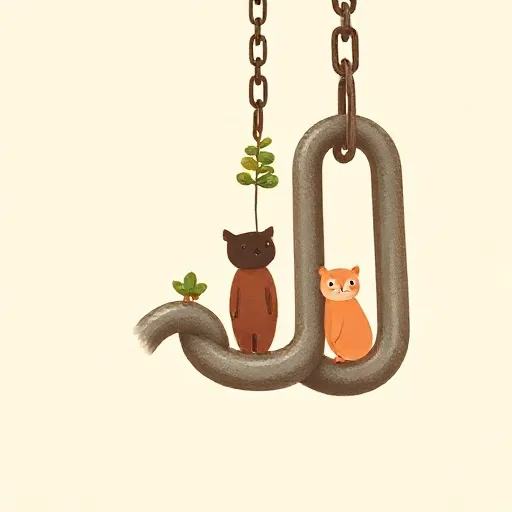
The Modistae uncovered what they thought was a triple chain. At the top were modi essendi—the modes of being. These are the real features of things outside our heads: a stone is a substance that endures; running is an action that happens. Because the world is carved up into substances and actions, the mind naturally forms corresponding concepts. Those concepts have their own modes, called modi intelligendi (modes of understanding). Finally, when we want to talk about something, we assign spoken or written marks, and those marks get modi significandi (modes of signifying).
Think of each word as having a tiny hook. The hook’s shape—whether it’s a noun-hook, a verb-hook, an adverb-hook—is determined by the concept it carries. The concept in turn gets its shape from the real thing it stands for. So the word “dog” gets a noun-hook because the mind understands a dog as an independent substance, and dogs really are independent substances out in the yard. If the thing were an action, like chasing, the word would get a verb-hook.
This triadic picture had a powerful implication: grammar is universal. Even though different languages sound different, they all have nouns, verbs, and other parts of speech because all humans perceive the same basic categories in reality. As Aristotle had noted long before, spoken sounds vary from nation to nation, but the mental affections they signify—and the actual things those affections resemble—are the same for everyone. The Modistae turned this insight into a full-blown science. A Latin sentence like “Canis currit” (the dog runs) is not just a string of sounds; it’s a mirror of the way reality is structured.
Thomas of Erfurt put it plainly in his book On the Modes of Signifying, completed around 1310: “Every mode of signifying is from some property of the thing.” The intellect, he argued, cannot invent a mode out of thin air—it must be moved by a determinate property of the thing itself. Otherwise, our words would be fictions with no connection to the world, and grammar could never be a demonstrative science.
When Reality Doesn’t Cooperate
But reality can be messy. The Modistae quickly ran into trouble when they tested their theory against ordinary language.
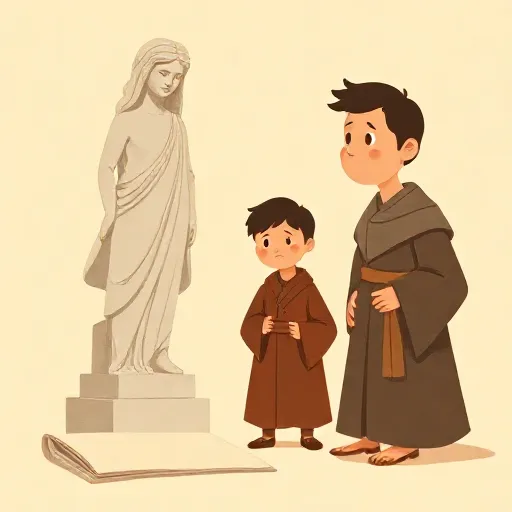
One classic puzzle was the Latin word dea, which means “goddess.” The word is grammatically feminine. In the Modist framework, a feminine noun typically carries a passive mode—it suggests something that receives action rather than acting. But a goddess doesn’t seem passive at all. Thomas’s solution was that the feminine mode of signifying need not always come from the thing signified itself; it can be “borrowed” from another, weaker entity that genuinely receives action, like a human woman. We then apply that borrowed mode when talking about a goddess. In the same way, when we say “in God,” we don’t mean God is literally inside something passive; we’re imagining him as if he were affected by our prayers.
Even trickier were words like “chimera,” which name a fictional monster. There is no mode of being for a chimera because no such animal exists. Thomas’s answer, inspired by his colleague Siger of Courtrai (c. 1280–1341), was that the active mode of signifying for “chimera” comes from the real parts we imagine it to have: the head of a lion, the body of a goat, the tail of a dragon. So the word indirectly hooks onto real modes of being, just pieced together in the imagination.
Then there were words for privations, like “blindness.” Blindness is not a positive thing—it’s the absence of sight. Out in the world, absence can’t cause anything. Yet Thomas insisted that the concept of blindness is a positive being inside the mind: it’s the understanding of sight as absent. So the mode of understanding of blindness counts as its mode of being within the intellect. Thus, the word “blind” can still have a proper grammatical hook.
With every puzzle, the Modistae built another layer of explanation. What started as an elegant chain of three simple rings turned into a tangle of borrowed modes, imaginary composites, and mental presences. Still, the theory held on—for a while.
The Tower Collapses

By the 1330s, Modism had nearly vanished from the University of Paris. Why did such an ambitious theory collapse?
The main reason seems to be that it became too complicated. The Modistae kept adding special rules to save the core idea, much like the astronomers who kept adding epicycles to make the Earth-centered model work. A simpler approach, championed by later logicians like John Buridan (c. 1300–1361), could account for the same grammatical facts without multiplying invisible modes endlessly. Buridan’s way of analyzing language through logic made Modism look unnecessarily cluttered.
There was another problem: the Modistae were so focused on the internal code of language that they ignored context. They couldn’t explain how a broken sentence, a gesture, or a half-finished thought could still carry meaning. Real communication often works outside strict grammatical rules, and Modism had no tools for that.
Thomas’s On the Modes of Signifying was the last major Modist work. After him, the tradition faded. The gleaming scientific grammar they had dreamed of crumbled under its own weight.
Why the Modist Dream Still Echoes

Although Modism as a living movement died out, Thomas’s book survived—thanks partly to a colossal mistake. For centuries, scholars thought it had been written by the great Franciscan philosopher John Duns Scotus (c. 1266–1308). It was printed in the collected works of Scotus and studied as a piece of his thought. Only in 1922 did a historian prove that Thomas of Erfurt was the real author.
That misattribution had a strange side effect: it meant many later thinkers wrestled with Thomas’s ideas while believing they were reading Scotus. The American philosopher Charles Sanders Peirce (1839–1914), the father of semiotics (the study of signs), quoted Thomas’s book at length in an 1869 lecture, fascinated by the idea that words, concepts, and things form a linked system. He saw in it the seeds of his own theory of signs. A young Martin Heidegger (1889–1976) used Thomas’s text in his early work on meaning and categories, trying to connect medieval grammar with modern phenomenology. Even Jacques Derrida (1930–2004) later mentioned Thomas as an early voice in the philosophy of language.
Today, the Modist project raises questions that still nag at us. Is grammar just a collection of useful conventions, or does it reflect something necessary about thought and reality? If you grow up speaking a language that marks every noun as animate or inanimate, do you perceive the world differently? Could studying the “hooks” of words ever reveal deep truths about existence? The Modistae were the first to ask these questions with scientific rigor, and even though their answer was too ornate to hold, the question remains. Next time you puzzle over why a word is a noun and not a verb, you’re walking in the footsteps of Thomas of Erfurt.
Think about it
- If someone invents a brand-new word for a creature they imagine—like a “snorzle”—does that word still “hook onto” something real, or is it just a made-up sound?
- Suppose we met aliens whose language has no words for past or future, only a single “now” tense. Would that mean they experience time differently, or just that their grammar is a different invention?
- Could there ever be a mistake in grammar that reveals a mistake in how we think about reality? For example, if a language treated “fire” as a living thing, would that show an error about what fire is?