What If Ideas Evolve Like Animals? Inside Evolutionary Epistemology
A Biology Class, a Question That Won’t Go Away
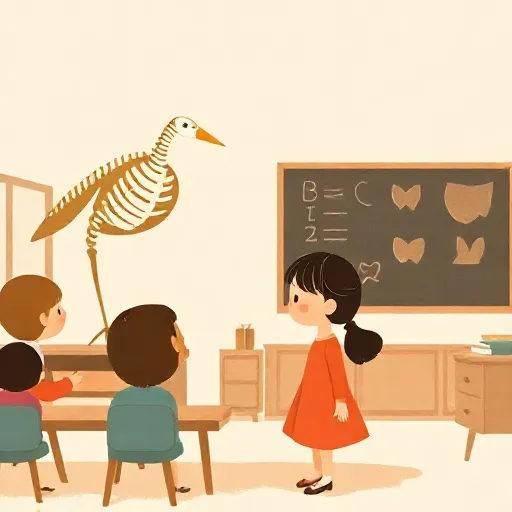
Sofia sat in biology class, sketching Darwin’s finches. Their beaks, her teacher explained, had changed generation by generation — some became thick for cracking seeds, others thin for sipping nectar. The process was natural selection: tiny variations, some useful, some not, and only the useful ones spread. Sofia raised her hand. “If animals evolve,” she asked, “do ideas, too?”
For centuries, philosophers tried to understand knowledge by asking what makes a true belief really count as knowledge. Plato thought you needed a justification — a good reason. But in the 1800s, after Darwin, some thinkers began to wonder if knowledge itself might be something that evolves, just like beaks and brains. In 1974, the psychologist Donald Campbell (1916–1996) gave this project a name: evolutionary epistemology. It is the attempt to answer big questions about knowledge — how we get it, why we trust it, how it grows — by using the tools and models of evolutionary biology.
The idea is bold. Instead of treating knowledge as a fixed structure of justified beliefs, evolutionary epistemologists treat it as a living, changing population. Beliefs, theories, and even the brain mechanisms that produce them could have been shaped by survival pressures over millions of years. Sofia’s innocent question in biology class turns out to be one of the most explosive in all of philosophy.
Two Big Projects: Evolving Brains and Evolving Ideas
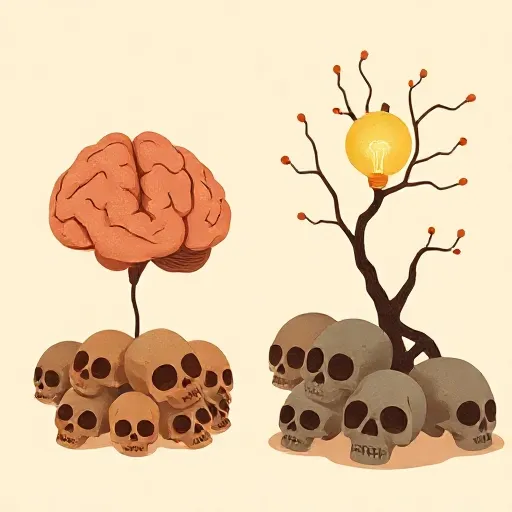
Evolutionary epistemology actually contains two distinct programs, which researchers label EEM and EET. Though they share the same Darwinian inspiration, they ask different things.
EEM stands for the Evolution of Epistemological Mechanisms. It focuses on the physical stuff: brains, sensory organs, and nervous systems. Thinkers like Konrad Lorenz (1903–1989), who studied animal behavior, and Campbell argued that our cognitive machinery — the very tools we use to perceive and reason — is the product of millions of years of evolution. Just as a finch’s beak adapted to its food, our brains adapted to the kinds of information that helped our ancestors survive. EEM is a straightforward extension of biological evolution: if bodies evolved, why not minds?
EET stands for the Evolutionary Epistemology of Theories. This program goes a step further. It tries to explain how ideas themselves — scientific theories, cultural norms, even whole systems of knowledge — grow and change over time using models borrowed from biology. The philosopher Karl Popper (1902–1994) gave one famous version. He argued that science advances through conjectures (bold guesses) and refutations (attempts to prove those guesses wrong). A new theory is like a random mutation; experiments act like the harsh environment that tests it. Theories that survive repeated attacks become part of our knowledge, but they are never finally “true” — they are just the fittest so far.
EEM asks how the hardware got here; EET asks how the software updates itself. The two programs are connected but can succeed or fail independently. A solid account of brain evolution does not automatically prove that ideas evolve like organisms, and vice versa.
A Sea Moss and a Costly Spine: How Models Work
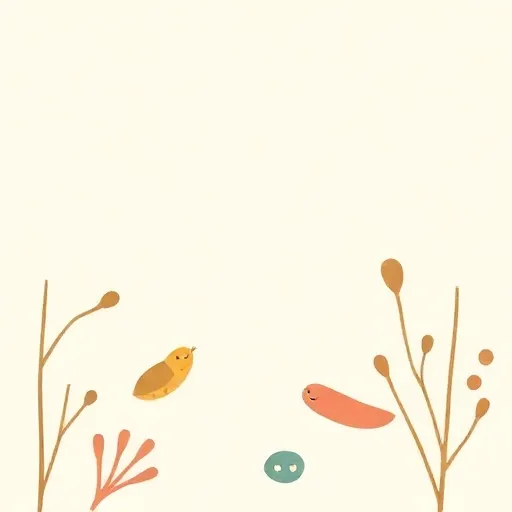
If this all sounds abstract, evolutionary epistemologists have built concrete models to test their ideas. One simple but powerful approach comes from what biologists call static optimization. Imagine a tiny marine creature, a type of sea moss, that lives in tide pools. Predatory sea slugs sometimes cruise through, and the moss can detect them only through a faint chemical cue in the water. The moss has two options: stay smooth (cheap, but risky) or grow a defensive spine (costly energy, but safer).
The moss cannot perfectly smell the difference between a dangerous slug and harmless water currents. Its chemical detector is noisy. What should it do? Over many generations, natural selection settles on a threshold — a level of chemical concentration above which the moss “decides” to grow a spine. Set the threshold too low, and the moss wastes energy growing spines all the time. Set it too high, and it gets eaten. The optimal threshold balances the costs and benefits, given how reliable the cue is and how often slugs actually appear.
This is exactly the kind of modeling that EEM uses to think about our own cognitive mechanisms. Our ancestors faced similar trade-offs: when to flee from a suspicious shadow, when to trust a sound as a signal of danger. Brains that got the balance right survived to pass on their wiring. The models show that flexible, intelligent responses are not always the best strategy — it depends on the numbers. Sometimes a fixed rule of thumb works just as well, and evolution will favor it if building a fancy brain costs too much.
The Conjectures and Refutations Machine
Popper’s model of knowledge growth is perhaps the most famous example of an EET program. He saw science as a grand evolutionary engine: scientists generate a variety of guesses (conjectures) and then ruthlessly test them, trying to find a flaw. A theory that gets refuted is like an unfit organism — it dies off, while better-adapted competitors flourish. The history of science, on this view, is a graveyard of beautiful ideas that could not stand up to the evidence.
But not everyone accepted this picture comfortably. The philosopher of science Thomas Kuhn (1922–1996) also used Darwinian metaphors to describe scientific revolutions, where one whole worldview replaces another. Yet when critics pressed him on the evolutionary implications, Kuhn backed away. Stephen Toulmin (1922–2009), in contrast, embraced the idea fully. He argued that concepts of rationality themselves evolve — what counts as a “good reason” changes over time, adapted to local circumstances. This is a radical claim: there is no single, unchanging standard of rationality that all humans must follow. Instead, standards of good thinking are themselves products of historical trial and error.
If Toulmin is right, then the very rules by which we decide what to believe have evolved. That makes traditional epistemology, which hunts for universal rules of good reasoning, look a lot shakier. Not everyone is happy about that.
Can Evolution Tell Us What We Ought to Believe?
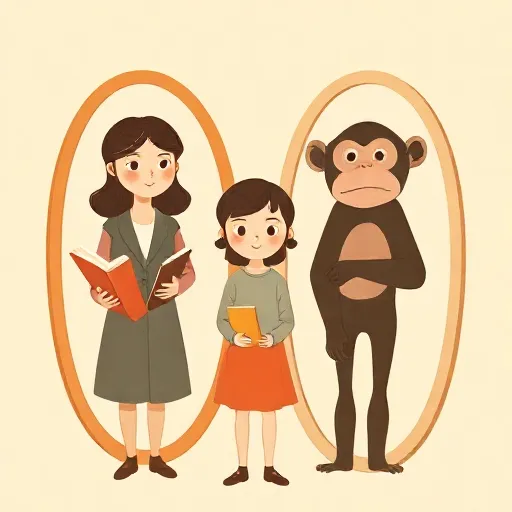
Here we hit the biggest tension in evolutionary epistemology. Traditional epistemology — the kind Plato started — is a normative project. It doesn’t just describe how people actually think; it tells us how we ought to think if we want justified, true beliefs. Evolutionary accounts, on the other hand, are descriptive. They explain the causal story of why our brains work as they do or why certain ideas spread. Many philosophers, most sharply Kim (20th century), have argued that you can’t get an “ought” from an “is.” The fact that evolution gave us a tendency to believe something does not make that belief justified or even likely to be true. If our cognitive systems evolved for survival, not for truth, they could be full of useful illusions.
Donald Campbell saw things differently. He thought descriptive and normative approaches could be complementary. An evolutionary account would not directly justify any particular belief, but it could rule out certain normative theories as simply inconsistent with human nature. If a theory demands a kind of reasoning our brains just cannot do, then that theory is a non-starter. On this view, evolution sets boundaries for what counts as a livable epistemology.
Others go further, treating descriptive evolutionary epistemology as a complete replacement for the old normative project — on the grounds that the old questions about “justification” are either unanswerable or not interesting. Most philosophers resist that leap, but the debate is far from over. The punchline for you: if your brain is a survival machine, not a truth detector, then every belief you hold suddenly feels a little less certain.
From Signals to Meaning: How Words Might Have Evolved
Evolutionary epistemology doesn’t only study big theories; it also tackles the very origins of meaning. Philosopher Brian Skyrms (1938–) built a mathematical model of how communication could get started from scratch, without any designer. Imagine two possible states of the world — say, a predator is present or not — and two possible actions — flee or keep gathering food. One individual, the sender, can detect the state and send one of two signals. The receiver must act based only on the signal. If the receiver acts appropriately for the state, both benefit.
Skyrms’ simulations show that when strategies are shaped by success (whether inherited or imitated), signaling systems evolve naturally. That is, the population settles on a convention where a particular signal means “predator” and another means “all clear.” No one sat down and invented this tiny language; it emerged through a blind selective process, much like a biological adaptation. The results closely mirror the naturalistic theory of meaning proposed by Ruth Millikan.
What is striking is how strongly these models favor signaling systems over rival strategies. Even when senders incur a cost to send a signal, coordinated meaning still can dominate. This suggests that the basic building blocks of language and meaning might be the products of evolutionary dynamics, not of conscious agreement. Words, on this picture, are not fixed labels but living, replicating bits of culture that have proven their fitness over time.
Why It Still Matters: Your Personal Idea Ecosystem
You don’t need a laboratory to see evolutionary epistemology at work. Think about the last catchy song you couldn’t get out of your head, or a clever argument a friend used that changed your mind. Some thinkers, like Richard Dawkins, have called such self-spreading cultural items memes — ideas that leap from brain to brain, mutating along the way. Whether or not we buy into the full memetic program, the metaphor is powerful. The beliefs and habits of thinking that fill your mind are not a static library; they are an ecosystem.
Sofia’s question in biology class points to a deep challenge. If our ideas evolve, then their survival may owe more to their attractiveness or usefulness than to their truth. That means you have to be an active caretaker of your own mental ecosystem — deciding which ideas deserve to multiply. It also means that the story of how science works might be less about a steady march toward truth and more about the branching, unpredictable diversity of life.
Evolutionary epistemology does not give easy answers. It destabilizes the comfortable picture of humans as perfectly rational knowers. But it also offers a compelling, naturalistic story of how we came to be knowers at all — a story that connects Darwin’s finches to the thoughts buzzing inside your own head.
Think about it
- If a belief helps you survive, is that a good enough reason to keep believing it, or should we demand something more?
- Ideas that spread easily are not always the truest ones (think of a rumor versus a slow, careful scientific theory). How should we decide which ideas to let shape our thinking?
- If the standards of good reasoning themselves have evolved over time, could what counts as “rational” in your culture simply be a local accident — and might it change again?