
How Can a Word Mean Both Truth and Feeling?
What Does It Mean When You Feel Something?

Imagine you see a friend trip and scrape their knee. A pang of worry shoots through you, and you move to help. Is that feeling simply a private event inside your head, like a thought? Many Western thinkers have answered yes: emotions are inner, subjective states, separate from reason and facts.
Ancient Chinese philosophers saw something different. They believed your worry is not just a private bubble — it is an interactive bridge between you and your friend, the world, and the situation. And they had a special word for what you are feeling and for the reality that makes that feeling genuine: qing (pronounced “ching”). In early China, qing could mean the true nature of a thing, the facts of a situation, and, later, human emotions. Over centuries, the word held these meanings together, and that double life can change how you understand your own feelings.
Confucius Says You Can’t Fake Love for Your Parents

Confucius (551–479 BCE) never wrote a textbook of emotions, but his conversations in the Analects are full of them. He insisted that the most important human virtues — xiao (filial piety, or loving respect for your parents) and ren (benevolence, or deep care for others) — have no value without genuine feeling. You could bow perfectly and provide food, but if your heart is cold, it is empty.
Confucius said that when someone dies, it is better to be filled with real sorrow than to obsess over every detail of the funeral. He described how a deeply good person finds joy in learning and loving what is right, not because it looks impressive, but because their heart is in it. In all this, he was pointing toward something that the word qing would capture later: moral life requires the sincere, living core of your feelings. In his own time, qing still mostly meant “truthfulness” or “the real situation.” But Confucius was already showing why the emotional side of qing would become so important — real virtue has to be felt.
Mencius and the Seed of Goodness

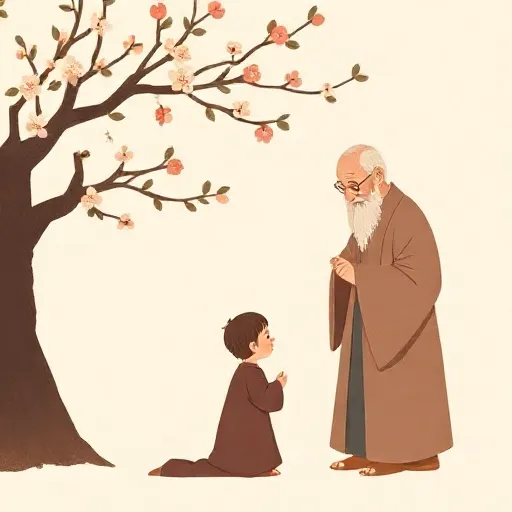
Mencius (372–289 BCE) took Confucius’s insight and gave it roots. He believed that every human being is born with moral sprouts (siduan), tiny emotional inclinations that can grow into full virtues. The most famous example: you suddenly see a toddler about to tumble into a well. Instantly, without thinking, you feel alarm and distress. You are not trying to win praise or avoid blame — the feeling simply rises in you.
That feeling is the sprout of compassion. Mencius listed four such sprouts: compassion, a sense of shame, a modest willingness to yield to others, and a sense of right and wrong. These are not cold calculations; they are feelings built into human nature itself. For Mencius, the human “essence” — another meaning of qing — is precisely these affective roots. With careful attention, like watering a plant, you can grow them into the mature virtues of a good person. This was a huge step: qing now named both the genuine core of being human and the emotional energy that makes us moral.
Mozi Asks: Can You Care for Everyone Equally?

Not everyone agreed that natural feelings were reliable guides. Mozi (480–390 BCE) looked at the wars and cruelties of his time and blamed them on partiality — the habit of loving your own family or clan more than outsiders. He argued that if you really want peace, you need jian ai, or impartial caring. You should care about a stranger’s well-being just as you care about your own mother’s.
Mozi did not toss emotion away. He said that if you train your mind with reason, you can develop a steady, fair concern for all. But to Confucian thinkers like Mencius, this felt unnatural. They believed you must start with the real, strong love you feel for your own parents and then extend it outward — not pretend that a stranger feels the same. The debate was not about whether caring matters, but about where real moral feeling comes from. Can you genuinely feel equal love for everyone? Or does fairness require something other than raw emotion? That tension is still alive today.
Zhuangzi Told a Friend to Stop Liking and Disliking

The Daoist thinker Zhuangzi (369–286 BCE) took a different approach. His friend Huizi once asked if a person could really be without qing — without feelings. Zhuangzi said yes. Huizi was confused: how could a human have no feelings? Zhuangzi answered that this was not what he meant by qing. When he said a person has no qing, he meant that they don’t let likes and dislikes get inside and do harm.
Zhuangzi was not telling people to become cold or numb. He believed emotions arise as naturally as wind and rain — joy, anger, sadness, delight are like mushrooms springing up in the damp, like day turning into night. You cannot stop them. But you can stop turning them into harsh judgments: “This situation is awful,” “I can’t stand that person.” Those evaluative likes and dislikes are what trap you. If you accept your feelings the way you accept weather, sadness will come and then it will go, without breaking you.
In this view, the precious thing is your xing ming zhi qing — your inborn, spontaneous qing, the natural current of your feelings before social rules twist it. Trying to force your heart into perfect virtue can actually drown its original liveliness.
Why This Ancient Debate Still Matters

Today, we often talk about emotions as private stuff inside our brains — something you “process” or “manage.” The ancient Chinese debate over qing offers a different picture. It says your feelings are never just about you; they are how you interact with the world, with your parents, with strangers, with loss. That means paying attention to whether your emotions are genuine, whether they connect you fairly to others, and whether they help you grow or trap you.
When you face a tough situation — a friend’s unfair accusation, a family argument, a moment of unexpected tenderness — you are standing in the middle of these old questions. Is it better to act out of raw, honest feeling, or to step back and consider what’s fair for everyone? Can you be sad without letting sadness swallow you? The Chinese philosophers you just met did not settle these questions once and for all. But they gave us a word — qing — that holds them together, reminding us that feelings and reality are not two separate worlds, but two sides of a single, living conversation.
Think about it
- If you help someone because you feel sorry for them, is that more valuable than helping because you know it’s the right thing to do?
- Mozi argued we should care for everyone equally. Do you think it’s possible to feel the same love for a stranger as you feel for a close friend or sibling — or does that ask too much of human nature?
- Zhuangzi thought you could feel sadness without letting it harm you. Can you remember a time when an emotion moved through you without taking over your whole day?