Poison or Progress? Du Châtelet’s Defense of Guessing in Science
The Noblewoman Who Started Over

In 1738, a French noble named Émilie du Châtelet (1706–1749) made a startling decision. Her book on physics was nearly finished, approved by the royal censor and ready to print. Then she met a mathematician who introduced her to new ideas from the German philosopher Christian Wolff (1679–1754). Du Châtelet realized her book was missing something important: a deep foundation for why nature works the way it does. So she pulled the manuscript, threw out huge sections, and started over.
The result, published in 1740, was Foundations of Physics — a bold attempt to put Newton’s brilliant mathematical descriptions of motion on a solid philosophical footing. But that’s not what made it controversial. What made enemies for her was the claim that science cannot move forward without hypotheses — educated guesses about the hidden causes behind what we observe. In her century, saying that aloud was almost as shocking as a woman writing a physics textbook in the first place.
Two Rules for Thinking About Anything
Du Châtelet believed that all knowledge rests on two simple but powerful rules. The first is the Principle of Contradiction (PC). It says something cannot be both true and false at the same time. You can’t be in Paris and not in Paris, a triangle can’t have four sides. This rule lets you spot impossible ideas immediately: if an idea contradicts itself, throw it out.
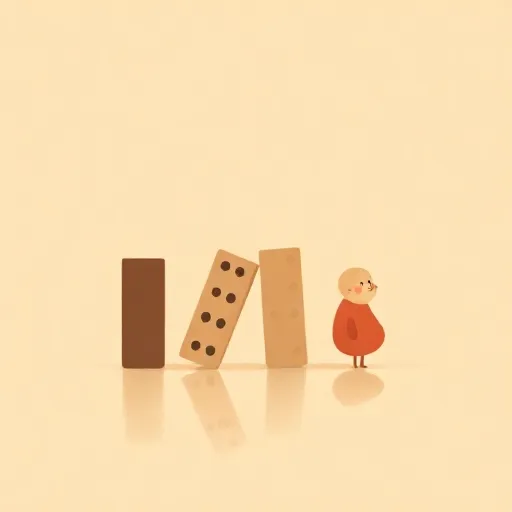
The second is the Principle of Sufficient Reason (PSR). It says every fact or event must have a reason why it is so and not otherwise. Imagine a single domino falling over — you can trace why it fell (the previous domino pushed it). The PSR insists the whole universe is like that: nothing happens without an explanation, even if we don’t know what it is yet.
Du Châtelet used these two rules like a mental toolbox. The PC sorts what’s impossible from what’s possible. The PSR then pushes you to ask why something that is possible actually happened. She didn’t think these were just useful tricks — she thought they were built into the way all rational minds work, including God’s.
Why God Matters for Physics

You might wonder what God has to do with a physics textbook. For Du Châtelet, the connection was essential. She argued that if every event has a sufficient reason, then the entire universe — all the matter and motion in it — must have one too. That ultimate reason, she said, cannot be another physical thing, because you could always ask “and why does that exist?” forever. It must be a necessary being whose own existence needs no outside explanation. That being is God.
But here’s the twist. Du Châtelet didn’t think God chooses randomly. She sided with what scholars call intellectualism: God’s intellect understands what is best, and then God’s will follows that understanding. This universe exists, she argued, because it is the best possible one — the one with the greatest order and the simplest laws that produce the richest variety. That belief gave her a powerful reason to trust nature. If the world was chosen for its elegant, law-like order, then scientists should look for that order and expect to find it.
This put her directly at odds with her famous friend Voltaire (1694–1778), who thought we should just accept natural phenomena as God’s mysterious will. Du Châtelet fired back: appealing to God’s will is no way to do science. It stops investigation, while the PSR demands we keep searching for proximate causes — the real, physical reasons within nature.
The Invisible Stuff at the Bottom of Everything
Du Châtelet’s philosophical rules led her to a strange conclusion about what matter is really made of. Imagine a chunk of gold. You can always imagine cutting it into smaller pieces — at least in thought, even if your knife isn’t sharp enough. Anything that takes up space, she argued, is divisible. So extended stuff can never be the ultimate, indivisible building block of reality. Atoms, being extended, would still be logically divisible, so they can’t be the true simple substances.
Therefore, the real base of reality must be simple substances — things with no parts, no size, no shape. She called them monads (a term from Leibniz). Monads aren’t tiny grains of sand; they’re more like points of pure activity. Each monad has an inner force that pushes it to change in an orderly way. The physical world we see — tables, planets, bodies — is the phenomenal appearance built up from these invisible activities. It’s a bit like a video game: what you see on screen are vehicles and explosions, but underneath it’s just code moving points in a simulation.
This sounds wild, but it gave Du Châtelet a powerful separation. The metaphysical world (monads) is deeply systematic and interconnected, as God made it. But the physics we can observe and measure is a step removed. Scientists can study motion, collision, and gravity without having to perfectly map those to the world of monads. That gap, she believed, is where hypotheses become essential.
The Art of the Educated Guess
Here is where Du Châtelet truly broke ranks with many scientists of her time. Isaac Newton (1642–1727) had famously declared, “I feign no hypotheses.” Many of his followers took that to mean good science should only describe what you can measure and predict — never imagine hidden causes. Du Châtelet thought that was nonsense.
She pointed to the history of astronomy. Copernicus and Kepler made brilliant hypotheses about the arrangement of the solar system long before anyone could prove them. Without those guesses, she argued, there would be no astronomy at all. A useful hypothesis, for her, is a probable proposition that explains many phenomena at once. As more observations agree with it, the hypothesis grows in strength. If a single well-established fact contradicts it, the hypothesis must be rejected — or at least the faulty part of it must be fixed.
She didn’t just defend guessing; she set strict rules for it. A hypothesis must not violate the Principle of Contradiction or the Principle of Sufficient Reason. It must fit all known facts. It must not be confused with certain truth — a hypothesis is always less than proven. And it must lead to new experiments. When used this way, hypotheses become the engine of science, not its poison.
This was a huge break from pure Newtonianism. Du Châtelet even criticized Newton’s followers who tried to make attraction (gravity) an inherent property of all matter, explaining everything from chemical reactions to electricity. That violated experience, she said, because bodies are sometimes at rest, and if attraction were always active, they would always be moving. The PSR demanded a reason for rest too. So her own metaphysics — the idea of active and passive forces in monads — acted as a check on wild speculation.
Guessing Your Way to the Truth

When Du Châtelet finished her Foundations, she didn’t try to give the final answer to every question. Instead, she gave a method: use reason’s two great principles to carve out what’s possible, then form hypotheses about hidden causes, test them against nature, and never pretend your guess is certain. She stood with one foot in the old world of natural philosophy, where everything from God to motion formed one grand system, and one foot in the modern world, where hypotheses are tested and may be falsified.
Why does any of this matter today? Because every time you ask “why” about the world — why the sky is blue, why your phone works, why a medicine heals — you are doing what Du Châtelet championed. You form an invisible picture in your mind, check if it fits the facts, and if it doesn’t, you adjust it. That’s the heartbeat of science. And it started with people like her refusing to accept that all we can do is describe the surface.
She also matters for another reason. After her death, a tutor falsely accused her of stealing his ideas, and for centuries many historians dismissed her as just repeating smarter men. Careful scholarship eventually showed how original she really was. Her story is a reminder that good thinking doesn’t belong to one gender, one nation, or one famous name.
Think about it
- If you were a scientist, would you rather only describe what you can measure, or would you also try to guess what’s behind the scenes, even if you might be wrong?
- Du Châtelet believed the universe must be orderly because God chose the best possible world. If someone doesn’t believe in God, can they still trust that the universe makes sense and follows laws? Why or why not?
- Newton said hypotheses are poison; Du Châtelet said they are necessary. Think of a mystery you have faced in your own life — would you solve it better by sticking only to what you could directly see, or by imagining possible explanations first?